
by Neshi Rodin
“Long long ago and far far away, there lived a man; but he was not an ordinary man. His name was the Baal Shem Tov.”
Many years ago when my children were little, I used to begin their bedtime stories with this very introduction.
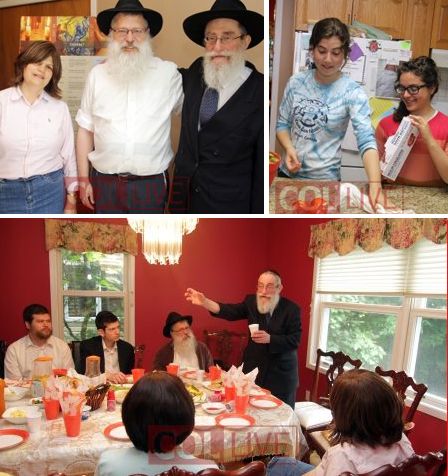
Recently I had the merit to participate in a Shabbaton organized by the Jewish Youth Library of Ottawa, Canada directed by Dr. Yosef and Devora Caytak which hosted a man of such caliber. He is not an ‘ordinary man; he is a very special man’; his name is Rabbi Shmuel Lew of London, England.
Rabbi Lew had previously been in Ottawa over 24 years earlier for the grand opening of the Caytak’s Chabad House/library.
The Shabbaton hosted over 200 people over the course of Shabbos and Sunday morning. Combined with the Shabbaton were Sheva Brachos for Shimon Dachevski and Aliza Gordon, co-hosted by their families, which added to the uniqueness of the weekend.
Cantor Dovid Caytak, who was born and raised in Ottawa, was the Chazzan for Shabbaton with Rabbi Lew. His beautiful voice and ‘Chazzanut’ prayers were enjoyed by the masses of people in attendance.
Caytak and his wife Mussia (nee Sirota) are living in Jerusalem this year, where Cantor Caytak is learning in Heichal Shlomo and studying at the famous Chazzanut Institute in Tel Aviv.
Camp Gan Israel counselors were on hand to run the children’s programs, help serve and clear the meals and of course enjoy the talks given by Rabbi Lew.
Rabbi Lew is an ‘old school’ chossid, learned and wise with deep wells of insight and understanding. Although he is thoroughly conversant with all the esoteric terms of Chassidus and Kaballah, Rabbi Lew speaks in ‘the language of the people’, that is, he speaks to his audience as his family, giving over the deepest morality and Jewish philosophy in the way of the holy Baal Shem, who interwove eternal lessons with stories and laughter.
The talks Rabbi Lew gave at the Shabbaton were entitled ‘Finding Harmony in Our Lives’ and from his gentle manner and easy grace, we understood what it meant for someone to be in harmony with oneself and one’s world.
He spoke about the celebration his family made for him for his fiftieth wedding anniversary, and told us that a son-in-law had asked him how he had managed to cultivate such a loving relationship with his wife over the course of so many years.
Putting his hand to his ear, Rabbi Lew motioned as if indicating that he hadn’t quite heard the question. When his son in law repeated the question in a much louder tone, Rabbi Lew responded by saying “I already answered you, I’m hard of hearing!”
With lots of appreciative laughter ringing in the room, we understood the unstated message that sometimes it’s wise to ‘not hear’ something, or at least to not respond.
The theme of focusing on the positive and turn a blind eye to the negative was approached from many different angles. Rabbi Lew spoke about a journalist who had major concerns with the religious world, voicing his antipathy in harsh and critical terms.
After great efforts on Rabbi Lew’s part, he agreed to stand in line for an interview with the Lubavitcher Rebbe. The meeting was quite brief, consisting of no more than seven words, a statement by the Rebbe that ‘you can affect more people than I’. What was the meaning of this cryptic statement and how did Rabbi Lew understand them? Rabbi Lew, as did the journalist, took these words deeply to heart.
He explained that he understood the Rebbe to be saying that the journalist, (and in fact everyone by implication) was able to have an greater influence over certain people than the Rebbe himself since the Rebbe would most probably never meet those people, and that the effect a person can have for the positive or the negative is not something to ignore.
These few words affected the journalist profoundly, inspiring him over time to change his life, carrying as they did the timeless and profound message of each person’s individual significance, that each person has a unique sphere of influence in which he can be an enormous force for the good if he would only realize this fact.
After leaving his audience with this deep appreciation of the responsibility and power of each individual, Rabbi Lew returned to a more light-hearted aspect, recounting his adventures as a young man sent on a Yom Kippur shlichus (mission). Still in his early twenties. Rabbi Lew was sent by the Lubavitcher Rebbe to conduct Yom Kippur services at the Thule Airforce Base in Greenland, close to the North Pole. He was called to this shlichus at the last minute, and he described the efforts that were made to allow him access to this Air Base which was part of the restricted system of Early Warning military bases set up to detect unexpected attacks during the Cold War era.
Rabbi Lew noted that one of the lessons to be learned out from his experience is that if one truly wants something, one can achieve anything, and he went on to describe how the highest levels of the Air Force as well as the Pentagon were involved in getting him access to the air force base so that the personnel could have a Rabbi for Yom Kippur. It seemed that almost everything that he had considered invaluable to having a proper Yom Kippur was unavailable in the far North.
When he inquired about Kapporas, a ritual that is usually performed with a chicken or a fish, he was told by the incredulous officials that the only fauna available were polar bears. There are of course alternatives, such as the use of coins, with which to perform this mitzvah (which he did make use of)- but there was no possibility for immersion in a mikveh, another custom he would dearly have loved to be able to fulfill.
Rabbi Lew told us that he brought 200 pairs of paper slippers with him, as on Yom Kippur one should not wear leather shoes. He had understood that over Rosh HaShannah there had been an attendance of 180, only to be told by the Chaplain at the Thule Base that in fact there had been less than a dozen at the services, and that Rabbi Lew would be lucky to have even ten men for the minyan. In fact, much to his relief and pleasure, over 40 people showed up that erev Yom Kippur, and one of the attendees, after having asked why the paper slippers, told the Rabbi that there was no need for them as everyone’s shoes were rubber rather than leather for safety reasons!
Another anecdote Rabbi Lew gave over was that he had brought versions of the special texts that are used on Yom Kippur translated into Danish, since many of the personnel were from Denmark. Looking over Rabbi Lew’s resources, the Chaplain of the Thule Air Force Base was astounded; there are no Danish Jews, he declared! Rabbi Lew was astonished; there was a Chabad House in Denmark with a large community in attendance; the Chaplain disagreed, only to find out that the engineer of the airforce base, a very respected Danish staff member, was indeed a Jew, although no one had had any inkling of this until he turned up for Yom Kippur services…
After recounting incident after incident of his often very funny experiences at the North Pole, Rabbi Lew’s manner became more serious as he turned to the Yom Kippur service itself. In his preparations for this most holy day, Rabbi Lew noted that just before Yom Kippur eve he had gone to check the status of the Sefer Torah, only to discover that the single Sefer Torah available was a child’s copy, written on paper rather than parchment, and therefore unusable.
After so many disappointments and unpleasant discoveries about the resources available to him in Thule, this was a final blow. He said that for half a second he began to cry- how would he be able to inspire and guide his congregation! Nothing was right! and then, for the other half of the second, he suddenly felt the most joyous sensation that he had ever had, an epiphany, an understanding and revelation that completely filled him and continued to inspire him throughout the rest of his life, even until this day of the Shabbaton.
Rabi Lew found a phrase running though his head as he realized that ‘the Rebbe has a minyan’- in fact the Rebbe back in New York had more than a multitude of minyanim, and he realized that much as he wanted to be with the Rebbe in New York performing the service with all its the rituals in the ‘most perfect’ way, he, Rabbi Lew, was not needed for the Rebbe’s minyan; he, Rabbi Lew, was needed in the far North, he was needed to do exactly what he was doing, to be there for his congregation, to help and guide them in their earnest desire and need to be a part of the holy day of Yom Kippur.
Rabbi Lew understood that he had to move out of his comfort zone and find a way to come to the aid of his fellow Jew. Later, back in New York, the Rebbe explained to him that in doing so he was drawing out of himself an inner strength and ability that he would not have realized or been able to access in any other way, bringing unity and alignment to his fellow Jews in their quest for spirituality and truth.
Rabbi Lew drew many lessons from this story, one among them being the incredible extent to which the Lubavitcher Rebbe demanded his followers to exemplify the mitzvah of loving a fellow Jew, to reach out with a helping hand to every Jew no matter how far away nor how difficult. By travelling to the far North to share Yom Kippur, the Rebbe said to Rabbi Lew, he had had the tremendous privilege of getting blessings for himself and his family.
In the same way, when facing challenges, Rabbi Lew continued, all of us have the opportunity to bring out something from our inner selves that can not be brought out otherwise. We all have the ability to care about and help our fellow Jews no matter whether they are, whether in a geographically cold place or a spiritually cold place – together we are all one, and as we access our inner abilities to realize this truth we can accomplish incredible things..
In the following session, Rabbi Lew in his warm and very funny manner, told a story of a man who had won a huge lottery. When asked how he had come to decide which number to choose, he shared that he had used several tricks. His first was that he used a Kabbalistic method called gematria, to calculate the correct number to choose.
Using this method he had added together the “numerical value” of his children’s ages, which then gave him a set of numerals to use in choosing his ticket. And secondly, the lucky winner noted that he was very bad in math…
As the laughter subsided, Rabbi Lew concluded that we can not determine what are the Creator’s plans for us. What we should do, rather than trying to second-guess Him, is look for the positive, connect to that which is good and overlook that which is less than perfect; in this manner we will “find harmony our lives”.
Thus the Shabbaton ended with the joyous aftertaste of heart and mind having gained much to recall, share and think about. Many thanks to the Jewish Youth Library for their continuing efforts in bringing to our city such wonderful and inspiring speakers as Rabbi Lew, a true friend and chossid.



Best Zaidy in the world!!!!!!!!!!
Shira! We love you! (A fellow Winnipeger)
Bocha Leah Caytak! Miss you!!!!
Love u!!!!!
Looking cute:)
Guess who
the best principal one could ever want!!!!!!!!!!!!!!!!
Thank you for sharing!
Go Shira and Chaya!!!
Rabbi Lew is a true chosid of the Rebbe, meaning that he does not mold the Rebbe to fit himself but rather molds himself to fit the Rebbe.
One of the best Rabbis in Lubavitch today!
You were the most amazing Chazan at the Shabbaton!!
CHAYA KARP!!!!!!! go you!
Greenland is hardly the North Pole! Thule is only 77°28′N! It’s further away from the North Pole than London is from Warsaw, or New York from St Louis.
mushky sirota and esther caytak!
-MSYer
best dc ever!!! we love you! cant believe our dc made it onto collive!
Rabbi Lew is amazing!
thank you very much. this was very meaningful.
!!!
Shira!
What an outstanding Shabbaton and beautiful Sheva Brachos for Gordon/Dachevski family.
Caytak Family……you brought in the very best speaker/chasid/educator in Lubavitch today……Rabbi Lew
So warm, so knowledgeable, so steeped in the Rebbe’s teachings and horaos.
Chabad world over, you have a treasure in Rabbi Lew…very few people have had such direct contact with the Rebbe.
Thank you Rabbi Lew for coming to Ottawa. We needed to hear what you spoke about.
Here is a video of Rabbi Lew talking about his fascinating story
http://www.torahcafe.com/rabbi-shmuel-lew/yom-kippur-at-the-north-pole-video_97f55cdeb.html
Shira Friedman and Chaya karp!!!
Luv u guys!!!