
By COLlive reporter
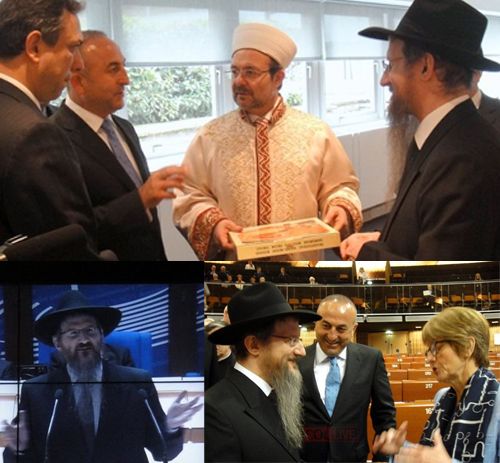
Chief Rabbi of Russia Berel Lazar took part in a debate on the religious dimension of intercultural dialogue – one of the highlights of the spring session of the Parliamentary Assembly of the Council of Europe (PACE).
“Whatever our divergences of opinion, we are all part of the one big family, and must find this mutual understanding in our common origins,” Rabbi Lazar told fellow clergy gathered in Strasbourg, France, seat of some European institutions.
Taking Russia as an example, Lazar stressed the need for religious leaders to co-operate and for religious communities to reach out to all, as well as the importance of the state’s responsibility in preventing all hate speech.
Other prominent religious figures who took the floor were Patriarch Daniel of Romania, Cardinal Jean-Louis Tauran of the Vatican; Professor Mehmet Gormez, Chairperson of the Presidency of Religious Affairs of Turkey; and Prelate Bernhard Felmberg, Plenipotentiary Representative of the Council of the Evangelical Church in Germany to the EU.
Rabbi Lazar began his visit, coordinated by Strasbourg Shliach Rabbi Mendel Samama, with Shachris morning prayer in the local synagogue where he immediately found himself in deep discussion with Dayan Shmuel Akiva Shlessinger.
At a reception with Thorbjorn Jaglan, Secretary General of the Council of Europe, Rabbi Lazar raised the Jewish community’s concerns about labeling kosher meat as “non stunned.”
COLlive.com was told that Jaglan attentivly listened. During lunch, Rabbi Lazar was seated near Secretary General and was served a Glatt Kosher meal.
With Pesach coming up, Rabbis Lazar and Samama used the opportunity to spread the message of freedom and offer Matzah to the Mufti of Turkey Ali Bardakoglu; President of the Parliamentary Assembly of the Council of Europe, Mevlut Casovuglu; Human Rights Commissioner of Council of Europe, Thomas Hammerberg; Russian Ambassador to Council of Europe, Alexander Alekseev, and more.
While walking in on of the corridors, an man called out to Rabbi Lazar, “Rabbi, can I speak to you?”
It turned out to be a Dutch Member of Parliament, who Rabbi Lazar didn’t spare his arguments against legislation to ban shechita, the practice of Jewish ritual slaughter in the Netherlands.
VIDEO: The full speech
Can’t see player? click here (full screen)
TRANSCRIPT: Extract of the verbatim records)
Thank you, Mr President, for inviting us and giving us an opportunity to share our ideas about the situation in Europe, about the problems in Europe, and about how religious leaders may be able to contribute to a solution to those problems. I think that you, Mr President, understand better than many that a united Europe requires not just a political arena and an economic relationship, but a cultural and religious understanding. Only when we have that understanding can we have a truly united Europe in which people live in harmony and peace.
It has been said many times that multiculturalism has failed in Europe. I myself have lived in Europe all my life, and I say that if multiculturalism has failed, Europe has failed. The beauty of Europe, and the foundations of Europe, have always been mutual understanding and open dialogue, notwithstanding all the differences between the languages, cultures and traditions of all the countries and all the people. I commend Secretary General Jagland for sending the message to the whole of Europe yesterday that we must find ways of coming together and finding understanding. We are all in the same boat, and if someone digs a small hole in that boat, sadly it will sink.
Everyone is now pointing fingers. Who is to blame for these problems? Some say that religious extremism is the source and the root of violence; others say that the blame lies with the xenophobic forces that are not giving freedom of religion to others. There was a great deal of frustration yesterday following the banning of a Muslim woman from wearing a full-face veil here in France. That produced a lot of tension. The question is, what is the right solution? Some people say “You must give us freedom of religion. How can you force us to live against our beliefs?” Others say “We must live in liberty and equality and respect each other.”
That reminds me of a story. A young couple visited a rabbi. First the husband ranted, saying that his wife had done this and done that. He said, “I cannot go on like this: it is terrible.” The rabbi said, “Do you know what? You are right.” Then the wife took the floor and said, “Do you know what my husband has been doing?” She went on and on and on. The rabbi looked at her and said “Do you know what? You are right.” The rabbi’s wife, who was standing near him, asked, “Dear husband, how can he be right and she be right as well?” The rabbi said, “Do you know what? You are also right.”
I have bad and good news for all of us. This news comes from the Talmud. Two thousand years ago, the Talmud made an interesting statement the truth of which many of us may not realise: there are not two people in the world who look alike, whose voices are similar, and who think alike. No two people anywhere in the world can we say are exactly the same. At the same time, all animals and all creatures were created in multiple numbers. The only creature that was created as one was Adam, the first man, and eventually his wife, the first woman. The world at that time was very big, as it is today, and there were two people in the whole world. Why did God not create many people? The answer is very simple, the Rabbis tell us. It is to teach each one of us that no one can stand up and say, “My grandfather and my grandmother were better than yours.” That is an important lesson for all of us. As much as we see our differences and as much as we see the things on which we do not get along sometimes, we are all part of the same family. We all come from the same people. There must be things on which we can find an understanding and a common language.
We speak about the Council of Europe and about the importance of bringing peace to the world, but if we were all the same and agreed about everything, we would not need to bring peace to the world and we would not need the Council of Europe. Everybody would live in harmony, and it would be a very monotonous life. Our whole being, the raison d’être of all of us, is to bring peace notwithstanding those differences and opposite opinions. We are different, and sometimes we are divided, but we live in one continent, one Europe, and we have to find ways to understand each other.
As much as I meet people, I always hear two schools of thought. Some people say, “You know what? I believe that the way I live is the truth and if people want to come to my country, if immigrants come in, they must accept my truth and my rules. They cannot come and live in my country and do whatever they want.” The truth is that this ideology brought this continent the Holocaust. Tens of millions of people were killed because people did not respect each other and did not understand that you could have people living in the same house with different opinions. Then there is a second school of though that says, “You know what? Live and let live. I am going to live my life and he is going to live his life. Why do I care what he does? Maybe he is my neighbour but I do not need to know what he does and what he believes. Let him do whatever he wants and I will do whatever I want.” Both views are dangerous, and we all understand why. There must be a golden thread, a solution for all of us, where we understand each other, help each other and convince each other to live a better life.
If you look in the Torah or the Bible, there are two interesting points. Our teachers tell us that proselytising and convincing others to join your religion is not always the best thing. Everybody has his own prayers to God and there are many rivers all coming to the sea. Everybody contributes what he has to give. If God wanted everybody to believe in one way, he would have created us all the same. God wanted the differences, but at the same time, interestingly enough, Maimonides says that when God gave the Torah to the Jewish people, he told us that we have a responsibility to spread the message of the seven Noachide Laws – the laws that were given to Adam, to his children, to Abraham and to our fathers, to all people in the world. We cannot sit and say, “I am going to take care only of my congregation, only of my people.” If I really care for this world that God created, I have a responsibility to tell others about values and morals, and to make sure that everybody stands together and understands that that is the only way that we can co-exist and survive.
How can we come together? It is beautiful that today, all the religious leaders are here in harmony, but I would say that that is not enough. We respect each other, we love each other, and we have to work together and do something together. What can we do? I had the honour to have a special teacher, who was actually born 110 years ago this Friday – Friday will be his birthday. Lubavitcher Rebbe, Rabbi Schneerson. I once heard him give an excellent idea, and I cannot figure out why the world is not grabbing this idea and making it into something that will help us understand each other. He suggested starting from early childhood, with little children. Convincing somebody of 20 or 30 years old to change his mind is very hard. We should start from education, but how are we going to educate? Everyone says, “Educate in this way.” But he said, “You know what? Start every single day and every single class in every single school with a moment of silence.”
We stood together earlier in honour of the victims of the terrorist attack, and we were probably all thinking about great ideas. There were no differences. We were all together, thinking of our responsibilities towards our brothers, towards God, and to make the world a better place. If each and every child started his day with a moment of silence he could believe what he or his parents believed, but he would understand that he had a responsibility to his fellow beings and a responsibility not only to learn and to become greater but to make the world a better place. I believe that that is feasible – I have seen it in Russia.
The President mentioned, when we started 20 years ago and when, thank God, things came out of the closet and we were able to celebrate our religion in Russia, that at the beginning there was a lot of mistrust. Today there is a full understanding between religious leaders in Russia. Surprisingly, anti-Semitism in Russia is at its lowest ever. How did that happen? I have three points, and I will end with them. The first is co-operation between religious leaders. We need constantly to discuss ideas and think how we can help each other and how we can send a message together to young people about the mutual values that we all share.
Secondly, very often governments feel that they should not mix into religious affairs. I personally think that that is a mistake. I think they have to interfere to make sure that no religious denomination will bring ideas of violence or extremism to the people. That is their responsibility. I must say that in Russia, those ideas are slowly leading to a better understanding and mutual co-operation between religious leaders and the government.
Thirdly, and I think most importantly, religious communities in Russia are opening up to the people. Our temples, churches, synagogues and mosques are open to everyone – “Come in and find out what we believe.” As long as we preach one idea in the synagogue and another one on television, it is not going to work. We have to show that what we believe is open to everyone and that our speeches, our ideology and our ideas are for everyone to share. Only then can we hope for a better future, a more united Europe and a place where everybody will live in unity, harmony and love.



Go Rabbi Mendy Samama!
See you at the white house!
mamosh amazing speech… Rabbi Lazar, yesher koach!! you should have much hatzlocho in all your holy work to bring yiddishkeit to all the Jews in Russia
Not much interset in politics at the european level, I guess.
wow!!! amazing!!!
the fact that such a thing could happen, that the rebbe`s a shliach can adress the whole eurpe, and tell them ideas what to do, and they should all accept it BEAHAVO UVEROTZOIN BESIMCHO UBESOSOIN, is only the rebbe`s koiach o`ein soif mamosh.
rabbi lazar, you did a very nice job. hatzlocho raboh.
kol akavod
Great speech! It’s possible to comment, but then again, it wasn’t me giving the speech.