
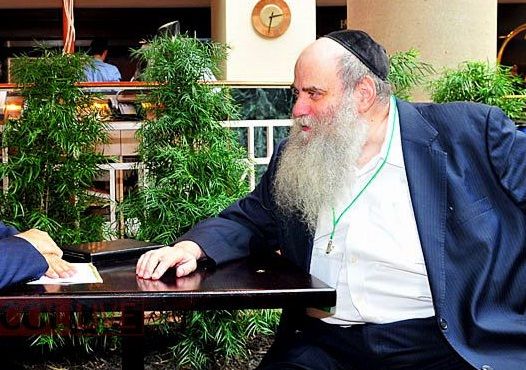
By Chris Leppek, Intermountain Jewish News
Writing a thumbnail biography on Rabbi Moshe Kotlarsky is no small challenge, at least if one follows the rabbi’s own guidelines.
By his own definition, the rabbi is not a leader, though he is the primary figure responsible for running the remarkably extensive Chabad-Lubavitch international network of slichim, or emissaries.
Such modesty and self-effacement notwithstanding, it must be noted that the rabbi is a pivotal figure in Chabad, circa 2011. Besides overseeing its emissary network, as vice chairman of Merkos L’Inyonei Chinuch, he supervises more than 4,000 religious and educational institutions worldwide and chairs the Chabad on Campus and Rohr Jewish Learning Institute programs.
He has also, to a considerable degree, become a recognized spokesman for the movement.
It was Rabbi Kotlarsky who announced to the world the tragic news in November, 2008 that the Chabad shaliach in Mumbai, India, Rabbi Gavriel Holtzman and his wife Rivka, had been slain in a bloody terrorist attack. He also eulogized the couple – both personal friends of his – at their funeral.
In Denver last week to serve as a keynote speaker for the movement’s regional conference, Rabbi Kotlarsky agreed to an interview with the Intermountain Jewish News, even though it was clear that his travels and the altitude had exhausted him, and despite the fact that he only rarely gives interviews.
In person, he is a soft-spoken, wooly bear of a man with sad eyes and very effective communication skills.
On June 3, in an informal talk before staff members of the Allied Jewish Federation, he enlightened his listeners on the subject of Shavuot, moved them with memories of his mentor, the late Rabbi Menachem Schneerson (the Lubavitcher Rebbe) and entertained them with stories that drew their punch both from traditional chasidic lore and modern New York humor.
As an interviewee, he is clearly less comfortable than he is as a speaker, revealing himself to be a man of relatively few words. They are very interesting words, however, and — perhaps in the style of his mentor, the rebbe — say much more than they might seem to at first glance.
Why do Chabadniks always seem so happy?
“I think that a Chabad shaliach has a sense of purpose, a sense of belonging. A rich man who has a million dollars is not satisfied. He wants two. He wants five, ten.
[The rabbi pauses for an illustrative joke: “Who’s more content in life — a man with ten million dollars or a man with ten daughters? The man with ten daughters — he doesn’t want any more!”]
“Chasidus has to do with joy and I’ll tell you something. We measure success in very small increments. A lady walked over to me two minutes ago and said, ‘You touched my heart. I have a lot to think about.’ That’s a source of joy.”
People, just today, have said things like “You should advise Coca-Cola,” which is a testament to your marketing abilities. There are a lot of people trying to do that in the Jewish world. Outreach has become the big word. Nobody does it as well as you, by far. Why is that?
“Because every one of our slichim has a DD degree — not a Doctor of Divinity but a Doctor of Dedication and Devotion. When you go out with that degree and you’re bound to an ideology and you’re inoculated by the teachings of the rebbe, that is the sole root of the success that is going on.
“The education and the ideology of the rebbe is the driving force behind everything that’s happened.
“The success of the movement is the slichim and their wives, who are equal partners, and the little child that is living as an emissary of the rebbe, too. They are living and showing the accessibility of Judaism, the happiness of Judaism.
“That is what the success of Lubavitch is — the ideology and the spirit of the rebbe, although he’s not here physically, and the dedication and devotion of the slichim, the slichot and their children. That is where it begins and that is where it ends.”
The word around the grapevine is that a lot of the success of the shlichim and the entire movement is due to you. True or false?
“False.”
But you’ve played a big role.
“I am only a bureaucrat. I was trusted with a mission by the rebbe and I try to accomplish it. But anyone who thinks that he is the root of the success of the mission is delusional.
“The rebbe trusted me with something. He gave me an opportunity. The rebbe didn’t give jobs, he gave opportunities. If you did it and did it well, he trusted you more. And that is true with every shaliach. Their success is based on dedication and devotion and if they’re successful, then they take a little more.”
All these exotic places where you mentioned you have emissaries — you sent most of those people, if not all of those people, to those posts, correct?
“Believe me, nobody goes there because of me. They’re going because of the rebbe. I facilitated a lot of them. I was involved with a lot of them. But anybody who says that I ‘sent’ anyone who’s ready to spend the rest of his life in a place like Mumbai needs a good psychiatrist.”
I’m trying to get around your modesty.
“But you’re not going to.”
When a young couple — I assume it’s usually a couple — comes to you and wants to…
“We have a system. If someone wanted to go to Colorado, they would turn to Rabbi (Yisroel) Engel. He would be the one who made the final determination. In certain towns, I was instrumental in giving seed money for people that went out to different campuses, for buildings, for programs that I’m able to procure funds for.”
What does it take for that young couple to be successful? What kind of qualities and talents do they have to have?
“Knowledge. Dedication. Devotion. Personality.”
You have to be very comfortable with people – outgoing?
“First of all, it’s like anything. If you don’t believe in what you’re selling, you can’t sell it.
“Number two, if you’re shy you can’t be a good salesman.”
You’ve met world leaders all over the place, powerful people, wealthy people, famous people. Does any of that impress you?
“Meeting anybody impresses me. I’m impressed with meeting you. I was very impressed meeting this group.”
Who is the most interesting person that you’ve ever met?
“The rebbe. There is no one who even comes close.”
What was it that impressed you about him?
“You’ve asked me a very personal question, and it’s very hard to answer.
“I grew up when the rebbe’s leadership was beginning. The rebbe was like a father to me, like a grandfather, a consummate teacher. He was the one that I turned to when I had great moments of joy. He was the one that I turned to when I had moments of sorrow. And he was always there for me.
“What impressed me about the rebbe? His vast knowledge. His knowledge in every aspect of life, not only Jewish life, which I was witness to. I learned well because I wanted to please him. It’s not that he had a hold. It was not, by far, that he didn’t give everyone the freedom that they needed. People could come and go as they wanted.
“I came to him on my third birthday. I have vague memories of going into his office and him giving me my first siddur.”
So, very personal…
“That’s right, but it’s also the aspect of the rebbe as a world leader.”
(Rabbi Kotlarsky recounts witnessing a meeting between the rebbe and Sen. Frank Lautenberg, a man known not only as politically powerful but as very wealthy.) “Lautenberg thought he was going to be asked for some serious money. Instead the rebbe said: ‘If I wake up tomorrow morning and you’re the same person, then I have achieved nothing.””
That’s a pretty fearless statement.
“The rebbe was a very fearless individual.”
Is it hard now, being a leader in the movement without him?
“You say, ‘a leader in the movement.’ You know, it’s the rebbe who is still leading the movement. I’m an advanced bureaucrat. I don’t ascribe leadership to myself in any form or fashion. As I say, if anyone were to go to Mumbai or Nigeria or anywhere and say he’s going there for me, before he goes he should visit a prominent psychiatrist.”
Was dealing with the Holtzbergs in Mumbai the most difficult thing you’ve ever had to do?
“Definitely. Gabi was very close to me, and Rivka too. He used to call me and talk to me about things he said he couldn’t talk to his father or father-in-law about (so not to sadden them). We developed a very close bond.
“He was the last person that I thought would be killed. He had such life. He had immense obstacles with his children and everything and he was the ultimate happy person.”
Did it change the movement when that happened, when Chabad was targeted by terror?
“We are definitely much more security conscious.”
Was your faith of great assistance to you in a time of trauma and crisis like that?
“Without belief in G-d, there are a lot of things that you can’t answer.”
It’s very apparent that it still hurts you.
“Very much.”

I thought I knew Reb Moshe, but I’m amazed all over again.
If everyone in Lubavitch “leadership” had this attitude (including, and primarily, our so-called “rabbonim”) we’d be in a much better place today
Well deserved and earned thru hard devoted work
wow
A lot of kotlarsky fans
You’ve obviously not asked a seasoned shaliach those questions. They are the easiest to answer. What bothers the questioner, namely the real question is where more thought is required, to discover it and to weave that answer within the stated answer.
uncle moshe your the best of the best
Very very nice
We are so proud to have R’ Kotlarsky represent Chabad!
Rabbi Kotlarsky is an amazing devoted chossid, keep making the Rebbi proud of you!!
Its a whole night farbrengen!
770 bochur
Rabbi Kotlarsky has sincere concern, compassion & sensitivity to our Mossad and us personally as Shluchim and I’m sure many others feel the same. May Hashem repay you in kind.
how come when it comes to these basic questions everyone starts to mumble?
like why should i be jewish?
why is the rebbe the most inspiring to you?
how do know theres a G-D?
all kno they have ONE friend in the Heicha Fensters ..and its Reb Moishe..ask any Shaliach from age 25-35 and they all swear by him..he doesnt demand respect ..he commands it thru his Mesirus Nefesh for the Shluchim..I love you Moishe ..SB
You are a true Shliach of the Rebbe!!
Very Impressive! finally some true humbleness in a chabad leadership interview, I Love it.
It is inspiring to have Rabbi Kotlarsky in our midst
Moshe K. is someone t look up to…but lets not forget his amazing wife RIvka!!
A chosid a shliach attributing all his doings to the Rebbe with not one ounce of “Kochi Veotzem Yodi” will always be successful in all matters. Reb Moshe is a living example for that.
nice concise answers!
Yes, a real special interview.
Let’s not forget that he was speaking these words to a public secular Jewish news paper, not to a Chabad -in house – website.
A true example of how to speak about Shluchis to the world at large!
Your in a class by yourself!!
Chazak V’amatz.
“EVED AVROHOM ONOYCHI….” How deligthfully refreshing and inspiring to hear a person that has B.H. such great Hatzlocho, attribute all the success to the Meshaleach, and insisting again and again that the Rebbe is the one who leads and sends and is the Meshaleach. and as far as he himself is concerned, he is privileged to be in a very special Schlihus.
CHAZAK VEEMOTZ!!!! The REBBE’S Brochos will certainly follow him in all of his Shlichusn and in all his personal Inyonim until we will be Zoyche to see the Rebbe back here with all of us, here Lemato…………
Dear Reb Moshe, The words of the Meshaleach resonate within your selfless being! Chazk uBaruch!
Such beautiful and humble responses!
Keep up the good work Rabbi Kotlarsky.
what an awsome interview!!
Rabbi Kotlarsky stands on his own level as a chossid and a dugma chaya. Thank you for being a constant inspiration.