
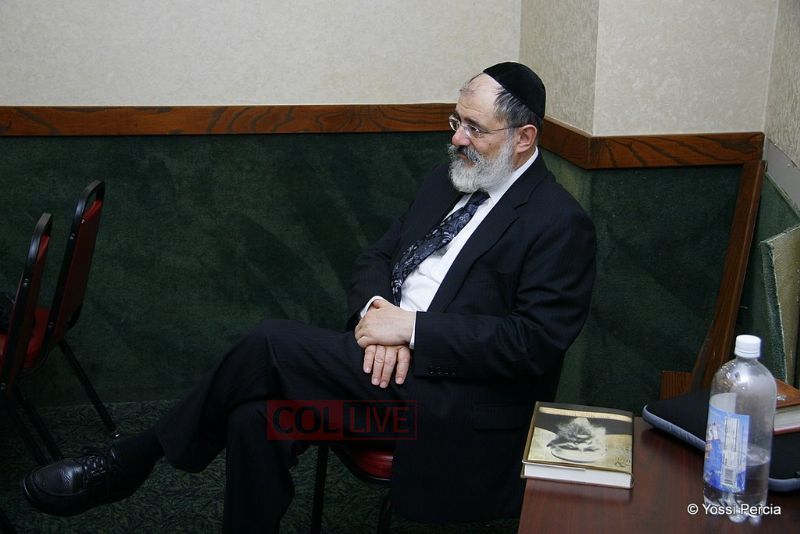
After a two-year post as president of the National Council for Private School Accreditation, Rabbi Nochem Kaplan is stepping down to make room for the new incoming president, current vice president Dr. Larry Blackmer. The transition will take place on June 21.
Established in 1993, the NCPSA is an umbrella organization comprised of 17 associations in the private school sector – secular and religious – working together to develop accreditation procedures for early childhood, elementary and secondary private schools, ensuring proper application, review and recognition of certified accrediting associations serving private schools in the United States.
“In the United States there is a unique way of dealing with accreditation,” explains Kaplan, chairman of the National Accreditation Board of Merkos L’Inyonei Chinuch, the educational arm of Chabad-Lubavitch, and its affiliated Chinuch Office, which serves more than 200 extracurricular centers, 80 elementary schools and 40 high schools in the Chabad network of educational institutions in North America.
“Congress ruled that school accreditation would not be a federal function, but rather each geographic region would be responsible for its own accreditation process that would serve to improve the quality of education in schools in that area.”
The NCPSA, which represents in excess of 4,000 schools and 5 million children nationwide, acts as a unified entity whose main purpose is to steer private schools from kindergarten through Grade 12 through a three-pronged accreditation process. In the first step, termed self-study, the school conducts a self-assessment of its strengths and weaknesses.
In the second step, a team of NCPSA-affiliated educators check to make sure the school has properly conducted the self-study. The third step requires schools to design a five-year master plan of improvement, which typically includes curriculum development.
“It’s essentially a way of making sure that private schools are doing what they are supposed to do, meaning that they are maintaining high quality standards in education and continuously working toward improving academics and an atmosphere of student learning,” says Kaplan, a 40-year veteran in the field of Jewish education.
As the organization’s president, says Kaplan, he sought to reintroduce rigor into American education and build a more demanding academic structure in which students acquired the skills to learn independently. Kaplan has also been a primary liaison between NCPSA and the International Alliance of Regional Accreditors, a group of five agencies devoted to the promotion and marketing of regional accreditation.
“The idea is to ensure that the process of traditional accreditation that we have known for the past 140 years will continue,” says Kaplan. “Half of Eastern Europe now does accreditation in the American fashion, as does China and the Middle East.”
Ethics and values have remained a main thrust of Kaplan’s educational beliefs.
“Education is not only knowledge and skills,” he declares. “We’re always looking for ways to reintroduce ethics and morality into the education process. This is something that’s important to educators at all schools, not only the religious ones.”
One of Kaplan’s biggest challenges was to bridge the gap between the organization’s participating members, many of whom held varying positions on the accreditation process and how it should be appropriately executed.
Kaplan’s 35-year tenure working in the field of Jewish education – Merkos L’Inyonei Chinuch runs the only Jewish accreditation center for primary and secondary schools in the country – primed him for being able to successfully carve out an environment with a balanced perspective on the state of private school education in the United States.
“Rabbi Kaplan offered an even voice to the organization,” says Clay Petry, NCPSA associate director. “In an organization of 17 groups you often had 17 opinions, and Rabbi Kaplan brought them all together in a commonality as a unified community.”
Petry credits Kaplan with breathing new life into the accreditation process.
“He was a wonderful presence and a wonderful president,” says Petry. “He energized all the members involved and reinvigorated the process of accreditation.”
Following the end of his tenure, Kaplan will remain on the NCPSA board and continue to play a role in its future work.
“I’m proud of the wonderful works we’ve accomplished,” says Kaplan. “That the NSPCA has maintained its integrity and continues to be a role model in the traditional accreditation process without getting sidetracked is probably the greatest achievement.”

Did you know?
We would welcome Rabbi Kaplan’s efforts to assist Chabad chinuch institutions to put a Quality Control system in place, setting clear measurable standards for principals and teachers, thereby raising the educational level of teachers, empowering them to understand how youngsters function and what instruments should be used in the classroom to engage also the 20% or so students who become fringe students. Anash is looking forward to hear Rabbi Kaplan’s views on this – also on a Chabad website.
A Talmid from yeshivas yonkers
that besides his amazing talents in Chinuch rabbi nochum kaplan is also a world renowned chazzan
must have had at least 18 opinions!
Please don’t -we need you!
from Chabad / Flamingo. Two of the top notch rabbinicals on the face of this continent.
Reb Nachum, continued hatzlacha in all your chinuch endeavors, pressnt and future!