
By Yehuda Sugar
As a 19-year-old bochur, Rabbi Yaakov Goldstein mourned the scarcity of halachic seforim and teaching of halacha in yeshivas and in the general population, especially among English-speaking audiences. Then and there, he set out on a monumental mission to help rectify the situation. This week, the now seasoned 42-year-old Chabad author, scholar and posek can look back on over two decades of progress in his undertaking marked by the publication of his 80th sefer and celebration of a website he founded a decade ago in support of his pursuit that fields some 100,000 visitors per month.
The books and the 24/6 accessibility of the website (www.shulchanaruchharav.com), as it is having grown to become the world’s leading halacha database, provide consumers in most cases at the touch of a screen thorough, clear and erudite material on the vast majority of Jewish law.
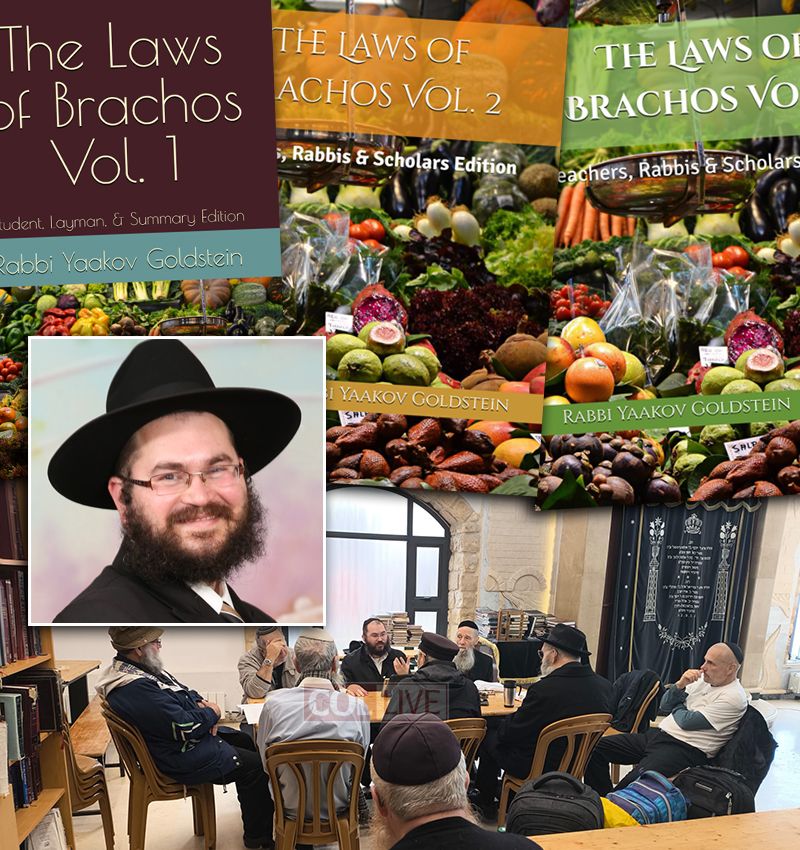
Though he cherishes – along with a dedicated readership — every sefer dating back to his first, a work on the laws of Shabbos he published in 2010 while teaching in a Jerusalem yeshiva, his latest work on the Laws of Blessings published Tuesday, just might be considered his magnus opus — great unparalleled work – addressing a subject that runs to the core of everyday Jewish practice.
“From the moment we first learn to say Baruch Atah Hashem, blessings become the heartbeat of Jewish life,” Goldstein writes in a promotional piece about the work he initiated amid learning for rabbinic ordination at Central Yeshiva Tomchei Temimim Lubavitch way back in 2004. “Before we eat, after we eat, upon awakening, before a mitzvah, after using the bathroom – our days are punctuated with moments of gratitude and connection to our Creator. Yet the laws of blessings are among the most complex, intricate and widely studied areas of Jewish law. They require clarity, precision and deep understanding — because every blessing is an opportunity to sanctify the mundane.”
The work, divided into three volumes spanning 44 chapters, with separate Rabbi’s and Student’s Editions, draws on foundational works of the first Lubavitcher Rebbe, Rabbi Schneur Zalman of Liadi, Birchas Hanehenin, Luach Birchas Henehenin and Shulchan Aruch HaRav, while incorporating insights from the Mishnah Berurah, Kaf HaChaim and other Achronim with emphasis on the modern-day poskim.
With the halachos meticulously organized in clear chapters and subcategories, “no detail is overlooked,” Goldstein writes. “Complex discussions are made practical and accessible with real-life examples to guide the reader.”
Some of those intricate discussions include the perennially hashed over question on the proper blessing on rice (Chapter 11), the subject of repetition of blessings when changing locations in the middle of a meal (Chapter 20) and heretofore labyrinthine discourses on the blessings on soups made easy or at least easier (Chapter 16).
It was between 2005 and 2008, after yeshiva, when Goldstein, originally from Miami, served as chaplain in the IDF that he would begin to churn out initial drafts of his seforim in between counseling sessions with soldiers in the synagogue that he built on the base.
Those works would eventually add up to the current number of fully and finally published works on subjects as wide ranging as Shabbos laws and customs (updated many times since the original) and holiday time halachic compendiums to more rarely visited topics such as the laws and customs of the child’s upshernish, the bris and pidyon haben. Specialty items like a four-volume series “From the Rav’s Desk” containing his answers to special shaalos and an encyclopedia on health and safety laws from the spiritual perspective round out the array.
Others on Chassidic subjects include popular English summaries of the Alter Rebbe’s Likutei Torah and another summarizing weekly talks of the Rebbe on the parsha.
The seforim have the approbations of Chabad Rebbeim Rabbi Menachem Mendel Gluckowsky, rabbi of the Chabad community of Rechovot and Rabbi B. Yurkowicz, rabbi of the Chabad community of Lod.
With great zeal, just days before publication of the newest work, Goldstein shared a sampling of some of its content — on the soup subject — for a group of older talmidim gathered for a shiur in his home city of Tsfat at the venerated Tzemach Tzedek Synagogue. “What is the blessing on a soup containing broth, chicken, vegetables and Lokshin noodles,” he asked, indicating by intonation the answer would come with an element of surprise. “If the noodles were cooked together with the broth to begin with, the blessing on the broth, even if eaten alone, would be mezonos. Otherwise, the blessing would be shehakol.”
“If you’re surprised, you’re not alone,” Goldstein added. “Many are stumped on this one,” later explaining that the broth of the soup is considered a secondary substance to the solid of the soup, which lends the soup its blessing.
His significant scholarship and output come through much sweat and toil founded upon impressive lineage. Goldstein is a 6th generation descendant of the Chief Rabbi of Izhmir, Rabbi Yehoshua Avraham Krispin, zt”l, author of his own well-known seforim who kept good company. Krispin was a colleague of another great of his time and place, Rav Chaim Falagi, zt”l and father-in-law of Rabbi Chaim Binyamin Pontrimoly, zt”l, author of the The Pesach Hadvir, whose son authored much of the Tanach series Me’am Lo’ez.
Having settled in Tsfat in 2016 with wife Shayna with 9 and now 12 children, KA”H, a packed schedule of teaching and work currently take him to several Tsfat institutions on a weekly basis for live and broadcast men’s and women’s shiurim, then back to his home office for maintenance of his website, answering of halachic questions to a worldwide audience and direction of his Home-Study Semicha Program, a self-study web-based initiative. Supportive seforim for the program such as “A Semicha Aid for Learning the Laws of Basar Bechalav” and accompanying workbooks have become household titles known to and relied upon by his and other rabbinic ordination students and lay people worldwide. A recent addition to his busy schedule: Rosh Kolel of the Merkos 302 Kolel Aliba Dehilchasa, a virtual kolel community covering fundamental topics in practical and business halacha.
Sitting in Goldstein’s office before more than one very wide-screened computers in what feels to be the halachic command center of the universe, one can witness live data of people reading articles on the website from the big Jewish hubs of Jerusalem, New York, Miami and Los Angeles to the far reaches of countries like Burma, Russia and believe it or not the myth-ensconced Polish city of Chelm, from whence some of his ancestors hail.
Launched in 2014 with the help of a motivated benefactor originally with the priority of hosting his published works, the website has expanded to encompass some 15,000 articles written at great depth and breadth covering all areas of Jewish law from Orach Chayim to Yoreh De’ah to Even Ezra to Choshen Misphat, providing of course where applicable the Alter Rebbe’s rulings and adjudications. The website also contains material on the weekly parshiot, Chassidus selections and entries from Tanach.
With 80 seforim under his belt, one might think it was time to rest on laurels or at least slow down and bask in the years of productivity. But that is the furthest thing from the rabbi’s mind and heart.
Aims for the future include seforim on Tanach, Talmud and Rambam in summary form, a vision he has already started to realize with summaries of the parshiot of the Chumash and of Nevi’im Yehoshua and Shoftim through Yeshayah.
All of the books are available for purchase at www.shulchanaruchharav.com and Amazon.com, with the latest three-volume set on the Laws of Blessings available specifically here. https://amzn.to/3K1SDrv




It’s truly an inspiration of how much someone can publish and make halacha available to the masses. I hadn’t heard of Rabbi Goldstein until recently, but I’ve benefited from his work and I wish him much hatzlachah!
Love your sefarim keep it up
May Hashem bless you with abundance of good in sweet ways in all areas of your life.