After practice one late-summer day in 1986, Alan Veingrad strode into the Green Bay Packers’ locker room, feeling both spent and satisfied.
An undrafted player from an obscure college, he had made the team and then some. On the next Sunday, opening day of the N.F.L. season, he would be starting at offensive tackle.
In his locker, Mr. Veingrad found the usual stuff, his street clothes and sweat suit and playbook. On a small bench, though, lay a note from the Packers’ receptionist. It carried a name that Mr. Veingrad did not recognize, Lou Weinstein, and a local phone number.
Alone in a new town, too naïve to be wary, Mr. Veingrad called. This Lou Weinstein, it turned out, ran a shoe store in Green Bay, Wis. He had just read an article in the paper about a Jewish player on the Packers, and he wanted to meet and welcome that rarity.
A few days later, Mr. Veingrad joined Mr. Weinstein for lunch at the businessman’s golf club. There Mr. Weinstein invited the player to accompany his family to Rosh Hashana services at Cnesses Israel, a synagogue near the site of the Packers’ original home field, City Stadium.
It had been a long time since Mr. Veingrad had spent much time in shul, nearly a decade since his bar mitzvah. He knew the date of the Packers’ Monday night game against the Chicago Bears better than he did Yom Kippur. “But when I heard the Hebrew,” he recently recalled of that service in Green Bay, “I felt a pull.”
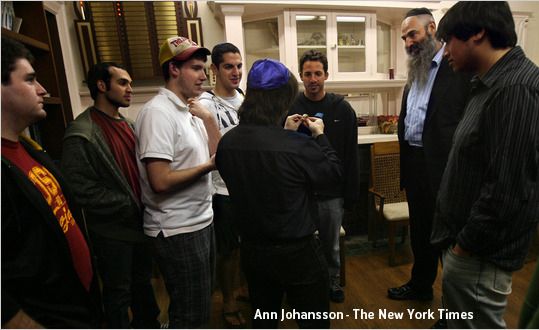
Maybe it was a presentiment, maybe it was the sort of destiny that Yiddish calls “goyrl.” Whatever the word for it, something stirred into motion. And that something brought Mr. Veingrad into the Chabad House — a Jewish center run by the Lubavitcher Hasidic movement — near the University of Southern California campus here five nights before the 2010 Super Bowl.
A promotional flier announced the evening’s subject as “Super Bowl to Super Jew.” There was truth in that advertising. Mr. Veingrad goes these days by his Hebrew name, Shlomo. He wore a black skullcap and the ritual fringes called tzitzit; he wore the Super Bowl ring he won in 1992 with the Dallas Cowboys and the Rolex watch that was a gift from Emmitt Smith, the team’s star running back.
Within his 6-foot-5 frame, Mr. Veingrad embodies two Jewish archetypes that do not often meet. He is the ba’al guf, the Jewish strongman, and the ba’al teshuva, the returnee to the faith. While two Jewish boxers on the scene now — Yuri Foreman and Dimitriy Salita — also are prominently observant, Mr. Veingrad may well be the only Orthodox athlete from the United States’ hugely popular team sports.
“I believe I played in the N.F.L. and have that ring so I can share my story with other Jews,” Mr. Veingrad, 46, said shortly before the U.S.C. event.
During it, he told a spellbound capacity audience, “The Torah is a playbook for how someone can live their life.”
Read full article Here