
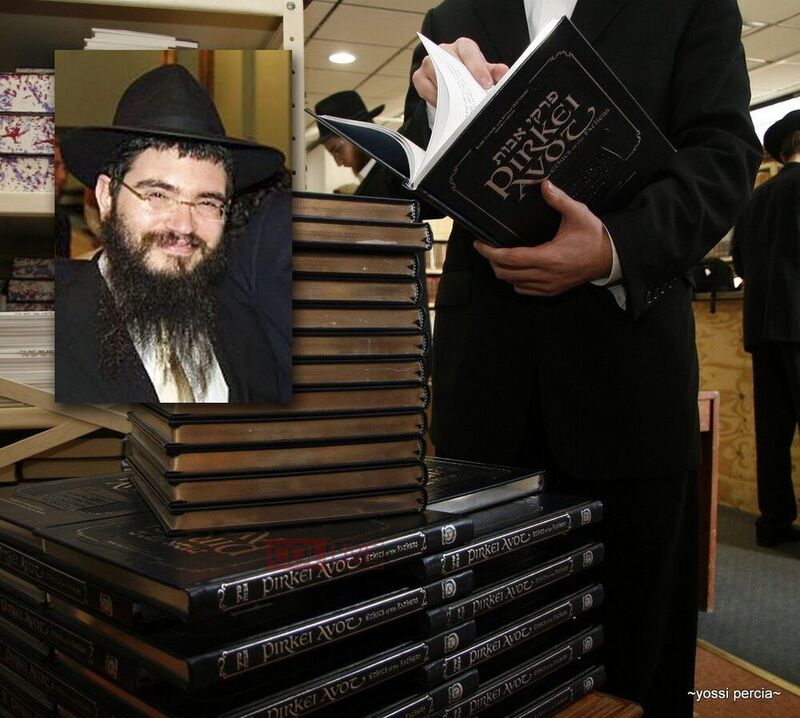
Why Pirkei Avot?
Well, besides being the ultimate classic Jewish text, which is studied every year following Pesach, and in many communities during the entire summer, the Rebbe was very fond of its study. This is evident in the fact that during the farbrengens following Pesach the Rebbe would regularly expound on a mishnah of that week’s “perek.” The Rebbe also indicated that at least one mishna be studied in depth, when learning Pirkei Avot on Shabbos afternoon.
What is new about this Pirkei Avos?
There are many things. Firstly, this the first time we have a full commentary that includes the Rebbe’s commentary along with the classic and later commentaries, stories and biographies of the tana’im, all of which is laid out in a way that is beautiful, easy to read, and encouraging to read. Kehot published a short version in a slim volume for shuls to buy in bulk a few years ago, which had a fraction of what is in this new edition, and of course did not have the stories, biographies etc.
This edition also includes many biurim of the Rebbe that have never appeared in English.
When you say “classic and later commentaries,” what are we speaking about here exactly?
Classic would mean the rishonim like Rambam, Rashi, Bartenura, Rabeinu Yonah, etc. Later commentaries include Maharal, Midrash Shmuel, Chida, R. Yakov Emden, Sfas Emes, Ben Ish Chai, etc.
From so many commentaries, how do you choose which to include? Is there a process?
Firstly, you want to cover the pshat, especially things that seem to need explanation. If there are several views of what’s poshut pshat the reader should be given the basic explanations. Then we looked for inspiring, enlightening or particularly interesting material from the various commentators. Of course those insights that coincide and emphasize the ideas that Chasidus focuses on, such as unconditional Ahavas Yisroel, etc., were of particular interest.
For example, Ben Ish Chai has a vort in which he poses the question whether it’s better, from a Torah perspective, to be rich or poor. He says this is the question of “Eizohi derech yesharah?” He concludes that it is better to be rich, since as a wealthy person you have more influence and your good deeds are a kidush Hashem, etc. This of course was always the Rebbe’s shitah, to utilize the permitted, including wealth, for making a dirah b’tachtonim.
Can you provide another geshmake vort from the book to share with us?
Here’s one from the the Kozhnitzer Magid. There are four types of spiritual leaders:
Some are completely oblivious to their flock. They offer delightful speeches but they do so mainly to hear the sound of their own voices, or to become famous, or for some other ulterior motive.
Such speeches have no effect on their listeners, who remain unchanged. This leader neither “goes nor does”—he neither leaves his own comfort zone to truly connect to his flock and as a result he does not “do,” he does not achieve anything through his speeches.
Some righteous leaders and mentors care for their flock but in their efforts to remain holy wish to operate in an ivory tower of holiness, untouched and unsullied by the struggles and sometimes failures of their students. To paraphrase the Mishnah, “They will do, but they will not go”—they will try to teach but will not truly descend into the troubled hearts of their students in their efforts to help them.
Still they receive reward for their “doing,” since their words will have some effect on their students.
A true tzaddik, a chasid, does not just do, he goes. He enters the psyche of the students to help and inspire.
What kind of response are you getting from readers?
From a professor at Brandeis we received the following:
“Quite simply, the new edition of Pirke Avot published by the Kehot Publication Society has the most comprehensive and spiritually rich commentary in English that I have ever run across. Drawing on a wide variety of classic and Chasidic sources, it illuminates and reveals the deeper meanings of the timeless verses in an accessible yet profound fashion.”
We couldn’t agree more.
More information – HERE




Interesting to see if Kol Menachem will come out with one or not
The sample gives you an idea of the layout, but it would probably give you a better idea if they gave a sample of a page that has the different “departments”, like biography, a story, a quote….these features is from the best features of this edition but you wouldn’t know from them by the sample they provided….
http://store.kehotonline.com/samples/eo-pirk.dl-sample.htm
Please provide a sample page for us who live overseas and can’t just pop into Kehos. Thanks.
I agree with Zev R. that this new PA is very well done and is more sophisticated than the Artscroll and of course contains Chabad chasidus instead of mussar (it also has a bibligoraphy and an index which is very useful).
The layout also makes it more inviting to read.
But i don’t see why he puts down the Artscroll as hard to use. It is not as easy as the Kehos, but i would not say it is difficult to use…
Makes a great gift. Very well done.
(A little overpriced though)
http://store.kehotonline.com/index.php?stocknumber=EO-PIRK.DL
Why doesnt Kehot get approbations from all types and really promote this? This is on par with the Gutnick Hagada and should be promoted to the non-chabad world. Lets not keep our Rebbe to ourselves.
extremely well done. pirkei avos has become a pleasure now.
I spent about four hours with the new PA over Pesach. Absolutely beautiful. Inside and out. An absolute must for the summer. Big YK to Rabbi Marcus for making this happen. I was reading Artscroll’s pirkei avot yesterday (by R’ Moshe Lieber). Its very nice and has a “velt” of information. But its actually much harder to use and not nearly as succinct and “relevant”. (on “val tehi rasha befnei atzemcha” Lieber reffers you to Likuttei Amarim Chapter 1. Typical non-understanding of the Tanyah. But still nice to see the “velt” referencing the Tanyah) In any case, the Artscroll again… Read more »
…This edition of Pirkei Avot takes a practical and relevant approach in understanding the text so that it applies to the life of the reader. In addition to classical commentary, the anthology culls from modern Chasidic thought and the works of ancient Kabbalists to provide a profound and esoteric understanding illuminating the deeper implications of the life-lessons to be learned from Pirkei Avot, and formulating a practical guide of directives on how to become a Chasid. Many of the commentaries in the digest are insights from the Lubavitcher Rebbe, Rabbi Menachem M. Schneerson. The Rebbe`s deep appreciation for Torah and… Read more »