
By Lindsay Melvin, Commercial Appeal
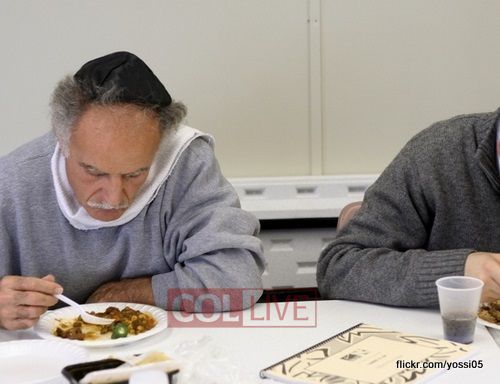
In celebration of Passover, about a dozen men will gather around the traditional lamb shank and bitter herbs Monday night.
The Seder, the ritual meal marking the start of the eight-day Jewish holiday, will have all the Passover essentials: Seder plate loaded with symbolic foods, prayer books and matzo — the cracker-like unleavened bread.
But at this Seder, grape juice will replace wine, prayers will be interrupted by a head count, and in the event of a lockdown, the guests will have to return to their cells.
So goes Passover at the federal prison in Forrest City, Ark.
Known as the “Festival of Freedom,” Passover commemorates the Jews’ escape from bondage in Egypt.
Yet for Rabbi Levi Klein‘s extended congregation, who number about 30 and reside among eight state and federal prisons across the Mid-South, celebrating freedom at Passover takes on a deeper meaning.
“How do you discuss freedom to people who are incarcerated?” said the rabbi.
For his imprisoned flock who face this conundrum each year, he says, “They’re really celebrating the freedom of the soul.”
For more than 17 years, Klein, the rabbi of the Chabad Center for Jewish Life in East Memphis, has amassed hundreds of miles on his odometer as he makes weekly visits to Jewish prisoners around Memphis and throughout Arkansas and Mississippi.
As the only visiting prison rabbi in the Mid-South, with the next closest in Little Rock, Klein provides Jewish prisoners with Torah study, Kosher meals and Jewish reading material.
Although Jews make up fewer than 1 percent of the 1.9 million prisoners in the United States — with a recent tally of 10 in Tennessee — Klein tends to his imprisoned congregants with the same intensity as he does his Memphis synagogue.
“A big part of rehabilitation is allowing people to connect with their faith,” said the Brooklyn native.
Klein gets a call each time an inmate identifying himself as Jewish enters a local prison.
One notification, just hours before Passover, has sent him dashing out to the kosher aisle of Kroger to throw together a Seder package.
And when an inmate loses a loved one, he will travel three hours to sit shiva with him and recite the mourner’s Kaddish.
Most of the men Klein visits landed behind bars for various white-collar crimes.
Not to say there aren’t murderers and rapists.
The hardest challenge came for the rabbi when he was faced with a soft-spoken Jewish policeman who had been arrested for child molestation.
It struck a nerve with the rabbi, who has seven children of his own.
Nevertheless, Klein puts on his rabbi hat and moves past it.
“We’re not here to judge,” he said. “If there’s someone within my reach, I have a responsibility to make sure their religious needs are met.”
A rabbi with the Chabad-Lubavitch movement, his aim is to cultivate Jewish knowledge among all Jews.
Chabad supports the largest network of visiting rabbis to prisons in the United States.
Among them is the Aleph Institute, a Florida-based Chabad organization with roughly 200 rabbis, including Klein, visiting Jewish prisoners across the country.
Passover, the most-observed Jewish holiday, has rabbis working overtime to allow inmates to celebrate behind bars.
“It’s crazy, off the chains,” said Rabbi Menachem Katz, director of Aleph’s outreach programs.
Katz had just finished preparing last-minute Passover packages for newly processed inmates, including one at the Shelby County Jail.
“A lot of Jews aren’t observant, but when it comes to Passover, everyone shows up,” he said.
For eight days following the seder, Jewish prisoners dine on kosher TV dinners.
The meals, sans leavened bread, may seem unremarkable to those on the outside, but for prisoners who have been eating the same food day in and out, it’s tempting enough to convert, Klein says.
Around Passover, the number of inmates looking to connect with Judaism skyrockets, and Klein has the task of discerning real Jews from “Gastro Jews.”
It’s easy to tell which ones aren’t serious about Judaism, he says.
“When I ask why they want to learn more about Judaism, they’ll answer, ‘My friend told me you get grape juice,'” he said.
But for most of Klein’s Jewish inmates, Passover is a very spiritual and emotional time.
“They miss their families. It’s very difficult to be alone,” he said.
A former Jewish inmate, now living in Memphis, who asked not to be identified, recalled how rough the holidays can be.
“Every day in prison away from your family is hard. Holidays are that much worse,” he said.
But Klein says Jewish inmates are just as free as Jews celebrating Passover in the warmth of their own homes.
“They’re free to make the right moral decisions,” he said. “They can make a difference every day, spiritually.”



great work!
Amazing! Keep up your great work!