
By Dr. David Lazerson for COLlive.com
Figuring that the kosher scene wasn’t yet a big scene there, my email was short and sweet: Is there anything we can bring you from Miami? How’s a chocolate melt-away for Shabbat dessert sound?
Rabbi Yitzchok Lowenthal, affectionately called Rabbi Yitzi, gave a quick response.
“Yes,” he wrote back. “Some warm sunshine and some goodies for the Shabbaton and upcoming Purim celebration.”
I wasn’t too confident on the weather change bit, especially since he mentioned it was about 50 degrees colder than South Florida. I didn’t even give matters a second thought until Rabbi Yitzi filled me in on the details.
“We need 400 hamentashen and about 150 chocolate chip cookies.”
At this point my brain went into overdrive. How would I pack such an order? How could we carry it in our luggage? Even if we could bring them on board the plane, wouldn’t they arrive in lots of teeny pieces? And mainly, how does one get 550 pieces of delicious goodies past security of a foreign country?
Well, it’s like this officer. I’m kind of addicted to cookies and figuring we’d be in Denmark for about five days, that really only allows 110 a day! Could be tough explaining this one. My last question was the most disturbing. Would they lock me up for attempted smuggling of kosher hamentashen and throw away the key?
I imagined it wasn’t too different from other countries where they impose such a high fee for items brought in that it’s easier and cheaper to buy a brand new stove and bake it all from scratch.
“Denmark is different,” Rabbi Yitzi tried to assure me. “They won’t even check you. Besides, you’re coming to do some big mitzvot for the Jewish community of Copenhagen. Remember, the Danish people are called the ‘Hassidei Umot HaOlam’ – the Righteous Gentiles. They saved almost all the Jews of Denmark during the war. They’re not going to give you trouble over Hamentashen!”
With this added boost in our trust, and our suitcases stuffed to the gills with a ton of delicious kosher treats, my wife Gittel and I boarded the plane for the long trip “over the pond.” The entire experience was a remarkable trip that we will never forget. More than simply recalling an awesome time, it is one that I hope we can put lessons learned into very practical, concrete action.
The recent “iJew” weekend in March 2011, sponsored Rabbi and Mrs. Lowenthal of Chabad House in Copenhagen was indeed a jam-packed event. I’d be speaking several times over Shabbos, giving a parent workshop on Sunday as well as another talk on my work in race relations, and giving a concert to conclude the entire program.
This special weekend also included talks from Arthur Avnon, Israeli Ambassador to Denmark, Chief Rabbi of Denmark Bent Lexner and Edwin Shuker who gave some fascinating and very inspiring talks about his escape from Iraq when Sadaam Hussein was in power.
“We’re all so excited to have you here in Copenhagen,” Rabbi Yitzi said. “But with the time difference and losing a night’s sleep, maybe you should get a few hours shut-eye before Shabbat begins. You’ll need your strength!”
My body was in full agreement but my spirits were in overdrive. It was the weekend before Purim and the theme from the Megillah of “v’nahafoch hu,” seemed to come to life. These two Hebrew words literally mean “and it was turned around.”
Just when things seemed so gloomy and worrisome for the Jews of ancient Persian, it all changed from one extreme to the other and they emerged totally victorious over Haman and their enemies. Purim may have been a long time ago in history but it somehow came more to life in March of 2011 in Copenhagen.
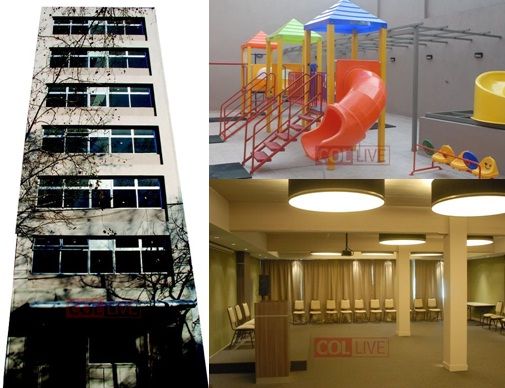
Rabbi Yitzi explained how the Chabad House used to be a headquarters used by the Nazis in World War Two. The tall, very Denmark looking apartment building now housed a hyperactively busy kosher kitchen, mezuzas all over the place, a Jewish library, a shul with Sifrei Torah, and a large social hall for Jewish events, discussions, and amazingly delicious homemade Shabbos meals.
V’nahafoch hu – and it will be completely turned around… from the ultimate in evil and negativity to the ultimate in good. In addition, several Jewish students rented apartments in the Chabad House building. It seemed as if the place was in action for most of the 24-hour day.
It was a tremendous blessing and merit, to be part of such a weekend in Copenhagen, and well worth the long travel time. There were Jews, as well as Gentiles, who came to participate in this “Weekend of Jewish Learning” events from all over the world. At my table alone on Shabbos night were people from Poland, Sweden, Denmark, Russia, Israel, Bulgaria, and with Gittel and me, Miami. And that was just one of eight tables!
I suggested to the Lowenthals that we change the name from the Copenhagen Shabbaton to the World Gathering Weekend. The Lowenthals are not only brilliant when it comes to Yiddushkeit, incredibly warm and friendly to all, but they are also walking historians.
Rebbetzin Lowenthal is truly the other half of this dynamic duo and, quite frankly, I was amazed at her spirit.
“Oh, it’s nothing,” she said hobbling her way slowly down the steep Chabad House steps to the first floor kitchen. “Baruch Hashem, Thank G-d, it’s much better,” she cheerfully added holding onto the railing with two hands.
“If this is better,” I responded, “I’d hate to see what worse was. Are you sure there isn’t anything I…”
“No no,” she laughed. “Just get yourself ready for the Shabbaton. You’ve got a lot to do here!”
I couldn’t help but marvel at Mrs. Lowenthal’s happy and positive attitude, which I’m sure contributed to her knee injury recovery throughout the weekend. She hobbled up and down the steep stairway all weekend long, always with a smile on her face.
As we drove from the airport to the Chabad House, Rabbi Yitzi pointed out various places that were critical during the Nazi occupation of Denmark. He also shared with us the amazing story of how the Danes saved almost 95% of the Jews during the war and ferried them across the waters to neutral Sweden in fishing boats. All this done in the still of the night, just days before the Nazis would deport those still remaining. He told us how of the 500 who were deported, 450 would return safe and sound. I couldn’t help but think how the world would be so different if, during World War 2, other countries were more like Denmark and Sweden in the treatment of the Jews.
Throughout the weekend’s events I was both a contributor and a rapt listener and learner. Edwin spoke of what he called the “Esther moment,” when she was faced with the personal decision to get directly involved in the Jewish people’s salvation or to take a back seat role and simply let the events unfold on their own. He urged us all to take action when we too are faced with these powerful “Esther moments.” Do we get involved or stay on the sidelines? Do we, in psychological terms, fight or take flight? The Megillah, he pointed out, tells us that G-d Almighty will help no matter what, but the fact that we too have these experiences to help our people, or not, means we have to follow Esther’s example and make the positive effort.
The Israeli ambassador followed a similar vein and urged everyone present to become modern day defenders of the Jewish people and of Israel. This doesn’t necessarily mean joining the IDF, but it means writing into the news media and speaking out when Israel’s name is defamed and its’ very existence delegitimized.
“Denmark is a very interesting place,” Rabbi Yitzi told me before the Shabbos night meal and events began. “They’re a hearty bunch and it’s very family oriented here.”
I wasn’t exactly sure what he meant but we would experience this in full force throughout our five-day stay there. It was amazing to see Rabbi Yitzi in action. He seemed a non-stop bundle of energy, helping with the cooking, picking up people, answering various questions of Jewish law, showing me the shul and mikva next door, chatting on the cell phone, arranging some last minute details, and of course, making sure our fridge in our guest room area was well stocked for the weekend for us.
On Friday night I shared some stories from my teaching experiences. I’ve been in special education and also community conflict resolution for more than 30 years straight, so by now I have an arsenal of wild, crazy and hopefully inspiring episodes. After my talk was over, Gittel and I decided to go out for some fresh air. It was almost midnight and what we saw was nothing short of astounding. Besides being dark it was also very cold, around 35 degrees Fahrenheit. We bundled up like Eskimos, ski jackets, hats, scarves, but what’s a bit of cool air to the Danes? They were out doing what they usually do – bike riding!
Copenhagen is biker’s heaven, and I’m not talking the motorized kind. Nearly every road has two wide bike lanes, one for each side of the road and they have rules and lights like cars. It Denmark it’s not equal footing for bikes; they get the upper hand! To our astonishment, there were lots of people, both males & females, out riding even at this late hour, not even in groups but many simply on their own, heading home from work or their studies perhaps. I couldn’t help but marvel knowing that if this was my hometown of Buffalo, NY, you’d have to look mighty hard to find even one lone soul out and about on such a dark, cold night.
Even in Miami, where we’ve lived for close to 15 years and the weather is basically outdoor and user-friendly year round, one doesn’t see even a fraction of the Danish lifestyle of biking. Cars are still the big thing in America but it’s something we can learn from the Danish people. It’s not only healthier – you also can’t beat the gas mileage! I realized first hand that it’s also somewhat of a necessity for the Danes with their astronomically higher prices for fuel. Rabbi Yitzi stopped to fill up as he drove us to the airport.
“Guess how much for a full tank?” he asked getting back into the car. I said $80 and Gittel guessed it at $90. “Not even close,” Rabbi Yitzi answered. “Try $175 worth!” He wasn’t driving an 18-wheeler either. It was a minivan. Our mouths fell open and we complain as the prices near $4.00 a gallon in the States?
After my talk was completed on Shabbos day, Gittel and I took a three-hour walk throughout Copenhagen. Another powerful lesson was in store for us. Or maybe I should say was not in the store for us? Copenhagen has many streets that no cars are allowed. They’re for walking only. Even bikers have to get off the two-wheelers and walk their bikes. It was a section of town that had all these cute shops and restaurants. To our astonishment they all closed at 6:00 pm. I thought that maybe it was a holiday. Gittel joked that perhaps it was in honor of the Shabbaton. In any case, we thought that for sure, come Sunday, we’d have a chance to shop and pick up some goodies. Sunday was a very busy part of the Jewish Learning Weekend experience. I’d be busy giving a session and a concert to conclude the entire event. Despite my open window of 2 hours, I found out that everything is closed on Sunday. The shopping and sightseeing would have to wait till Monday.
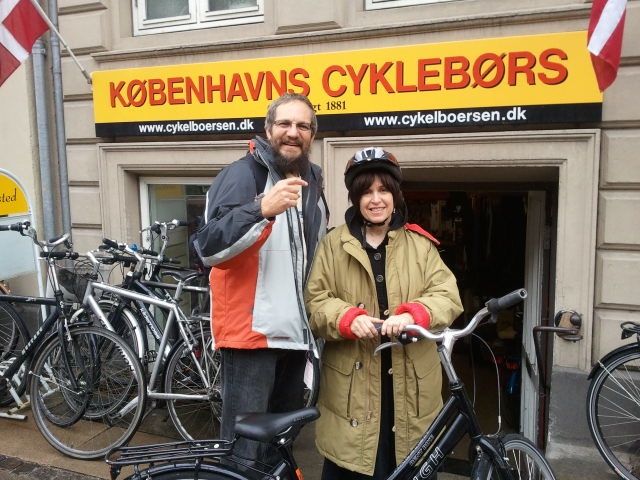
There were many options on Monday, our one day off, to explore Copenhagen. Rabbi Yitzi had a driver lined up to take us around, if we wanted. There are all sorts of bus tours as well. But Gittel and I decided that when in Denmark do as the Danes do – ride bikes! So we stopped at a bike rental shop Monday morning and headed into the Copenhagen. Now while we knew full well how to ride, in fact we bike in Florida, but we were total “green horns” when it came to the rules of the road in Denmark. All I can say is thank goodness the Danes are a polite and friendly people. I wasn’t aware of the hand signals that notify the zillions of bikers behind you that you’re stopping or turning. And I sure as heck wasn’t knowledgeable about putting your right foot down when you stop at a light and not your left foot. And I had no concept whatsoever that the passing rules are pretty much the same as with cars; the faster ones pass on the left.
As I kind of zigzagged about, stopping here and there, even sticking my feet out to the side in utter joy, I finally realized that those 398 bell rings and whistles were meant for yours-truly, who was way too close to causing massive bike pileups all throughout Copenhagen. After a few hours of biking we started to blend in a bit better, although we sure kept our helmets nice and secure.
We stopped off at a natural juice place and just when we were settling into these warm and very comfortable couches, the owner announced that it was 6:00 PM and closing time. I gave him that “huh?” kind of look. I mean this was Monday, not Saturday or Sunday. It was a weekday and one can and should stay open later and continue to do business and make good money, right? Wrong. Pretty much the entire place, except for some restaurants and pubs, simply shut down come 6:00.
Rabbi Yitzi later explained to us that Denmark is very pro-family oriented. Evenings and the weekends are meant to be family time. I later asked a random store owner and he said that “we work all day and the kids are at school all day, at the very least we spend our evenings and weekends together. Time goes by too fast. Who can go through life and not get to know your own family?”
Good question indeed, my Danish brother. Unfortunately, about 95% of the world would not have a good answer to that last question. I’ve worked with individuals at risk for over three decades and so much of what I see can be attributed to poor dynamics between family members. Maybe it’s time we took some lessons from the Danes and started closing our businesses early and started spending some more real quality time together. And I don’t mean doing video games or hitting the Xbox 360, PS3, Wii, PC, DS, PSP or the iPhone together.
Another highlight and learning experience from the event occurred our last evening with the Lowenthals, at least on this trip. After davening in the Chabad House shul upstairs, Rabbi Yitzi introduced me to Mr. Dan Edelsten. Despite the late hour, we settled into the library, sipped some herbal tea, as we all listened to how he was one of those individuals hiding in a fishing boat in 1943 waiting to be taken to safety in Sweden.
Dan was only six years old at the time but he recalls each detail vividly. At first, they moved from their regular apartment to a friend’s apartment by the harbor. They couldn’t take any bags of belongings since this would attract the attention of the Nazis. He told us how his father’s friends put them up and how he’d look out at all the ships passing by, most of them German vessels of different kinds.
The lady of the house, an older widow, was so worried about someone spotting this young child that she brought large plants to block the windows. Dan could then peek through the leaves to gaze out at the harbor. As the Nazi plan of deportation for the Jews came closer to reality, Dan and his family were taken up north to a little fishing village where they hid for several days before being taken by boat to Sweden.
“We were all squeezed in, laying down at the bottom of this boat under some blankets,” Dan told us. “We had to be totally quiet. The fishermen didn’t put the motor on, as this would attract the attention of the German patrol boats. Two people rowed the boat. It was very frightening but we arrived at the shores of Sweden all safe.”
Dan and his family couldn’t return to their home until after the war was over, nearly 18 months later. To the credit of the Danish people, who not only hid them and helped them reach Sweden, Dan told us that everything in their home was intact and in wonderful shape. The Danes were taking care of the homes of the Jews until they’d be able to return.
Our amazing experiences were coming to a close in Denmark and I offered to drive Dan home, with the rabbi’s car of course. It was, after all, quite late at night and besides, Dan was almost 76 years old. But Dan just looked at me and smiled. “Oh, no need for that. I’m only a few miles away and I have my bike here!” Of course.
The weekend-long iJew events concluded with a late afternoon concert and, I must admit, it was an emotional experience for me. As I picked up my guitar to entertain the large crowed gathered inside the Chabad House,
I couldn’t help but marvel at the environment around me. The room was filled with all these people who had come to learn and be inspired about Yiddushkeit and Torah. We sang and danced to Jewish music and to my rather unusual blend of Jewish themes in various genres, like rock, reggae, rap, & even bluegrass; all in the very same room and building that was used by the Nazis to plan their evil against us, and humanity at large! And yet, just a few generations later, the building was ours. They were defeated, their horrific philosophy destroyed, and here we were, thriving, growing, involved in positive endeavors, and in that irrepressible style of Chabad, doing it all with simcha, with true joy! May all the enemies of Am Yisroel and Elokei Yisroel experience the same downfall and may we all continue to grow, inspire, and help others until the geulah, the redemption is truly here.
By the way, the hamentashen and cookies made the long journey safe, sound, and in good shape. A few were M.I.A. – missing in action, but that, I must admit, was due to the fact that one of the packages mysteriously opened up and a few somehow ended up in my stomach. Like Rabbi Yitzi assured us, we weren’t even stopped at customs.




Go Doc Laz! From a world-wide fan who’s followed your amazing career & activities for klal yisroel and for bringing Moshiach Now! Mosh – we played football together in Buffalo! Kol Hakavod!!
Shkoyach Yitzi och Rochel!!
från eran svensk granne….
turning over the worldddd!!!!!!!!!!!!!!!!!!!!!!!!
#1 fans in cali
GO DR. LAZ!!!!!!!!!!!!!!
COUSINS FROM SWEDEN 🙂
Dr laz’s article, while expertly written, cannot even begin to describe the amazing activities the loewenthals do on a daily basis. They are truly amazing and inspiring shluchim! Proud to be a family member
Yitzy and Rochel are wonderful wonderful shluchim. Yasher Koach
BROUGHT MEMORIES BACK….
KEEP UP THE GOOD WORK AND REFUO SHELEMOH TO ROCHEL .
FROM AN EXPAT.
KOL TUV BEGUR INGE -MIRIAM
Go Yitzy and Rochel. You are absolutely the best! You are both a continual source of nachos and visual fulfillment of the Rebbe’s brocha!