
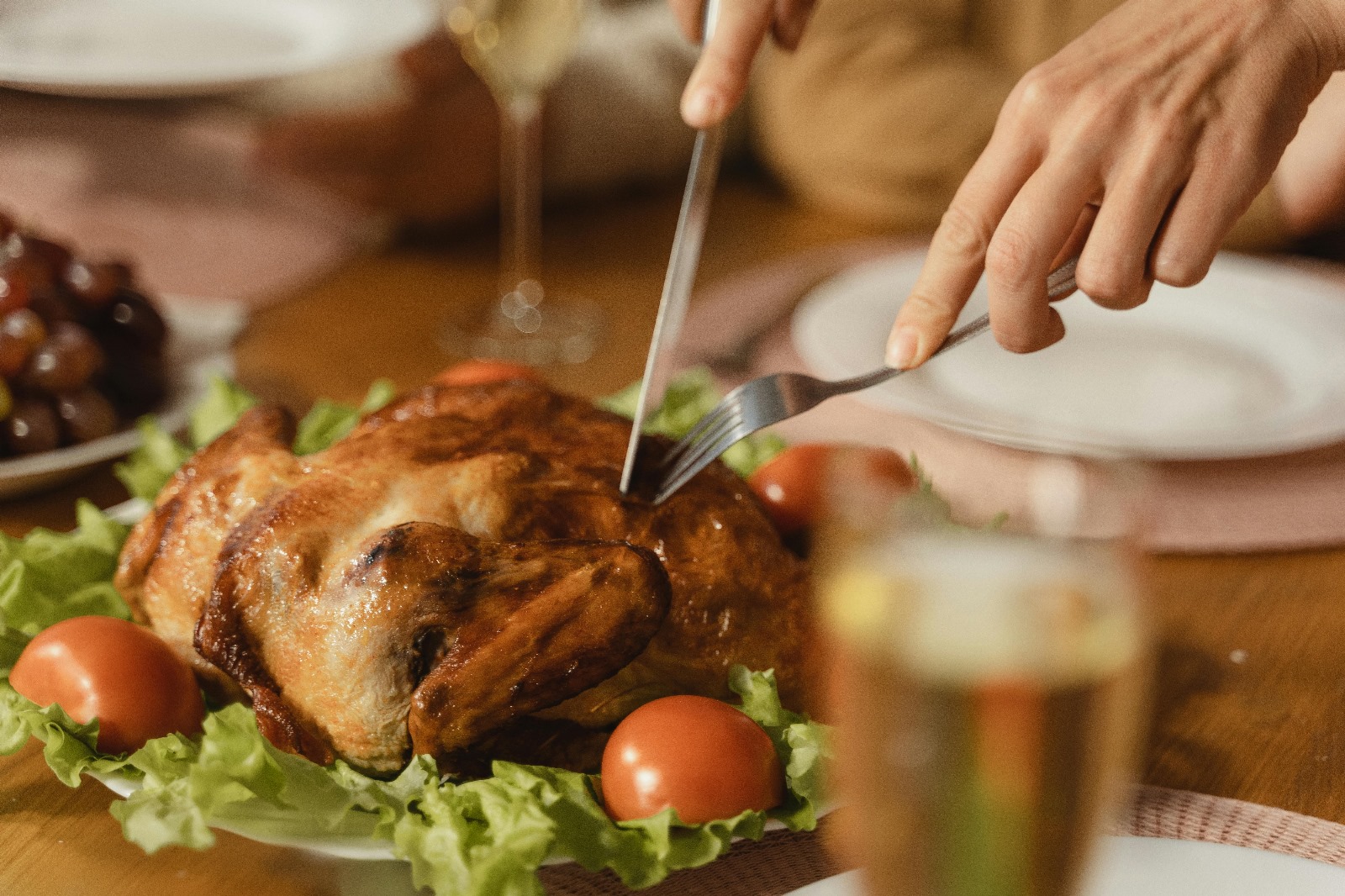
Question: I’ve been celebrating Thanksgiving with my family for many years. Recently, someone mentioned to me that there may be halachic concerns with observing Thanksgiving, and that some poskim have reservations about it. I’ve only heard bits and pieces and nothing clear. Can you please clarify what the area of concern may be?
Answer by Rabbi Mendel Prescott, Rosh Yeshiva of Machon Smicha:
As Torah Jews, we are fortunate to live in a country that upholds values that are significant to us. Three times a day, we express our gratitude to Hashem for the endless kindness He bestows upon us. In a similar spirit, the people of America celebrate Thanksgiving annually in November, a tradition we deeply appreciate. See for example the Farbrengen of 19th of Kislev 1986[1] where the Rebbe addresses the meaning of Thanksgiving and its significance.
The origins of which trace back to the early settlers of America, the Pilgrims. Who after having endured a difficult year in the New World marked their survival with a communal meal expressing gratitude for the harvest of 1621. It is important to note that it was not instituted by any religious authority; rather, it was a local custom of a small, isolated colony. Over the next centuries, these regional gatherings gradually took on a broader cultural identity, eventually prompting President Lincoln who in 1863 decided to designate it as a National Day of Thanks during the Civil War. Later, in 1939, President Roosevelt shifted the date to stimulate the economy after the Great Depression by extending the shopping season
To provide some context—not to draw conclusions or offer guidance—here are the perspectives of recent poskim regarding Thanksgiving.
Firstly, Rav Yosef Dov Soloveitchik, followed his father Rav Moshe’s opinion, saw no halachic concern with celebrating Thanksgiving.[2]
However others contended, arguing that although the core idea of Thanksgiving aligns with Torah principles, the holiday is tied to another religion. The reason for this is because initially, the Pilgrims introduced Thanksgiving as a day of gratitude and prayer to the Christian deity, which is considered avodah zarah.[3] For this reason, some poskim viewed the celebrating of Thanksgiving as avizraya (association) of avodah zarah.
In a letter, Rav Hutner addresses this concern and strongly disapproves of establishing an annual festival of gentile origin.[4] He is particularly troubled by using the non-Jewish calendar for this purpose, as he sees the non-Jewish calendar as a having a connection to avodah zarah.
However, the general sentiment among poskim is that avodah zarah is not a concern in this case. Thanksgiving was not established by the church but began as a folk celebration. It eventually evolved into a civil holiday focused on unity, family, and shopping customs.
Some poskim consider another issur: “bechukoseihem lo seileichu,” which prohibits following the practices of Gentiles, even those that do not involve avodah zarah.
However, not every practice performed by non-Jews is classified as chukoseihem. The Rama,[5] based on a teshuva from the Maharik,[6] outlines three conditions—any one of which is sufficient – for a practice to fall under chukoseihem:
- A practice of pritzus, indecent in nature.
- A baseless practice without reason.
- A practice with origins in avodah zarah, even if the connection is remote.
Those Poskim who permit celebrating Thanksgiving argue that none of these conditions apply to modern-day celebrations: it is not immoral; its origins are reasonable; and it was not instituted by a religious body.
However, the Gra holds a more stringent view than the Rama, explaining that chukoseihem applies to any practice adopted from a non-Jewish source—if it is something we would not do were it not for that non-Jewish practice. Theoretically, the Gra’s position poses a challenge to the permissibility of celebrating Thanksgiving, but in practice, poskim do not seem to adopt the Gra’s position l’halacha. (Even among the more stringent authorities don’t factor in the Gra’s shittah.[7])
According to a teshuva by Rav Yehuda Henken[8] (grandson of Rav Yosef Eliyahu Henkin) we can suggest that Thanksgiving celebrations do not fall under chukoseihem even according to the Gra. He discusses participating in a national moment of silence to commemorate fallen soldiers and questions whether it could be classified as chukoseihem. He points out that even according to the Gra, a moment of silence is permitted because it was instituted as a universal observance, not as a non-Jewish practice. This reasoning could also apply to Thanksgiving, as it developed mainly from secular sources and was established as a holiday for all Americans, regardless of their beliefs.
Nevertheless, many argue that Thanksgiving celebrations do correspond to some of the Rama’s three categories. Rav Menashe Klein expresses caution about permitting it because of the third condition—its ties to avodah zarah—placing it under chukoseihem. Although the holiday was not established by the church, its original focus was prayer to a foreign deity. Therefore, he strongly advises against celebrating it.
An interesting discussion arises regarding the application of the second condition to Thanksgiving. On one hand, the observance is certainly not baseless; it has an understandable historical basis. On the other hand, the traditional, almost ritualistic way of serving the dinner (turkey and pumpkin pie etc.) resembles non-Jewish superstitious practices.
Rav Moshe Feinstein seems to be unsure about this point. Following several teshuvos in Igros Moshe we see a progression in his view. In a teshuva[9] dated 1963, he takes a strict stance and doesn’t even entertain the prospect of permitting Thanksgiving celebrations. He goes as far as to advise against making any sort of celebration, like a bar mitzva, on that day.
Years later, in 1981,[10] he begins to analyze the question more of celebrating Thanksgiving, where he considers it chukoseihem because of the second condition. But still, he is not completely sure whether that condition applies. In a teshuva[11] written a month afterward, Rav Moshe takes a more lenient stance, considering Thanksgiving celebrations not to be chukoseihem. However, he cautions against making it an annual celebration, which would be akin to adding a mitzvah, touching on the issur of of bal tosif.
In a subsequent teshuva[12] written a month later, he revisits his previous two teshuvos and elaborates on the topic, analyzing whether the symbolic practices of thanksgiving are baseless or not. Was the turkey eaten by the Pilgrims—at a time when the land already offered abundant food—truly significant enough to inspire centuries of celebration? Or perhaps the whole matter is overstated and borders on chukoseihem?
In contrast, one could reasonably infer that, according to Rav Moshe, celebrating July 4th is acceptable. The celebrations do not include anything mysterious but involve normal patriotic activities.
Sources:
[1] https://www.chabad.org/multimedia/video_cdo/aid/6682682/jewish/The-Rebbe-on-Thanksgiving.htm
[2] נפש הרב (עמ’ רלט)
[3] רמב”ם הל’ עבודה זרה (פרק ט הלכה ד)
[4] פחד יצחק אגרות וכתבים (סימן קט)
[5] יורה דעה סימן קעח (סעיף א)
[6] סימן פח
[7] כגון בתשובות של האגרות משה המובאים להלן, לא מצינו שדן בשיטת הגר”א
[8] בשו”ת בני בנים חלק ב (סימן ל)
[9] אבן העזר חלק ב (סימן יג)
[10] אורח חיים חלק ה (סימן כ, אות ו)
[11] יורה דעה חלק ד (סימן יא, אות ד)
[12] שם (סימן יג)
The Q&A is an excerpt from the Olam Hahalachah weekly publication, produced by Machon Smicha. Download this week’s Olam Hahalachah.
Sign up to receive the Olam Hahalachah each week straight to your inbox by clicking here.


It’s a special holiday to keep as an American Jewish person!
American before Jewish that’s what matters
American = adjective
Jew = noun
I learned this in high school!! You are correct
for native americans it’s kind of like a tragedy day.
Why?
A bunch of outsiders got involved in an inter tribal dispute and profited in the long run. Kind of like how the Romans found an entering wedge in Judaea.
Thank you for such a thorough analysis. This is a really good thing for truly respecting whoever took any of the above stances.
Part of the custom, which as stated above some respect and some not, is perfecting the turkey recipe and cooking process. Turkey meat is pretty bad, but very elaborate and laborious cooking can make it into a once-a-year amazing treat.
I find it surprising that lubavitchers are looking to celebrate this while we BH have an abundance of yomim tovim, especially in kislev , and of course shabbos that im sure we can all always improve in making more family gatherings alnd farbrengens. We have plenty of ways of thanking Hashem BH, and its hard to understand why someone davka wants to eat Turkey tonight . If you’re feeling especially thankful to Hashem, say some tehilim and make a farbrengen with ur kids, give tzedaka etc.
You are closed minded
There is no contradiction
For people who grew up celebrating it with their family, it can be very nostalgic and associated with memories of family time and fun.
many nostalgic practices that a BT may have in memory.
It’s a special,day
families get together and thank the one above
Watch the football games, and have the cowboys win
Whereas it is the duty of all nations to acknowledge the providence of Almighty God, to obey His will, to be grateful for His benefits, and humbly to implore His protection and favor; and-Whereas both Houses of Congress have, by their joint committee, requested me “to recommend to the people of the United States a day of public thanksgiving and prayer, to be observed by acknowledging with grateful hearts the many and signal favors of Almighty God, especially by affording them an opportunity peaceably to establish a form of government for their safety and happiness:” Now, therefore, I do recommend… Read more »
…that even though Washington’s conception of “Almighty G-d” wouldn’t match ours, there’s no explicit reference to any form of avodah zarah or even shittuf in this letter.
He writes, “that great and glorious Being who is the beneficent author of all the good that was, that is, or that will be.” That seems like Y-K-V-K to me.
However, not every practice performed by non-Jews is classified as chukoseihem. The Rama,[5] based on a teshuva from the Maharik,[6] outlines three conditions—any one of which is sufficient – for a practice to fall under chukoseihem:
I would like to point out that having social media fulfills all 3 of those points.
Stop preaching your hate and judgemental attitude
Stop refusing to engage rationally with people’s arguments, rather than baselessly dismissing them as “hate.”
Social media has origins in a avoda Zara? And it’s a baseless practice without region? And social media is indecent in it’s very nature (maybe arguable but dontnthink so)?
I’m surprised that Eivah wasn’t a factor – you live in a country where you should be anyways thankful to Hashem for, and people see and say, Jews aren’t even thankful for living here.
I don’t make an official celebration, but if a non Jew asks, I say that I celebrate thanksgiving EVERY day, and I’m so thankful to G-D that I live in this wonderful country.
I personally have no issue wishing someone happy thanksgiving
After all, being grateful is a Jewish value.
Thanksgiving is nice but shabbos is the next day. Many do not desire another 3 meal in a row/ two day yom tov 😉 still nice to celebrate but to each their own.
Thanks Mendel.
Since when did Kiruv Rechokim become Rechokim kravim? Instead of us influencing the world… We are sadly being influenced by the goyishe world. in speech, dress and action.
B”H I’m a shlucha. When someone wishes me happy thanksgiving, I answer the same. I was once invited many years ago to a family for thanksgiving meal. All we did was sit there for hours with no devar Torah and just yenta. I felt like my day was stolen for me. What I do now is invite people for a thanksgiving meal and make it into a meal where there is dvar Torah and stories told. A Jew is not allowed to sit there and waste time. I do this for my community so I can bring some holiness into… Read more »
in a chabad house its more socializing yidden with more yidden. dvar torah and talking yiddishkeit is recommended
what city are you a shlucha in
Anywhere, USA
Like she’ll identify herself.
I was with family celebrating a traditional Thanksgiving dinner with all the Festive food and lots of Torah was given over. We discussed the Parsha the upcoming 9, 10 and 19 Kislev Yomim Tovim. Chanukah etc. We had a debate about Hilchos Tzisis. I have also been to Shabbos meals where hardly a word of Torah was repeated. At any occasion you can choose to elevate and make it holy.
thanks for an example of complicating something. be grateful. express thanks. enjoy food and positive spirits with family and friends. l’chaim tovim
Some respect torah is the way frum Jews look at something
I like thanksgiving bc of football. Is that a problem?
Nope
Go Cowboys!!
What a wonderful article!
It looks like the author mentioned the Rebbe but right after that copied and pasted from others without indicating if from what the Rebbe said we can get the answer to the question or not. Please explain that part.
Did you open the link that the Ruv referenced?
The Rebbe took lessons from the fact that we live in a country that celebrates it the road did not speak about whether or not you should
It’s a day off of work and school for a lot of people and a good excuse to get together with family and friends, why not? We serve our own family’s favorite traditional foods (not the typical American fare), along with very- expensive- because- it’s-kosher– turkey. Also fun fact, “Thanksgiving” seems to have been inspired by Sukkos….remember, the Pilgrims were religious! And were inspired by the idea of harvest and bounty.
And yes, we still have Shabbos the next day, with different group of family and friends. It’s a win-win.
Beside Rosh Hashana, I can’t think of any other opportunity that American Jews have to so easily connect in the spirit of giving thanks to Hashem and break bread with the goyim. I think one of the big reasons for antisemitism is because some many goyim have no understanding of what it is to be Jewish, and prejudice is the child of ignorance. Even within our own people, look at how many secular Jews have negative misconceptions regarding Yiddishkeit based on a lack of knowledge and understanding. I believe if there is ever to be a true and lasting peace in… Read more »