By COLlive reporter
The Association of Jewish Communities of Hungary (EMIH) commemorated the 76th anniversary of the liberation of the Budapest ghetto with a special 76-hour online broadcast which began on Sunday.
The program includes survivor’s recollections, thought-provoking conversations, and videos of public figures, artists and celebrities discussing their connection to Judaism. Documentaries and popular feature films on the subject will be aired over the course of the 76 hours.
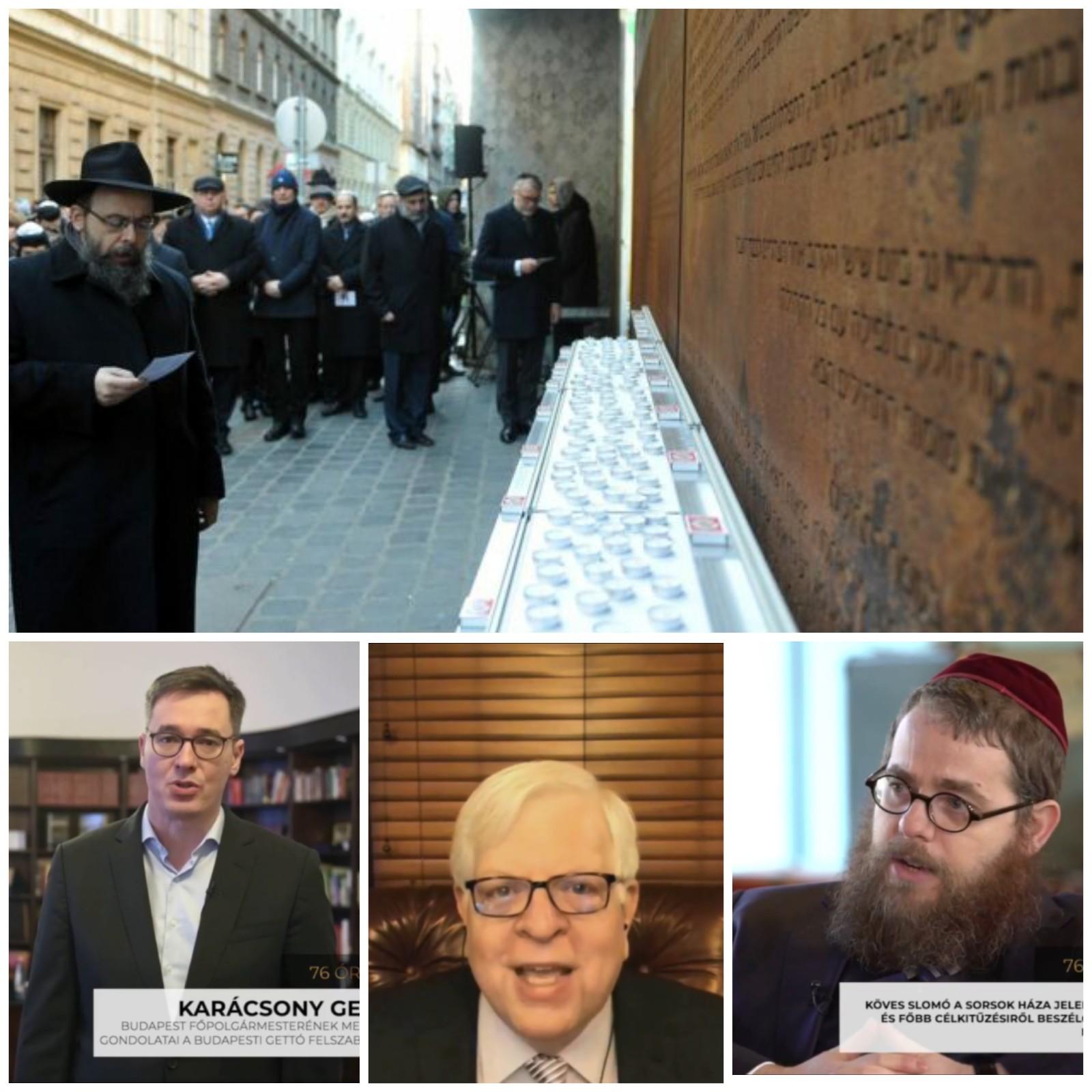
The Jewish community holds its candle-lighting ceremony each year to commemorate the liberation at the Budapest Ghetto Memorial Wall on Dohány Street. With current restrictions on large gatherings, however, this year the outdoor ceremony could not take place. That’s when the EMIH decided to hold a commemoration with online programming.
“While the pandemic may prevent us from our annual remembrance in person, we can still be together, watching and listening to a variety of engaging and inspiring programs – all accessible online. The program will be repeated for three days, giving as many people as possible a chance to be involved and experience this memorial together,” said Rabbi Shlomo Koves, who heads EMIH and is a Chabad Shliach.
Programming includes films and documentaries of the Holocaust and the Budapest ghetto, including Jewish Tales, a film by director Péter Gárdos, and the popular 1955 film, Budapest Spring. Viewers can hear well-known artists, public figures and scholars talk about what Judaism means to them in a series of short films, and several films address the fate of women during the Holocaust.
Among the personal memoirs and recollections are uplifting stories from survivors, including Olympian Ágnes Keleti, singer György Korda, and Gusztáv Zoltai, the former managing director of the religious organization, Mazsihisz.
Also participating in the remembrance with video messages are dignitaries and public figures, including Israel’s Ambassador to Hungary Yakov Hadas-Handelsman, Mayor of Budapest Gergely Karácsony, Head Shliach of Hungary Rabbi Boruch Overlander and American author and radio host Dennis Prager.
A discussion on the relationship of religion to the Holocaust includes Cardinal Péter Erdő, Primate Archbishop Tamás Fabiny, a Lutheran Bishop, and Rabbi Koves.
The Budapest Ghetto was liberated on January 18, 1945. Set up over an area of 20 square blocks, more than 70,000 people were crowded into the ghetto. Although the ghetto operated for only a short time (it was set up at the end of November 1944), inhumane conditions, overcrowding, food shortages, and frequent raids by the Hungarian Arrow Cross claimed many lives. Thousands of buried corpses were found in the area following the liberation of the ghetto.
In 2014, the 70th anniversary of the ghetto’s liberation, EMIH, together with the local government of Erzsébetváros, erected the Budapest Ghetto Memorial Wall on Dohány Street, where an interactive map shows the history of the district.
VIDEO: Remarks in English by Dennis Prager begin at 1:52:40