

It’s Friday, June 13, and the moment Israel has been preparing for for 30 years has arrived: The all-out attack on Iran’s nuclear sites. This is far from a one-and-done show, but I’ll recap what we know so far.
At around 3am Israel time, reports began emerging of Israeli strikes in Iran. According to the IDF, over 200 Israeli Air Force aircraft took part in the initial strikes, which saw fighter jets hit some 100 targets with over 330 munitions.
What did Israel target? Iranian nuclear facilities, military and scientific leadership, and missiles aimed towards Israel.
Perhaps the most significant nuclear facility to be targeted was in Natanz—Iran’s largest uranium enrichment site. According to the IDF spokesperson, Israel struck Natanz’s underground facilities, including “a multi-story enrichment hall housing centrifuges, electrical rooms, and other supporting infrastructure.” The military also says “critical infrastructure at the site was targeted, which enables its continuous operation and the Iranian regime’s ongoing advancement of its nuclear weapons project.”
How badly did Israel hit Natanz? According to sources close to President Isaac Herzog, the International Atomic Economic Agency told the president that Natanz was critically damaged.
As of writing, Israel has reportedly renewed strikes on Natanz.
For an understanding of just how widespread the attacks are: This was the largest attack on Tehran since the Iran-Iraq war in the 1980s.
And in what is perhaps even more astonishing, the IDF said that all pilots who took part in the attacks on Iran this morning returned home unharmed. Just to hammer the point home, as the crow flies, it is around 1,000 miles from Israel to Tehran.
Think for a moment about what an achievement it is to carry out such a mission safely.
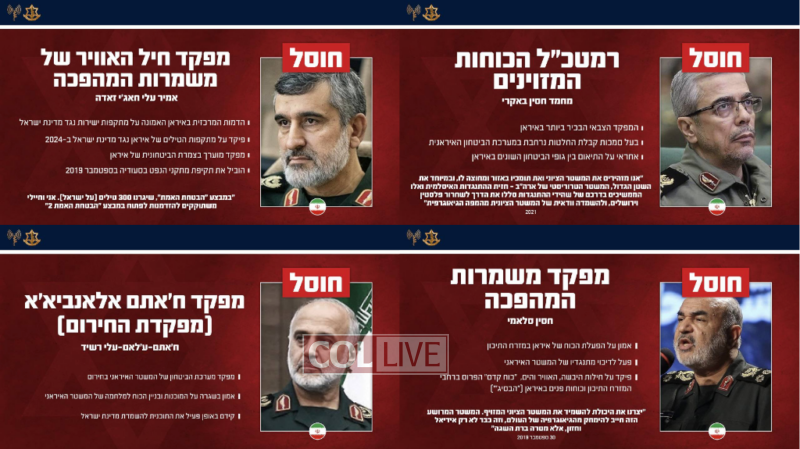
Now for the eliminated Iranian officials. As of writing, the below individuals are confirmed dead:
Mohammad Bagheri, chief of staff of Iran’s armed forces—and the second-highest Iranian commander after Supreme Leader Ayatollah Ali Khamenei.
Amir Ali Hajizadeh, head of the Islamic Revolutionary Guards Corps airspace unit.
Hossein Salami, commander in chief of the Islamic Revolutionary Guard Corps.
Gholamali Rashid, deputy commander in chief of Iran’s armed forces
Fereydoun Abbasi, former head of the Atomic Energy Organization of Iran.
Mohammad Mehdi Tehranchi, president of the Islamic Azad University of Tehran and a theoretical physicist.
By this point, you’re probably wondering: How on earth did Israel pull this off? Here’s what a source in Israel’s security establishment told me:
Significant intelligence was gathered and surveillance was conducted against senior members of Iran’s defense establishment and nuclear scientists who were eliminated. Alongside this, a covert operational campaign targeted Iran’s strategic missile array.
The Mossad carried out a series of covert operations in Iran aimed at damaging Iran’s strategic missile infrastructure and its air defense capabilities.
As part of these operations, Mossad agents executed significant actions to infiltrate large quantities of special weaponry into Iran, deploy them across the country, and launch them toward designated targets with precision and effectiveness.
There were three distinct operations:
The first: In central Iran, Mossad commando units deployed precision-guided weapons systems in open areas near Iranian surface-to-air missile (SAM) systems. At the start of the Israeli offensive, simultaneously with IAF airstrikes across Iran, these systems were activated and the precision missiles were launched simultaneously and with high accuracy at their targets.
In another operational campaign aimed at neutralizing Iran’s air defense capabilities threatening Israeli fighter jets, Mossad embedded strike systems and sophisticated technologies within vehicles during covert missions. When the surprise attack began, the weaponry was launched and completely destroyed the designated Iranian air defense targets.
In the third campaign, the Mossad established a base of explosive-laden drones that were smuggled deep into Iran well before the attack by Mossad agents. During the Israeli offensive, the drones were activated and launched at surface-to-surface missile (SSM) launchers located at the Esfajabad base near Tehran—which pose a threat to strategic and civilian targets in Israel.
Much more will likely be written about this mindblowing operation in the weeks and years to come, but for now, that’s a little insight into the historic operation.
And how did Israel make the decision to go to war with Iran? I reported exclusively on the details earlier today:
In November, after President Donald Trump’s election and shortly before the ceasefire in Lebanon, Netanyahu signed a written directive to advance the plan that was put into action early this morning.
This marked the culmination of a multi-year process involving tens of thousands of people, and the beginning of an operational phase that concluded overnight. The main mission was to get the United States to permit the strike. After months of efforts led by Netanyahu and Ron Dermer—including previously undisclosed meetings—the green light was given.
The U.S. position ranged between “allowing” and “supporting.” In meetings between Netanyahu and Trump, the prime minister told the president: “Surprise is success.” Still, leaks and excessive chatter nearly jeopardized the operation. A lot of information was leaked, but ultimately the decision was made to proceed. In the end, everyone supported the decision made last Monday.
The leaders of the Haredi parties, except for Aryeh Deri, were unaware of the strike while they were threatening to bring down the government. Foreign Affairs and Defense Committee Chairman Yuli Edelstein was informed of what was developing, which helped broker a compromise—as he knew what was about to happen within 24 hours.
Ok, so what now? In response, Ali Khamenei warned that Israel will face a “bitter and painful” fate. Iran launched 100 drones at Israel, which as of writing, have not all been shot down—however the IDF said it had “control over the situation.”
Just before 2pm, IDF Spokesperson Effie Defrin said that this operation is only in its early stages, while Israel knows Iran is planning further attacks on Israel.
But for now, there’s another enormous victory: Hezbollah announced that it will not respond to Israel’s attack on Iran. Don’t forget: For years, the ayatollahs have been preparing Hezbollah for this very moment—and now the Lebanese terror group is paralyzed.
We have long, critical days ahead of us.
For more updates follow COLLIVE on WhatsApp.
VIDEO: Mossad personnel operating inside Iran
Israelis celebrate the Israel’s attack on Iran at the Kotel



According to IDF on site, over 100 Israeli Air Force “aircraft” took part in the initial strikes ( before 2:30am Israel time), which Israeli DRONES from within vicinity of Tehran hit some 100 targets.
A big שומר ישרא-ל thank you Hashem Yisborach!!!! Moshiach now!!!
These are all great facts, but we have to remember that the success of Israel right now is because of all the miracles Hashem is performing!