
By Mica Soffer
In light of the recent war in Ukraine, COLlive.com reached out by several Chabad Chassidim to hear directives from the Rebbe in regards to times of war.
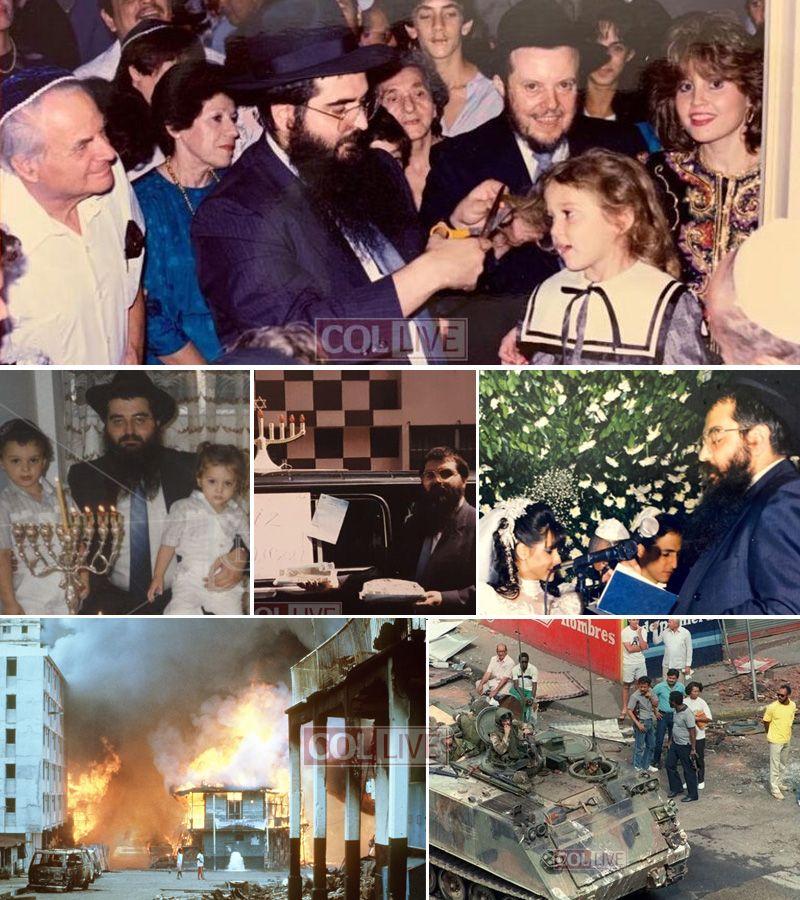
Our research led us to the story of Rabbi Zushe Wilhelm OBM and his wife Esther Wilhelm, who served as Chabad Shluchim in Panama during a time of conflict and danger.
Here is their fascinating story (recounted with the help of Mrs. Wilhelm and her children):
In 5746, the Ashkenazi Jewish community in Panama City (affiliated with the Beth E-l synagogue) sent a request to the Rebbe’s office at 770 Eastern Parkway, saying that they were looking for a new Rav. Rabbi Chaim Mordechai Hodakov, the Rebbe’s Chief of Staff, spoke to Rabbi Zushe Wilhelm, who knew Spanish, and suggested that he take the position.
Rabbi Hodakov made it clear that if he went, it wouldn’t only be as a Rav of the community but also as the Shliach of the Rebbe. He would be tasked with arranging programs independent of and beyond the parameters of the shul, Rabbi Hadakov said.
Rabbi Wilhelm and his wife Esther Wilhelm (nee Sperlin) agreed and set out to the Central American country, bordering both the Caribbean Sea and the Pacific Ocean, between Colombia and Costa Rica.
Immediately upon arriving there, Rabbi Wilhelm opened a Gan Israel Day Camp. Many children enrolled and enjoyed an uplifting Jewish experience. The influence of the camp continued into their parents’ homes as well.
True to halacha, Rabbi Wilhelm transformed the synagogue into an Orthodox shul by putting up a mechitzah. That Friday night, a congregant named Julio Dovid walked out in protest. “I will not pray in a synagogue divided by the Berlin Wall!” he dramatically said. Rabbi Wilhelm remained firm in his resolve, yet he handled the matter b’darkei noam. After Shabbos, he called Dovid and conversed with him. It wasn’t long before Dovid returned to shul and the two become good friends.
DARK DAYS
The Wilhelms spent three successful years servicing the Jewish community of Panama. However, this was not to last.
The mutually beneficial relationship between the United States and the de facto ruler of Panama Manuel Antonio Noriega became sour in the mid-80s. The U.S. suspected that the dictator was involved in drug trafficking and sharing intelligence with other countries.
In 1986, Noriega was indicted by U.S. federal grand juries in Tampa and Miami on drug-smuggling and money-laundering charges. Panama was placed under economic sanctions, and Panamanian assets on American soil were frozen.
Things came to a head in March 1988 when the Panamanian government charged that the United States was waging a “non-declared war” against Panama, and a state of emergency was declared.
R’ Moshe Sperlin, the father of Mrs. Wilhelm and a chossid in Crown Heights, heard the news and became anxious and worried. With phone lines and electricity in Panama down at the time, he was unable to communicate with his children.
When the situation worsened, R’ Moshe ran to 770 and went to the office of Merkos L’inyonei Chinuch. He reported the news and asked the Mazkir Rabbi Leibel Groner to ask the Rebbe what his children should be doing in such a situation.
Rabbi Groner said he will present the question to the Rebbe and that he will call the Sperlin residence once an answer is given. As R’ Moshe left 770, Rabbi Groner came running after him. “Please come back!” he called out.
Rabbi Groner said: “The Rebbe told me to tell you as follows: Your daughter and her three young children should come back to the United States. However, your son-in-law R’ Zushe should stay with his community as long as he possibly can. The Rebbe then said that you should be in touch with the Rav, as well.”
GUNSHOTS AND SLURS
Reaching the Wilhelms by phone was practically impossible. Panamanian schools and banks were closed. Since the United States had frozen Panamanian assets, credit cards (based on American banks) could not be used and phone calls between both countries couldn’t easily be made. Provisions could only be obtained with cash. Civilians were not permitted to drive in the street.
During the next few days, the Wilhelms remained at home. At the window, they watched soldiers march down the street, tanks rolling by, and fires burning. Their sons Berel Wilhelm and Rabbi Chaim Yisroel Wilhelm, both young children at the time, still remember the gunshots fired into the air as a show of force.
These gunshots also affected their youngest child at the time, Levi Wilhelm. When his speech was delayed, the doctors attributed this to the loud sounds he had heard as a baby.
When they got word of the Rebbe’s instruction, the Wilhelms weren’t able to purchase airline tickets to the United States since they didn’t have available cash. Mrs. Wilhelm’s parents sent them tickets via the Telex text-based message network. Mrs. Wilhelm stood in a line that stretched a full block to enter the Eastern Airlines building to pick up the tickets.
Mrs. Wihelm and her 3 children were able to safely board and arrive in New York. Rabbi Wilhelm remained in Panama.
The very next day, gunshots were fired while he was at shul. As an American and Panamanian citizen, Rabbi Wilhelm was soon offered security detail from the Panamanian army and later from the Southern Command of the American military base.
Rabbi Wilhelm was hesitant to accept either offer. Realizing that he was the subject to a game of “tug of war” between the opposing sides, he tactfully turned down both of them. He explained that this increased security would heighten the fears of community members, and they would be afraid to attend synagogue. Hearing this explanation, they relented.
However forthcoming the authorities may have been, Rabbi Wilhelm soon began detecting signs of animosity from non-Jewish neighbors. As an American Jew, and a Rabbi, they would call him “gringo” to his face—a derogatory term for foreigners in Latin America. Rabbi Wilhelm interpreted the animosity as the anger of common people with the United States for their unwanted intervention.
CODE WORDS
Several tense and scary weeks went by, according to members of the family who have spoken with COLlive.com. Throughout this time, Rabbi Wilhelm continued to encourage the Jews to remain strong and faithful.
When the United States began gathering American citizens to assembly areas in Panama City and Colón for evacuation, the American Embassy called Rabbi Wilhelm. They notified him that the United States would no longer be protecting its citizens.
To stay protected, they said, Rabbi Wilhelm would be required to either leave the country or relocate to the American military base. Rabbi Wilhelm refused both offers, following the Rebbe’s directive that he stay with the Jewish community.
Seeing that he was serious in his resolve, the Americans gave Rabbi Wilhelm gave him the International Radiotelephony Spelling Alphabet (known as the NATO phonetic alphabet). Each codeword – such as Alfa, Bravo, Charlie, Delta – signified a varying level of danger and the associated precautions he must take. These words would be heard on the American channel of the little transistor radio given to him.
By now, the United States had suspended all military and economic aid to Panama. On March 16, there was an attempted coup against Noriega; it failed, demonstrating that Noriega was still supported by the Panamanian Defense Force. The U.S. began to realize that economic pressure alone would not succeed in removing Noriega from power, and defense officials were floating the idea of military intervention.
Three weeks later, on a Thursday, the electrical grid in the country collapsed. The supplies of kosher food in his freezer would spoil within a few days, and all lines of communication were cut off.
Rabbi Wilhelm realized he needed to escape before it would be too late. The situation was only worsening and becoming more dangerous, he concluded. Concern was expressed that failure to capture Noriega soon after the initial assault might allow him to flee to the hills and organize guerrilla warfare. Some feared that Noriega might order the abduction or killing some of the nearly 35,000 U.S. citizens residing in Panama.
Having no luck in communicating with his relatives abroad and being afraid for his life, Rabbi Wilhelm made the difficult choice to leave. He had stayed in Panama as long as he possibly could, as the Rebbe had instructed, and now it was time to catch a flight out.
A DANGEROUS DASH TO THE AIRPORT
Rabbi Wilhelm left his apartment with all his belongings behind, running with nothing more than a small bag. A day earlier he met with the director of the local branch of Israel’s Bank Leumi who let him enter through a back door and withdraw some cash from his account. That money would be the only way he can get a ticket.
On his way to the airport, Rabbi Wilhelm’s car was stopped by a group of soldiers. It was right outside a statue of President Franklin D. Roosevelt in tribute to the U.S. help in creating the Panama Canal. The bronze statue was now completely destroyed and Roosevelt’s head was chopped off and covered with red paint.
The soldiers frisked Rabbi Wilhelm searching for ammunition and then questioned him at great length about his affiliations and whereabouts. Rabbi Wilhelm begged one soldier to let him leave, explaining he was more than halfway to the airport to be reunited with his wife and children. Finally, they let him go without harm.
Rabbi Wilhelm succeeded in arriving at the Omar Torrijos International Airport. (The name was switched back to Tocumen International Airport after the fall of the dictatorship of Panama by the U.S. invasion of 1989 when the airport was seized by 82nd Airborne Division paratroopers.)
Rabbi Wilhelm met many Jews who hadn’t yet left the country. One of them said to him emotionally, “Rabino, this is literally the Exodus from Egypt!” They began chanting, “Yetziat Mitzrayim, Yetziat Mitzrayim!” But there weren’t any flights departing that day. Rabbi Wilhelm slept on an airport bench that night.
The next morning was a Friday – Erev Shabbos Hagadol before Pesach. It was announced that a single plane would be leaving Panama that day, yet its destination was unknown. It certainly wasn’t to the United States as Panama was not allowing any planes to fly to America.
There was a panic rush to get tickets to that flight and fortunately, Rabbi Wilhelm and other Jews were successful. Onboard, they recited Tefillas Haderech with great concentration. Once the flight took off, the pilot announced that they were headed for Puerto Rico.
From Puerto Rico, Rabbi Wilhelm was able to take another flight to Miami, Florida. He arrived on U.S. soil as the sun was setting, making it just in time for Shabbos Hagadol. His brother-in-law, R’ Michoel Lozenik, arranged for him to be picked up at the airport, given a kapote, and brought straight to shul.
The United States Invasion of Panama lasted over a month between December 1989 and January 1990. Panamanian general Manuel Noriega was deposed. According to the Central American Human Rights Commission, over 2,000 were killed. Thanks to the Rebbe’s instruction, Rabbi Wilhelm had helped the Jewish community in Panama during those trying times.
Rabbi Wilhelm later took a position as Rosh Yeshiva of Mesivta Oholei Torah in Crown Heights and later head of Lemaan Yilmedu, a rabbinical ordination program. Since those challenging times, Rabbi Wilhelm continued to maintain ties with the Jewish community of Panama. He visited Panama many times, bringing the light of Yiddishkeit and the Rebbe to the Jews of that country.



The person who was instrumental in pursuading Rabbi Zushe to become the Rabbi and Shliach in Panama was Rabbi Davd Laine. The Rebbe told Esther Wilhelm on the Dollars line that her stay in Panama should be “Mitouch Menuchas Hanefesh and Menuchas Haguf’
We stayed at Goldie Abbo approx 15 years ago when visiting Panama as a young couple, and the Wilhelms came up in the conversation: our hosts spoke about their amazing work and have very fond memories of them. I believe they were still in touch at the time…