

By COLlive reporter
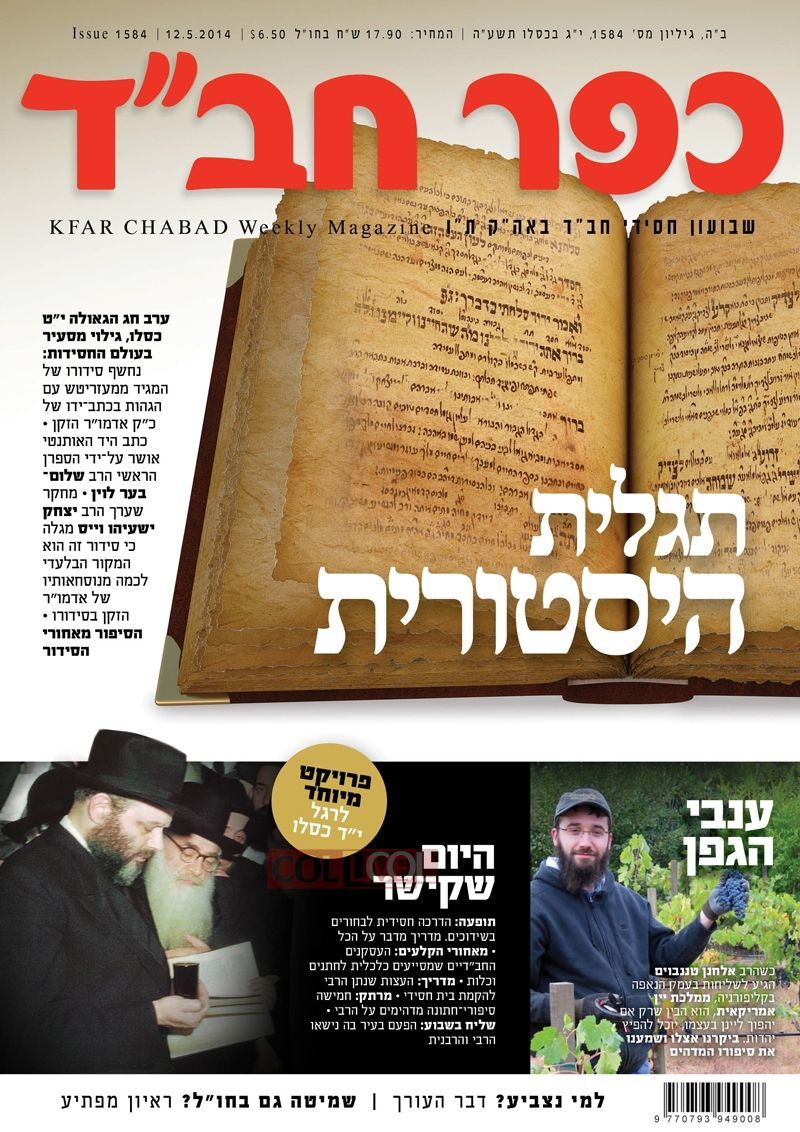
The prayer book that was used as the framework through which Chabad’s Tehillat Hashem was created close to 200 years ago will be displayed to the public for the first time next week.
The Jewish book fair Otzros Hachassidus being held next Motzoei Shabbos in the the International Convention Center in Jerusalem, commonly known as Binyenei HaUma, will be presenting the rare finding.
The siddur belonged to R’ DovBer, the Maggid of Mezeritch who was the second leader of the Chassidic movement and successor to Rabbi Yisrael Baal Shem Tov.
Upon his passing in 1772, the siddur was passed down as an inheritance to the Maggid’s son Rabbi Avraham HaMalach and later to the Rebbes of Ruzhin.
Writing in the Kfar Chabad Magazine this week, Rabbi Yitzchak Yeshaya Weiss of Bnei Brak said that the siddur is now held by a private person whose name wasn’t disclosed, but was willing to have it examined for handwritten notes on it.
According to the Maggid, there are as many as 13 Nuschaoth, forms, of prayer or Minhagim, customs of prayer. Each Nusach represents a tribe or “gate,” and Rabbi Yitzchak Luria (the “Arizal”) composed a “General Nusach-Gate” through which any Jew can enter into the presence of G‑d, Dr. Nissan Mindel writes in the book My Prayer.
When the Arizal arranged the siddur according to the Kabbalah, many communities adopted it, and a new series of Nusach Ari prayer books were printed, Dr. Mindel explains. At the time, printers were not always careful in the printing and errors were not uncommon.
The Maggid commissioned two of his disciples to create a corrected version: Rabbi Yisroel Hopstien, known as the Maggid of Kozhnitz and Rabbi Schneur Zalman of Liadi, the first Chabad Rebbe and author of the Tanya and Shulchan Aruch Harav.
“Since we know that the Maggid spoke to the Baal Hatanya about proofreading the siddur, we checked and conducted a comparison between the handwriting in the siddur (we found) and copies of the Baal Hatanya’s handwriting,” Rabbi Weiss writes.
“We indeed found that the handwriting in the siddur is remarkably similar to the writing of the Baal Hatanya,” he reported and noted that this opinion was supported by Rabbi Berel Levine, chief librarian of the Agudas Chassidei Chabad Library in Brooklyn, NY, and an expert on the Alter Rebbe’s teachings and works.
The full article about the findings of this historic siddur and differences found in the Alter Rebbe’s notes can be read in this week’s issue of the Kfar Chabad Magazine.



Chabad’s “Tehillat Hashem” was only printed in the ’30’s, IIRC. The correct titled should be “Nusach Ari al pi Admor Hazaken”; the Siddur called Torah Ohr certainly preceded Tehillat Hashem, as did Siddur Im Dach.
Will it be on display in the US?
I would be excited to see it!
I wish I could see it
If so, where? I’d love to just gaze at it. What a zchut to be able to see such a holy book.
Its amazing that we can see with our eyes a sidur of the Admor Hazaken…