
By Dovid Zaklikowski for COLlive and Hasidic Archives
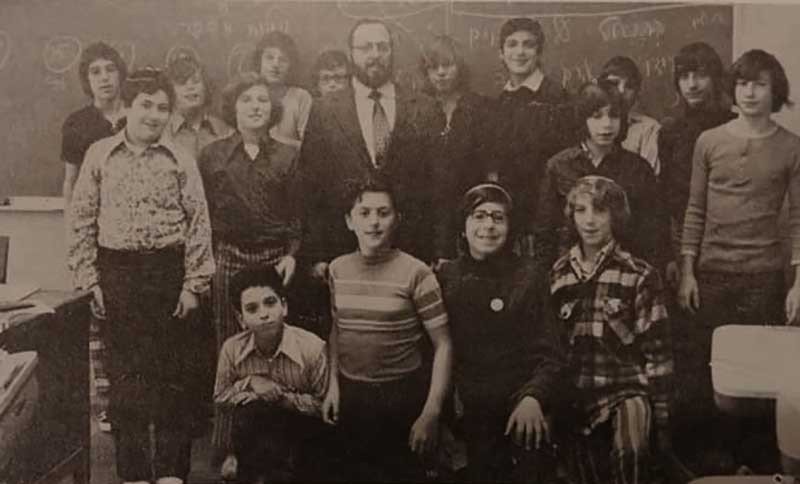
Shortly after his marriage, in 1954, Rabbi Abba Lerman moved to Pittsburgh, Pennsylvania, and got a job teaching in a Jewish school. He would spend the rest of his life in the classroom. A quiet, unassuming man, he saved his energy and drama for his students.
In 1962, Rabbi Lerman and his family moved to New Jersey, where he taught at the Yavneh Academy in Paramus. From there he moved to the Crown Heights neighborhood in Brooklyn, New York, and would travel from there to work. It was a turbulent time in the once affluent neighborhood. A wave of West Indian immigrants had sent Jewish residents fleeing; real estate prices crashed, and crime became rampant.
One evening in 1969, fourteen-year-old Avrohom Moshe Deitsch was walking down Montgomery Street, when three boys armed with crowbars and sticks descended on him. The began beating him savagely and didn’t demand money. Avrohom Moshe screamed at the top of his lungs, and used the lid of a garbage can as a makeshift shield. At first, no one responded to his calls for help.
The attackers began dragging their victim to the back of one of the houses to finish the “job” in privacy. There had been several murders in the neighborhood recently, and most residents would lock their doors and windows when they heard a ruckus outside.
Rabbi Lerman, who lived nearby, had just returned home after a long day of teaching in New Jersey. Hearing screams, he opened the window and saw the young boy with blood streaming down his face, obviously losing the fight with the group of thugs. The mild-mannered teacher ignored his instinct to shut the window and hide, and rushed out into the street.
Seeing new prey, the hoodlums left Avrohom Moshe alone and went after Rabbi Lerman. After circling a car, in front of the home, several times, a group of others had the courage to approach the attackers together and they ran away.
Avrohom Moshe had deep cuts on his face and head, but he was alive. Bloody and exhausted, he was brought to his home on Crown Street. His newly widowed mother Mirel Deitsch was first overwhelmed, then relieved to find that he was not seriously hurt.
To show her appreciation to the quiet teacher who had saved her son, for decades, Mrs. Deitsch sent him elaborate gifts of food every Purim. Rabbi Lerman, who would have preferred to forget the whole incident, was embarrassed by the attention. Finally, he begged her to stop, saying, “There really is no need!”
Find Hasidic Archives latest books on HasidicArchives.com Judaism in a Nutshell and The Edifice: Dating, Marriage and an Everlasting Home, also available on Amazon Prime.


Thanks for sharing
.
May we only experience happy and safe moments in our lives
Approached this situation like he approached teaching. He assessed what’s happening, and took the most successful course of action.