By Richard Weizel
For nearly 20 years Miriam Gutfeld, of Fort Lee, N.J., has spent summers in a Milford beach cottage, attending Sabbath services and observing Jewish high holy days that mark the ancient religion’s new year at the strikingly austere “Little Synagogue By the Sea” in Woodmont.
But Gutfeld, 66, is among the last of a vanishing breed.
One of the small number who regularly worships at the Hebrew Congregation of Woodmont during the summer, Gutfeld cherishes the cozy temple, but this year is unable to stick around for the holidays for the first time since she started attending in 1990.
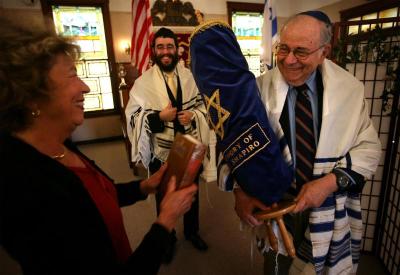
She did, however, stop by the synagogue last week to view its recently restored Torah, a holy scroll housed in every temple that is penned by hand in special Hebrew script on parchment.
She was also there to say goodbye until next summer to other congregation members and the new rabbi, who were making preparations for Rosh Hashanah services Monday night, Tuesday and Wednesday, and for Yom Kippur on Oct. 7 and 8.
“The high holy days are based on the Jewish calendar and are usually in early or mid-September, but don’t start this year until almost October and I have to get back home to New Jersey before the holidays,” said Gutfeld, who grew up on New York’s West Side in a religious family and finds the Orthodox services and customs at the Milford temple “quite comforting.
“I’m very sad about not being able to stay this year for the high holy days,” she said. “This is such an intimate, welcoming place and it’s become a tradition for me to be here for Rosh Hashanah and Yom Kippur. This year, the holidays really won’t be the same.” Not much at the 82-year-old temple is the same from even as recently as a few years ago.
With the passing of a growing number of worshippers who had attended summer services before returning home to places like Florida and New York after the holidays, long-time temple leaders such as Congregation President Joel Levitz were determined to find a way of keeping the congregation alive.
“We decided the best way to do that was to make the synagogue a year-round local temple,” Levitz said, “led by a new spiritual leader who could help revive the congregation.” That new leader is 26-year-old Rabbi Schneur Wilhelm, who grew up in Brooklyn within the Chabad Hasidic sect. While Wilhelm was among those who prayed at large gatherings with the revered Hasidic spiritual leader, Rebbe Manachem M. Schneerson, who died in 1994, he said the congregation is open to all Jews, not just the devout.
While it has held firm to its Orthodox roots and perhaps gone even a step further in its orthodoxy than before — installing a divider down the middle of the synagogue to create an “equal, but separate space” between men and women during services — it is not a Hasidic temple, and Wilhelm wants it known that “all Jews are welcome in our spiritual home.
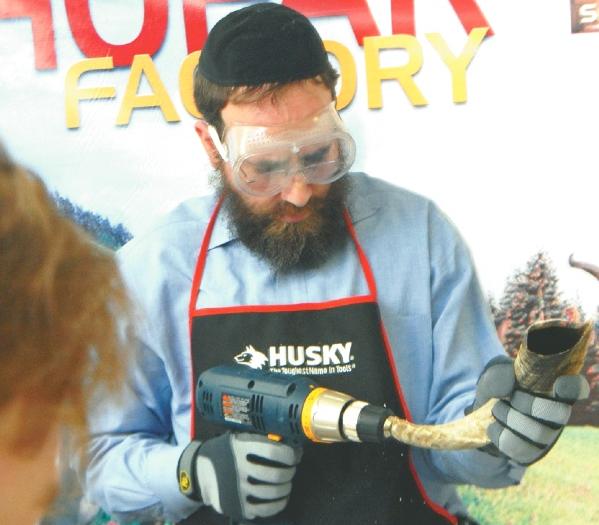
“From the moment I walked in I knew I was home, I felt such a connection here it felt like I had been part of this place since it was built in 1926,” Wilhelm said, standing inside the temple as he practiced blowing two Shofars (ram’s horns), an integral part of the Rosh Hashanah services that start Tuesday.
“I love the history here, you see it everywhere you look and I am determined to keep that spirit of the past alive,” Wilhem said, pointing to the stain glass window memorials with the names of members who have died. “We want Jews to know that no matter how religious, they are all welcome here as we look to build this congregation for the future.” Wilhelm said he envisions that future to include a blend of ancient customs and traditions with renewed vigor and energy to attract young families.
The rabbi, who with a long black beard and black hat, appears older than his 26 years, became a father for the first time a year ago on the day after Yom Kippur.
“My wife Chanie sat here in the synagogue a year ago praying all day, and then gave birth to our daughter Chaya the next day,” he said. “Now, what more could you ask from a good Jewish wife?” he joked. “She waited until my job was done to start our family.” Wilhelm said he’s also determined to create a new family of congregation members, while maintaining its colorful heritage.
Indeed, the synagogue appears frozen in time from another era.
Inside the small, strikingly simple building is a place where one could easily imagine seeing characters such as Teve from the fictional “Fiddler on the Roof” sitting on a wooden bench adorned with a prayer shawl and yarmulke covering his head, wistfully looking up to Heaven and singing to God, “If I Were a Rich Man.”
From the exterior, the 82-year-old building may appear worn, with chips of paint hanging from its exterior walls. But inside the white clapboard building, about the size of a one-room schoolhouse, is a place that seems to embrace those within its walls.
The stained-glass memorials, the Hebrew letter, the simple chairs and Star of David embroidered on a colorful cloth make the inside look and feel as though it could be any of the hundreds of small, austere European temples where, before the Holocaust, religious Jews gathered to pray.
But this simple white synagogue was established in 1926 as the Hebrew Congregation of Woodmont for Jews who went to the shore in Milford during the summer months.
Listed on the National Register of Historic Places in 1995, the synagogue is a piece of Jewish-American history, a vestige of the days when Woodmont was a summer colony.
Because Woodmont was open to Jewish settlement and not subject to anti-Semitism sometimes encountered elsewhere during that era, so many Jews came to the neighborhood that the stretch of sand across the street from the synagogue was known as “Bagel Beach” by the 1940s.
Jews from across the region — and from out of state — had summer homes there and worshiped at the synagogue, but the congregation had dwindled in recent decades until those who remained feared it might fade away.
It even functioned until about a year ago without a full-time rabbi, having part-time rabbis and congregation members leading services.
But long-time leaders of the congregation said they knew drastic action had to be taken to save the synagogue.
“As many of the older members died and younger members moved, it became increasingly difficult to get 10 men for the required minion [quorum] to hold prayer services, and at that point we realized we had to have a full-time spiritual leader to help bring in new members,” said Dr. David Fischer, 78, a retired oncologist who was president of the synagogue 14 years until 2006.
“If we hadn’t made that change it is likely we would not be having services at all, and be looking to sell off the assets,” Fischer said. “At least hope is now alive, with a very personable rabbi, and the community is very happy.” But Fischer and other long-time members say it won’t be easy, as the temple is not heated and estimates are that it will take a half-million dollars to winterize the building with heat and installation and that is likely to take years to raise the money. Until then, winter services are held in the rabbi’s home.
One member has been attending the synagogue since more than 70 years, and while not as religious as some others, said he is pleased the congregation now has a chance to survive.
“I tend not be as Orthodox and wasn’t in favor of the divider being put up when the rabbi came here, but he’s a wonderful person and has energized the synagogue,” said Richard Jacobs, 78, a lawyer who grew up in New Haven and spent summers with his family in a summer cottage in Woodmont, recalling attending the synagogue 70 years ago as a child.
Later, he became involved as an adult when he moved back to Milford.
“My father was part of it in the beginning back in the 1930s, I remember his being very involved in the early running of the synagogue,” Jacobs said.
“The big thing for us as kids was when the holidays came early in September we could stay at the beach where it was a lot more fun than going back home.
“Being so close to the beach is still so wonderful for a temple, and I hope it now can succeed as a year-round congregation.”
-Connecticut Post