
By COLlive reporter
Mazal Tov!
Odom Popper, a resident of Coral Springs, Florida, who was recently ordained as a rabbi and sofer stam, has succeeded in completing the entire Talmud Bavli – Shas.
It was a commitment he made 10 years ago in the merit of his grandfather who went on to live several more years. Odam then decided to continue with his studies, while simultaneously becoming, practicing and receiving smicha.
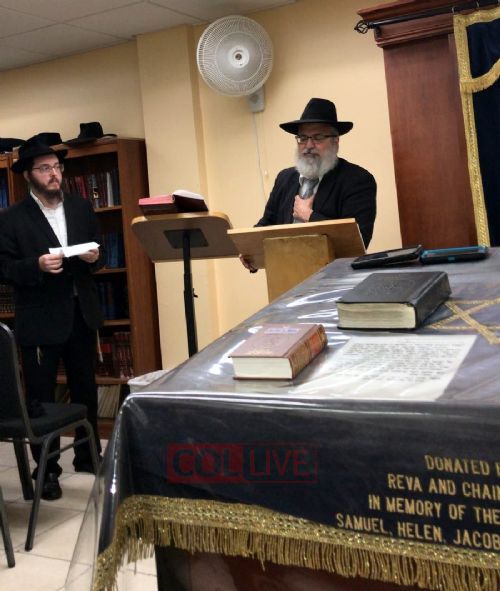
This rare ceremony was held at the Chabad Spanish Center of Coral Springs, Florida, and attended by congregants, family, and friends. A full meal was later served to commemorate the occasion.
Shliach Rabbi Mordechai Lichy said the center is very blessed to have been part of this event and wished Rabbi Odom much hatzlocha in all future endeavors.
Rabbi Popper expanded on how each seder of the oral Torah leads into the next in order to prepare a person for life in this world.
Here are his remarks at the siyum:
After raising the Torah we say the Pasuk of V’zos Hatorah. In the last 2 sentences, it says ” it lengthens days in the right in the left wealth and honor”. There are many reasons for a person not to learn. This passuk gives the 3 biggest reasons – it’s a long day, being preoccupied with making Parnosa, and with a reputation and social scene- what does a businessman have to do with a scholar? The Passuk continues the prayer of Hashem’s blessing Am Yisroel with Peace. How does this help?
When there is real peace, boundaries of social classes disappear – and businessmen support Torah scholars, people get along and suddenly the day isn’t so long as we first thought.
The completion of the Shas does not go without credit to my parents, teachers, family members, people whose sefarim I was able to borrow etc. and I thank each one of them immensely!
The Mishan starts out in Seder Zroi’m, Mesechas Brachos, – with the question, when do we read the Shema – which is the accepting the yolk of heaven? Answers the Mishnah – from when the Kohain goes to eat his Terumah.
The way we do this is by working on ourselves – Seder Zroim talks about farming- a task that needs to be worked on every day. Corresponding to this are out daily habits- chitas, Rambam, etc….
Then there are the periodicals, with Seder Moed, which talk about Shabbos, Sukkos, Pesach, things that don’t happen every day.
Next comes Seder Nashim – Having a wife and family- and in a broader aspect, relationships with other people after we have worked on ourselves.
Once we have brought someone else into our lives the concept of responsibility for our actions becomes very great and we must be very careful with others. This connects with Seder Nezikim.
Seder Kodshim – speaks about Karbonos, sacrifices. Through our Avodas Hashem it is inevitable that sacrifices are made. All sacrifices have a requirement to be –Leshma – for the sake of Heaven, to be done with the correct intent and focus. This too is a requirement of our daily actions – and even more – there are priorities that Korbanos should be given in. A Korban for Teshuvah will come before a Korban Olah – etc..We should not be discouraged when someone else is getting more attention. Hashem is in charge.
Finally, we have Seder Taharos – The concept of Tahor (purity) is not tangible, often depending on a person’s thoughts. In this past week’s special – Parshas Parah and the Parah Aduma – it says that Shlomo Hamelech could not figure it out. Parah Aduma is something that gives –Chassed (Kindness) – and specifically, a red cow symbolizing Gevurah (Strict Judgement) and with having this balance of Chessed and Gevurah – the middle path, an expression of divine will with can make something pure. Shlomo Hamelech, the wisest man couldn’t figure this out? The Royal throne was RED.
Sometimes we are too close to a situation and need another view from a Rav, Mashpia of Friend, or we could end up sitting on the answer.
Nidah – At times we are not in our purist state, and we have to remember to get up and become Tahor again. A deeper message for us – In life we constantly strive for a higher level, where our Tahor of yesterday is today’s Tamei –
Again we ask the question: when do we say shema? Only when the Kohain is tahor again.
When a siyum is made a kadish is said that is only recited at a funeral or when a masechta is finished.
What are we mourning at the special siyum – the part of us that said we couldn’t do it – and we weren’t good enough. May we all be blessed to achieve higher than we thought we could!

It’s very impressive !!
try it yourself…
Why is it so rare to accomplish this that it should make the news
Adam did a masterful job weaving lifecycle events with the names of each tractate. Very compelling. And a great big yasher koach!
Rabbi Popper I was so happy to read this and what you have accomplished. Im ecstatic to see that all of the efforts of our former days and investment is poaying off. May Hashem bless you and your family for continued brochos in a revealed manner.
M
What a talented guy! Obvioiusly a special neshama..It takes serious determination and discipline to finish even just one mesechta. Unreal. This is a certain step closer to greeting Moshiach.
Mazal Tov!! May Hashem bless you with all you desire and may you continue in your studies and be an inspiration.
beautiful wonderful work, you serve as inspiration to me and my family. we dont know you, but are very proud of you. keep it up! mchayil el chayil
Amazing, caring and loving Shluchim! Go Lichy’s!
I can’t wait until you finish Talmud Yerushalmi, Adam you’re an amazing inspiration, keep it up!!