

Researched and written by Shabi Soffer
As chassidim prepared to celebrate the Rebbe’s 90th birthday in 1992, a documentary crew — led by Emmy-winning director Jerry Levine — received special permission to follow the Rebbe for weeks, documenting the sichos, dollars, kuntreisim, tefillos and more. Their state-of-the-art cameras were like nothing ever seen before in 770, and the footage is some of the clearest that exists of our beloved Rebbe.
Though many segments featuring the material have been published through the years — now, some 30 years after it was filmed, the full-length footage has been published by JEM for the first time.
Background
The year was 1992, and the excitement was uncontainable. Aside from the famed Sunday dollars distribution that took place weekly, drawing thousands of people from all walks of life to share a brief moment with the Rebbe, nightly talks from the Rebbe were becoming a frequent occurrence, often followed by a distribution of dollars and, on special occasions, kuntreisim — booklets featuring Chassidic teachings.
These became such a frequent occurrence that in order to maintain the necessary supply of newly-minted dollar bills, Rabbi Yehuda Krinsky arranged frequent special deliveries to 770 from the Federal Reserve Bank in New York.

The Sunday Dollars line down Eastern Parkway, 1991, JEM.
A Farbrengen in the main shul of 770 was held every single Shabbos. After Shabbos, the sichos would be edited by the Rebbe himself and published weekly.
The Rebbe would speak on a wide range of topics: from the week’s Torah portion and the time of the year, to current events and headlines the world over. All of the talks were infused with Moshiach, as the Rebbe wove the age-old Jewish belief with current events, showing its relevance and importance in today’s modern world.
Add to this, the fact that the Rebbe’s 90th birthday was fast approaching. As early as two years prior the Rebbe had already begun alluding to the spiritual significance of reaching 90. In addition to the general excitement of a major milestone, as the date approached, the Rebbe made reference to it, greatly intensifying the anticipation and atmosphere around it.
Filming
The Rebbe’s secretary, Rabbi Yehuda Krinsky, organized the creation of a special film under the auspices of JEM, together with the Aleph Institute. Emmy-winning director Jerry Levine was brought on, and Rabbi Krinsky wrote in and received the Rebbe’s approval for the project, as well as permission for a crew to film in 770, to record close-up footage of the Rebbe himself for the program.
Levine, who had a background in producing documentaries, enthusiastically joined the project. “I was thinking, ‘Wow! What an amazing opportunity to get to film the Rebbe,’” said Levine in a recent interview.
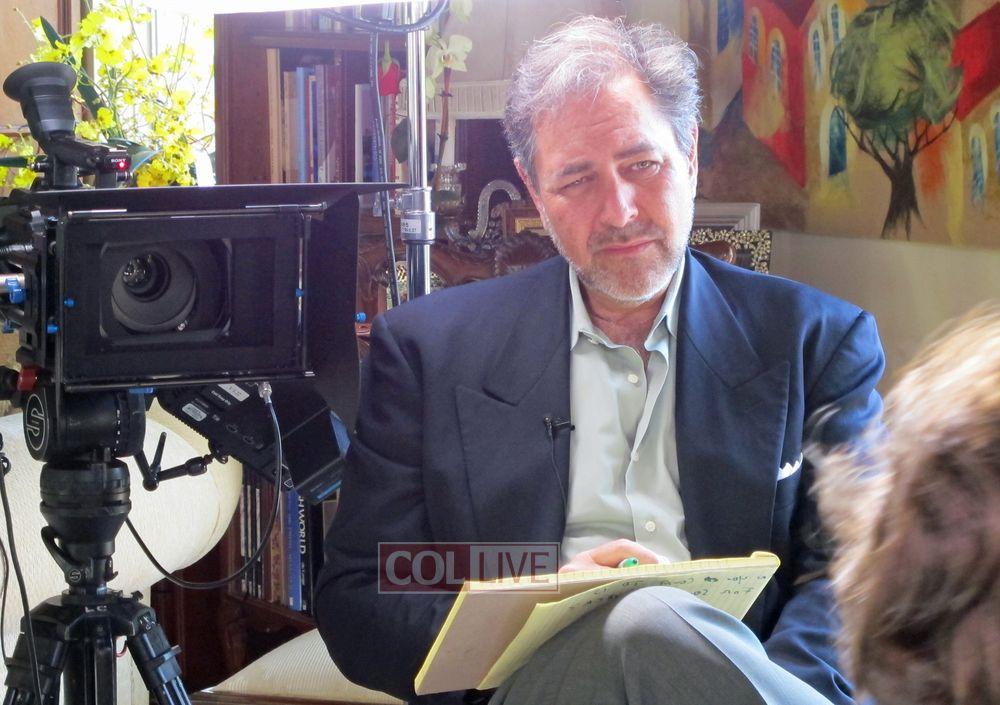
The film’s director, Jerry Levine, in recent years.
Once the Rebbe approved, Levine went about hiring a crew and began filming for the planned documentary about the Rebbe and Lubavitch. “We planned to film in Crown Heights, in the Soviet Union, in Australia,” he recalled. “We went to South Africa, to Italy, to France. We covered a lot of ground at that time, working with shluchim in those locations.”
Chaperoned by JEM’s director at the time, Rabbi Dovid Krinsky, the special access afforded to the crew allowed them to film unique recordings of a time period that was filled with special moments.
“When we started filming, we wanted to get these shots of the Rebbe walking in,” Levine recalled. “We stood fairly close to the Rebbe — we had gotten permission from Rabbi Krinsky — but we knew it would be a bit of a ‘culture shock.’ My cameraman, who had filmed in all kinds of urban environments, was actually scared. There were thousands of people — he wasn’t used to any of that. I remember that after he stood and took these great shots of the Rebbe, he was shaking — that’s how intense it was. For me, it was the opportunity of a lifetime.”
The filmmakers were there for hours of Sunday dollars on 21 Shevat, zooming in as the Rebbe spoke with the individuals passing by. The cameras also took “B-roll” footage of scenes surrounding dollars, like the line that snaked across downstairs 770 — footage we don’t often otherwise see. Uniquely, the Rebbe put a dollar on the lens as the cameras rolled (min 13:26).
“I remember the Rebbe giving me tzedakah — putting it in my hand, interacting with us,” said Levine. “What we were doing was different, and we understood that it wouldn’t be easy, but I knew the Rebbe was on board, and that’s all I needed.”
The crew was there as the Rebbe davened the tefillos at the amud on Yud Shevat and Chof Beis Shevat of that year, as well as at a regular Shacharis on 6 Adar I.
When the Rebbe visited the Ohel of the Frierdiker Rebbe on Yud Shevat, they were there as well.
They followed the Rebbe from when he exited 770 and gave out coins — including holding a coin out directly to the camera, and looking directly into the lens. Filming from the back of a pickup truck, they followed the Rebbe’s car until the Ohel, staying until late at night, long after everyone else had gone.
The footage shows the Rebbe alone, answering and reading letters, praying for the Jewish people. And the cameramen took unique footage of the Rebbe visiting his mother’s grave.
A short time later — still on his feet, and still fasting after a long day — the Rebbe would enter a packed 770 for Maariv and distribute dollars.
On the Eve of Yud Shevat, after hours of handing out kuntreism to thousands of people, the film crew captured a remarkable moment. As the Rebbe was leaving the room, the Rebbe asked all those standing near the exit if they had already received one, and continued to give them out, standing in place (13:08). Incredibly, this is something the Rebbe did after every time he distributed anything.
New York Times Magazine
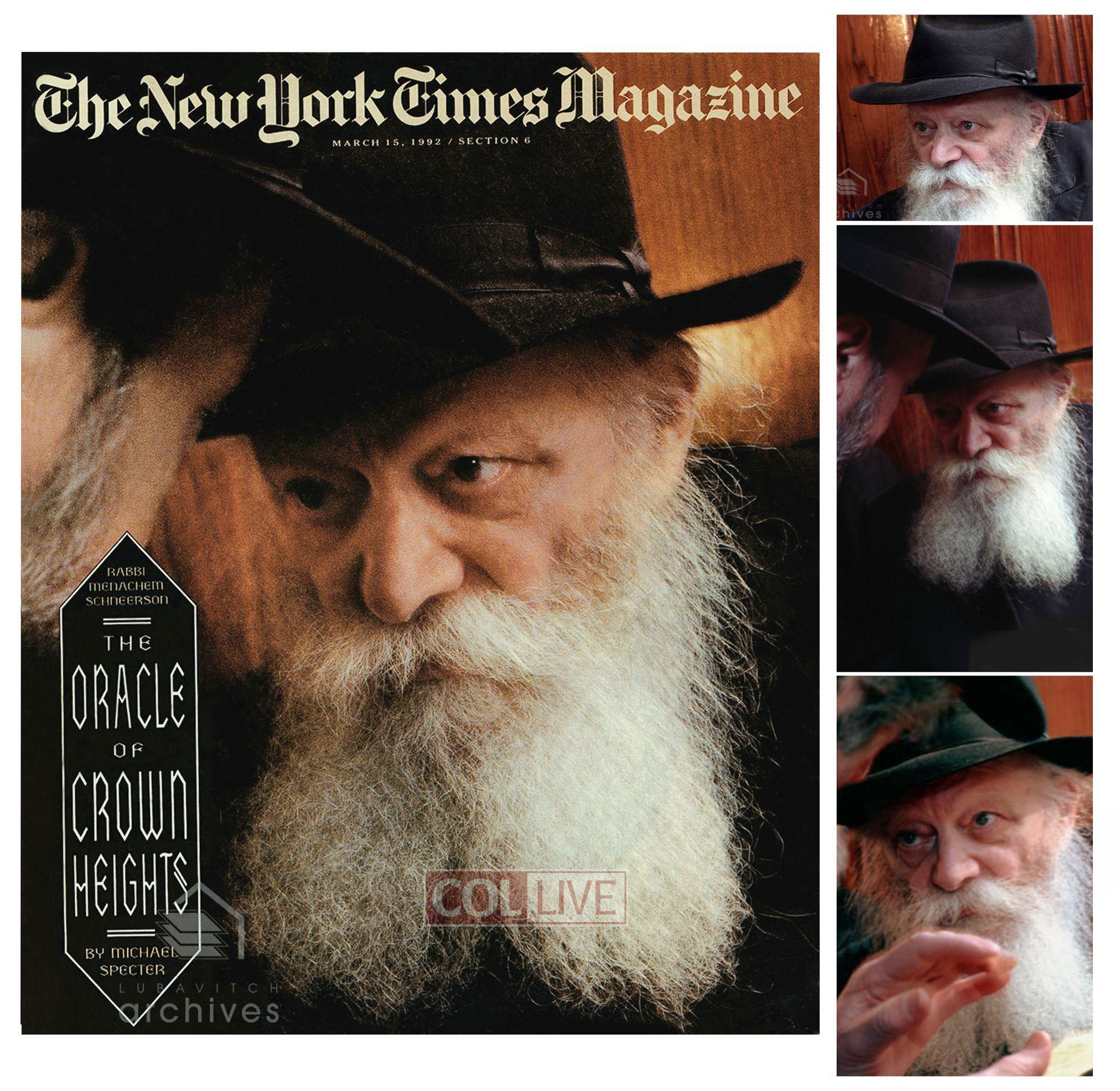
Over the same time period as the filming, the New York Times Magazine was working on an in-depth cover story on the Rebbe, marking his 90th birthday. Award-winning photojournalist Marc Asnin was sent on a two-month assignment by the New York Times to photograph the Rebbe for the piece.
Mark, led by Rabbi Zalman Shmotkin and Rabbi Yehuda Krinsky, received remarkable access as well.
On 22 Shevat that year thousands filled 770 to mark the 4th Yahrtzeit of Rebbetzin Chaya Mushka and the international Kinus Hashluchos. As Maariv came to an end, the Rebbe ascended the main dais in the packed shul to deliver a Sicha.
“All of a sudden the entire room was moving,” Asnin recalls, suddenly, everything stopped, the Rebbe was speaking.
It was then that Asnin captured what he would later refer to as the greatest of his career, a photo of the Rebbe delivering a Sicha, surrounded by Chassidim. “Though I did not understand what the Rebbe was saying, I felt deeply connected.”

Marc Asnin/Hasidic Archives
“At that moment I perceived the tremendous passion and depth of belief innate to Chabad ideals. No one was simply a spectator. The energy in 770 was palpable. The sparse furniture in the synagogue was irrelevant beside the pulsating spirituality that emerged during a Hassidic gathering.”
“It was overwhelming yet enthralling,” Asnin remarked, stating that although he was not religious and did not attend synagogue services, there was something unique and welcoming about the energy in 770, a feeling of unconditional love.
The photograph was used on the two page opening spread of the article, and years later was included in a book published by the New York Times Magazine that collected their all-time greatest photos. In addition, the cover photo taken that morning by the “Sunday dollars” distribution was chosen by the magazine as one of the “25 Most Memorable Covers” of the previous 100 years, in 1998.
It was this unforgettable experience and feeling of unconditional love that inspired Asnin to travel across the globe photographing Chabad houses for over a decade, and says he wants to be expressed in his upcoming book The Oracle, to be published by Hasidic Archives.
Marc Asnin/Hasidic Archives
After addressing the large crowd, the Rebbe again distributed a kuntres, and famously, this one was unique: it had a distinct light pink cover, by the Rebbe’s request, and was titled “Kovetz Chof Beis Shevat.” It contained talks and letters of the Rebbe regarding the unique role and special qualities of Jewish women, and was handed to each and every individual along with a five-dollar bill and a piece of lekach.
The Rebbe stood for many long hours until the entire crowd managed to pass by, eventually distributing by hand a total of over ten thousand booklets.
A Moment in Time — an Eternity of Inspiration
The video footage and more was intended to be used for a documentary to be aired as the world celebrated the Rebbe’s 90th birthday on 11 Nissan, 5752. But to our tremendous sorrow, that celebration was marred by the events of 27 Adar I, and the film was never completed as planned.
30 years later, as chassidim prepare to mark the Rebbe’s 120th birthday, JEM has released thousands of hours of raw footage, including these unique recordings, containing precious moments with the Rebbe in high-quality; moments which have been seen by precious few people until now.
Levine shared some of his thoughts on what it meant to him to film the Rebbe, and to be in the Rebbe’s presence during this extraordinary time.
“I knew we were doing something that would be historically significant,” said Levine. “I don’t think any crew had ever gotten this close to the Rebbe before, and I didn’t think any crew would get this close again.”
“I think we captured the Rebbe at a very important moment in time. The Rebbe was in the fullness of his glory as a Jewish leader; in all his vibrancy, all his expressions. I think those moments are precious for that reason.
As a journalist I have been around a lot of very important people; the President of the United States, the Secretary of State, and other world leaders. But being around the Rebbe was something totally different. Because you feel the spirituality, and the depth of the trail of history that he represents. You feel elevated when you’re around him. Like you’re transcending time and space in that moment.
There’s no environment I’ve ever experienced that was like 770. There’s no synagogue in the world where you will see that and feel that.
That’s something that people who are younger have missed, and this footage, I believe, can bring that experience to them — as best we can. The Rebbe wanted us to use technology. It’s important that people know that: this is something the Rebbe wanted to share, and we were honored to be the nexus for documenting it; that was very special.
It was very eye-opening to me as a journalist to see a man at the Rebbe’s age to have the patience he had, to be able to stand that long, to be able to interact with that many people; that’s really extraordinary. The Rebbe was an extraordinarily dedicated man and he was selfless; that’s something I really felt; I felt that to spend this much time with this many people is a selfless act. When you realize how little he sleeps and how much time he spends with the Jewish people, you realize that there is no other Jewish leader like this. Celebrities want people to pay attention to them. The Rebbe was the opposite — he didn’t want the attention; he wanted to pay attention to you.
Everything about being around him was grounding for a person, it made you think about what was important in life, because his selflessness was so profound, and that had an impact on me.
When my children were growing up, a lot of their friends had posters of famous baseball players or famous rock stars. We had pictures of the Rebbe. Because if you want a hero figure that you want your child to grow up with, why shouldn’t it be a person who is a selfless Jewish leader. That for me was the epitome of what I wanted my children to grow up with.
30 Years Later
Rabbi Elkanah Shmotkin, director of Jewish Educational Media, shared his memories of the filming and his thoughts on the release of the footage, 30 years later.
“I remember very distinctly the crew filming at 770. There were times during Davening when they were mere inches away from the Rebbe’s face, and all of the bochurim felt incredibly uncomfortable — we felt like the Rebbe’s personal space was being invaded and it was too close for comfort.
“But the Rebbe allowed it,” continued Rabbi Shmotkin. “And I have no doubt he knew how much these scenes would mean to us today. And when we look at them today, not only are they unmatched in their clarity, but we can also experience incredible closeness. The scenes are extremely unique and intimate.”
According to Rabbi Shmotkin, there are other ways in which one can see the Rebbe was looking ahead, embedding a message into the videos for Chassidim today. He points to several instances where the Rebbe engages not only the cameraman, but the camera itself. “When the Rebbe looks straight into the camera and places a dollar on the lens, the Rebbe is interacting with every person watching today. He’s saying ‘I am with you, I am looking at you, and giving you this dollar bill’.”

Various instances where the Rebbe can be seen interacting with the camera.
When asking Hashem to appoint a successor, Moshe Rabbeinu beseeches Hashem,
יפקד ה’…איש על־העדה אשר־יצא לפניהם וַאשר יבא לפניהם ואשר יוציאם ואשר יביאם
“Appoint a man… who will go forth before them and come before them, who will lead them out and bring them in, so Hashem’s children will not be like sheep without a shepherd.”
“Watching these recordings can give you a small glimpse of the Rebbe giving himself totally, for us and to be with us. Just shy of 90 years old, the Rebbe is spending entire days and nights standing in the cold, coming, going, speaking, teaching, advising, and praying on behalf of the Jewish people, living his leadership 24 hours a day.”
As we celebrate the Rebbe’s 120th birthday, may these scenes inspire us to reciprocate the Rebbe’s kindness and strengthen our connection to the Rebbe. We look forward to Moshiach’s coming very soon when we’ll be reunited with the Rebbe, and we’ll be filming live once again.
—–
The highlights included in this article are only a preview of this special collection, to see these films in full quality and length, visit: Jem.tv



Is there a way to download or purchase these images without any watermarks?
The difference in quality between WLCC & this documentary is astounding!!
The kuntreism videos are out of this world!
The way the Rebbe interacts with every single person, waving the kuntreisim in front of babies eyes to get their attention. Incredible!
This really brought me back to those times, thank you for sharing this
The footage of by the Ohel is very unique, so chilling to see the Rebbe alone at the Ohel
Does anyone know what the Rebbe is saying at Rebbetzin Chana’s kever?
How can I get the full video of the rebbe davenning?
There was so many things going on back then, it’s hard for people who weren’t there to understand but our lives revolved around the Rebbe, we spent hours of our time running back and forth to and from 770 , standing on lines for hours, 770 was our home base. Speaking for myself here, but I feel like as much as we were there, we took all of this for granted… Watching the Rebbe hand out booklets for hours, booklets that I still have, made me think about what that actually meant, especially realizing now that the Rebbe was much… Read more »
Took the words out of my mouth. It wasn’t just a part of life, it WAS our life
Would love to see more of the photographer’s photos, very interesting stuff
Lubavitch archives has been working on an album book with him I think
We need more detailed articles like this
These videos are so precious and touching to see
Thank you so much for sharing these treasures.