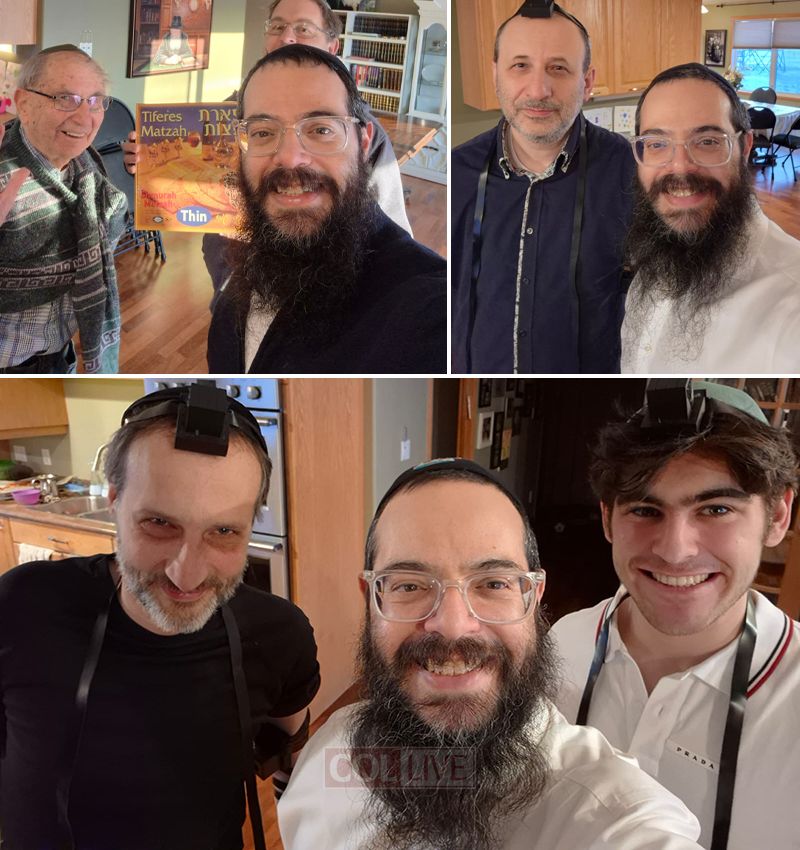
Rabbi Raphael and Sarah Kats, Chabad of Saskatoon, Saskatchewan, Canada
DOWNLOAD PDF
By: Chaya Chazan
It was perhaps the fact that both my wife’s family and I discovered Chabad and chose it for ourselves on our own that made us so determined to strike out on shlichus, almost immediately after our wedding in 2006.
My father-in-law went to Yeshivas Hadar Hatorah on a dare, but found he loved it and stayed. My route was a little more circuitous. My family was traditional and respectful of Torah-true Yidden, but we didn’t keep many of the mitzvos. At 16, NCSY volunteers inspired me to take the plunge and commit to a Torah life. A few years later, I discovered Chabad, and chose that as my path. I switched to a Chabad yeshiva, and finished my education in the Chabad system.
While both my wife and I were excited by the prospect of shlichus, we felt starting a Chabad house in uncharted territory was too intimidating. However, after a few years of fruitless efforts, we realized that would be our only way forward.
We spread a map on the kitchen table and poured over it. There weren’t many areas without a shliach, but, as a native Torontonian, my eye was drawn toward the “Wild West” of Canada. Quebec and Ontario had plenty of shluchim, but what about Alberta? Manitoba? Or – Saskatchewan?
Excited, I called Rabbi Altein, the head shliach of Manitoba and Saskachewan. He admitted there was no shliach in Saskatchewan, but wasn’t sure how feasible it would be. Undeterred, I called the main Merkos office and convinced Rabbi Kotlarsky, A”H, to send me there on “Merkos shlichus” with another bochur. Although Merkos shlichus is reserved exclusively for unmarried bochurim, Rabbi Kotlarsky agreed to this exception.
We visited Saskatchewan twice, each time visiting Regina, the capital, as well as Saskatoon. Both had potential, and we weren’t sure which city would be the better choice.
We kept our research quiet, choosing not to inform our friends until we knew for sure. It was around that time that I hosted a farbrengen in my Crown Heights apartment. I asked Rabbi Yossel Katzman, a well-known figure and organizer in Chabad, to speak at the farbrengen. I gave him no specific direction or instruction, but he chose to discuss the need for young couples to go on shlichus in small cities and communities. Instead of using the colloquial, “Yehupitz,” or even “Timbuktu,” Rabbi Katzman used “Saskatchewan” as an example of a far-flung outpost.
It was hashgacha pratis too pointed to ignore, and it made us sit up and take notice.
Greg*, a businessman we met through the shliach in Edmonton, Alberta, offered us a basement apartment in Saskatoon, rent free. I pushed my luck and asked if we could have two adjoining apartments and knock down the wall between them. Greg agreed without hesitation. Then Eddy*, an auto body shop owner we’d met in Saskatoon, offered us a car if we moved there.
We took these as signs that our mission awaited us in Saskatoon, Saskatchewan.
—————-
With our car and apartment already taken care of, much of our financial stress was diminished. As our community and activities grew, we knew we’d need our own proper building eventually, but relegated that discussion for a time much later on.
A few years later, Greg sold the property, and the new owner wasn’t willing to keep giving us two sizable apartments for free. We took that as our sign to scale up our Chabad house and look for a building of our own.
We weren’t just looking for any house or property. It needed to be big enough to house our growing family, a shul and community events, and a mikvah as well. For years, we’d been using the closest mikvah in Edmonton, but it was a six-hour drive each way, and in Canadian winters, the roads were often icy and impassable. It was time for Saskatoon to have its very own mikvah.
Amazingly, we found a five-acre property right at the edge of the city, although such large tracts of land can usually only be found in the suburbs. There was already a house on site, and it didn’t even need renovations to suit our needs!
We joined six other shluchim in remote areas for a joint mikvah fundraiser. Baruch Hashem, we managed to raise the funds, and now have a beautiful mikvah right in our backyard that is utilized by women in the community, travelers, and even occasionally other shluchim.
We also have a large flock of free-range chickens, which provide us with dozens of eggs every day. We sell the eggs, or gift them to community members. We also keep a beehive where we make and collect our own honey.
—————–
“Hello. My name is Mary*,” said the hesitant voice on the phone. “I have a bit of a strange request…”
“Go for it!” I encouraged her. “I’d love to help if I can.”
“I’m calling on behalf of my sister, Celia* who lives in Regina,” Mary explained. “Her husband of 30 years just passed.”
“I’m sorry for your loss.”
“Thank you.” Mary cleared her throat and continued. “Before my brother-in-law passed, he asked Celia to bury him in a rural area in Saskatchewan – and he also asked to be buried in a pine box.”
“Interesting,” I broke in. “Having a plain pine coffin is actually a Jewish tradition-”
“Exactly!” Mary’s voice rose with excitement. “Both Celia and I thought it was a strangely singular request, so we Googled it. When we saw it was a Jewish custom, we started to think maybe Scott was Jewish. We did a little genealogical digging and found that Scott was Jewish! Celia was shocked! In all their decades of marriage, he’d never once mentioned anything about it.”
“That’s fascinating! I’m actually a bit of a genealogy nut myself, so I’d like to research the family tree a bit. Can you give me some basic information?”
With Mary’s approval, I found incontrovertible proof of Scott’s Jewish legacy. In fact, his family were members of the shul in which Sarah and I got married!
I spoke with Scott’s widow, Celia, and excitedly shared my findings. She exclaimed over the connection, and even heard me out as I explained the importance and significance of a Jewish burial.
“That sounds meaningful and lovely,” she replied. “I’d love to honor Scott’s Jewish background. But, to be perfectly frank, my bigger priority are his two express wishes. I know the pine box won’t conflict with the laws of a Jewish burial, but it was very important for him to be buried in rural Saskatchewan. I already found a cemetery I know he would love, and the funeral home already has his body and has begun preparations. If you can just make the ceremony Jewish, that would be enough.”
“It would be a start,” I answered, diplomatically. “I believe with all my heart that Scott’s soul wants a proper Jewish burial. What are the chances that the rabbi in Saskatoon got married in the same synagogue he attended as a boy? It’s a clear sign from G-d! I’m going to consult with some colleagues and get back to you. Maybe there’s still time.”
After asking a rav well versed in these matters, I called Celia with a suggestion: “If you can buy the burial plots around your husband’s, we can fence it off and create an ad-hoc Jewish section in the cemetery.”
Celia had no problem with that; the cemetery administrator, unfortunately, did.
At this point, Rabbi Simmonds, the shliach in Regina, and I were determined to find a solution.
After more research and digging, I found Lipton, Saskatchewan. A relic of the homesteading communities that swept across Western Canada at the turn of the century, Lipton had once been home to a small, but steadfast, Jewish community. The cemetery was still in service, although they hadn’t had a kevurah for over fifty years.
“I found it!” I told Rabbi Simmonds, my words almost tripping over themselves. “There’s a perfect Jewish cemetery in -”
“-Lipton!” we both said together.
“How did you know?” I asked, stupefied.
“I’ve been researching as well!” Rabbi Simmonds laughed. “I just found out about Lipton, and I was about to call you!”
A short while later, I got a text from Celia. There’s a small Jewish cemetery in a rural hamlet called Lipton. I think that would be perfect.
There were a thousand details to arrange, but the incredible hashgacha pratis that had brought us this far kept us energized through it all. We started a crowdfunding effort to raise the amount necessary to cover all funeral expenses. Everyone who heard the story was inspired to take part in this eternal and altruistic mitzvah, and the fundraiser was a success.
Rabbi Simmonds’ nephews made the six-hour drive from Winnipeg to help with the taharah. They drove another three hours to the funeral home where Scott’s body was being kept, and then another three to Lipton.
In an inspiring collaboration between shluchim across the territory, Scott was finally laid to rest in rural Saskatchewan, in a pine box, and, most importantly, with a proper kevuras Yisroel.
——————–
I first met David* in Costco, where he was working the meat counter. He was Israeli, and a proud Jew. Although he was married to an indigenous woman and lived on her reservation an hour north of Saskatoon, he was excited to meet me and became very involved in the community. He often attended programs and shiurim despite the distance.
One day, David called and confided that he’d been having a lot of trouble in his marriage of late. It had reached the point where they mutually decided to separate and take some time away from each other.
“I’m sorry to hear that, David. How can I help?” I asked.
“Would you be able to pick me up and find me a place to stay for a short while?” he asked.
“Of course!” I replied.
A couple of days later, when David and I were heading back down south to Saskatoon, he told me he had a crazy story to share.
“Nu?” I prompted him.
“Did I ever tell you how I landed in Saskatoon?” he prefaced his story.
I shook my head.
“You know those Israeli kiosk vendors, who sell Dead Sea products?”
I nodded with a little smirk.
“That was me,” David explained. “I came here with my fiance, and we were running a skin care kiosk in the mall. Then, one day, seemingly out of the blue, she told me she couldn’t see a future for us anymore, and she wanted to return to Israel. I was blindsided and heartbroken, but a while later, I met my wife, and almost forgot all about Michal*.
“Just this morning, I got a call – from Michal! I’d never expected to hear from her again, and I was shocked to hear her voice. She told me she was chozer b’tshuvah, but hadn’t yet found her shidduch. Her shliach told her the advice the Rebbe gave to many people in the same circumstances: to think of any previous relationships she may have hurt or disappointed from whom she needed to ask for forgiveness. Of course, she immediately thought of me. I told her I forgave her, and that was it.
“Can you believe that, Rabbi? On the very day that the Rebbe’s shliach is helping me leave my non-Jewish wife, the Rebbe sent my ex-fiance back into my life!”
Although the separation between David and his wife wasn’t final, I learned I am a cog in the Rebbe’s machine. The Rebbe’s role is the ever faithful shepherd, who chases after even the most wayward lamb and tries to bring them home.
*Names changed to protect privacy