
Rabbi Aryeh and Leah Lang, Chabad of Camarillo, Camarillo, CA
By: Chaya Chazan
When I was a young boy, living in Florida, my parents asked the Rebbe if they should move to Crown Heights to provide me with a more robust Jewish education. The Rebbe agreed, and our family moved to New York. Growing up in an environment so richly steeped in chassidishkeit was an invaluable gift. I was able to attend many farbrengens, and formed close connections with the greatest mashpiim of our day. These experiences shaped who I am and directly influenced my ambition of joining the privileged ranks of the Rebbe’s shluchim.
——————
Before we moved to Camarillo, my father gave me great advice: join the chamber of commerce, since it was a great place to meet Jews. It was there that I met Mr. Stan Daily, a longstanding, founding member of the community, mayor emeritus, and the eponymous inspiration for the main street. He became a great friend, so when someone donated a Torah to our shul, I asked him to speak at the celebration.
Mr. Daily was so friendly and accommodating, I then asked him for help in another area.
We’d been in Camarillo for over a year, working out of our home, and were looking for a commercial property to host our Chabad house. Camarillo is a planned city, with blocks of residential homes carefully disbursed amongst conveniently located strip malls. One mall in particular seemed an especially good choice for our Chabad house, since it was near Leisure Village, a large senior housing community, and would attract a lot of foot traffic.
One morning, I drove to the shopping center and saw a man standing nearby. In his formal suit and tie, he stood in stark contrast to the more casually dressed passersby all around him. I introduced myself and he, in turn, told me he owned the shopping center. He asked me what brought me there, and I explained that I was opening a synagogue.
The man – clearly a Jew himself – looked at me with a scornfully cocked eyebrow. “A synagogue in Camarillo? This is Goyimsville! I can count the Jews I know on one hand!” he told me.
Undeterred, I answered. “Honestly, I’m really happy to have met you. We were hoping to use one of your properties for our new Chabad house, and I wondered if -”
“No,” he interrupted me. “It won’t work. There’s not enough parking to satisfy city ordinances about places of worship… It’s not a good idea.”
I was disheartened by his vehement and outright refusal, but hoped Mr. Daily might be able to help. I explained everything to him, and he chuckled.
“Oh, Larry*? Yeah, don’t worry about him. He’s a good friend! We sit on the board of the directors of the chamber of commerce together. I’ll bring it up at our next meeting.”
A few days later, Larry let me know that the storefront was mine if I wanted it, with no more red tape to break through.
All at once, Chabad of Camarillo had a home – one we’re still enjoying to this day!
During a follow up conversation with Mayor Daily, he made it clear to me why he had a soft spot for the Jewish people. He’d shared that, in the late 19th century, his family was trying to buy a ranch, and needed a loan. The loan was given by Mr. Achille Levi, with the shake of a hand, and no paperwork.
Years later, when asking Mr. Levi why he gave such a young farmer a loan like that without any documents, he was told Mr. Levi used to hitch his horse and wagon at 5am, and see whose light was on at 4am. Your light was always on, so I knew you were a hard worker.
After thinking about this, it struck me the far-reaching power of a Mitzvah! This loan given by a Jew over a hundred years before had directly helped us find a Chabad house in Camarillo today!
——————–
It’s not often that we’re granted the clarity to see how a yeridah – a setback – can lead to an aliyah – improvement.
In 2007, we were still young shluchim, trying to balance the demanding load of a growing family and community. Then, tragedy struck.
My in-laws, Zev and Rochel Simon AH, were on their way to a wedding, when a horrific car accident claimed both their lives. We were devastated by the double loss, especially since my wife had eight younger siblings still living at home. A few months later, we were blessed with the arrival of a baby boy, whom we tearfully named for his recently departed grandfather.
But little Zev required all of our energy and time. He was born with hyperinsulinemia, where his body’s overproduction of insulin put his life at risk constantly.
With the limited resources we had being pulled in so many different directions, we knew we had to make some important decisions. It was difficult, but we decided to hire another couple to care for our community, while we concentrated on our family’s health and mental wellbeing. Rabbi Yosef and Shira Muchnik were an incredible addition to our community, relieving us of our responsibilities with so much grace and understanding, we knew our community would be in good hands.
We cherished the gift they gave us, allowing us to focus on our family’s needs until we were ready to shoulder responsibility for the community once more. The Muchniks were part of our family by then, and we knew we had to keep them on. A city like Camarillo may not have had a second pair of shluchim quite so early on, but the special circumstances surrounding their arrival was a bracha in disguise. The challenges we faced effectively allowed us to double our impact in the community with twice the amount of shluchim!
Rabbi Yosef brings renewed life, joy, and care to seniors in our area, while Rebbetzin Shira heads the preschool that attracts children from all the surrounding communities. The tragedies and yeridah we experienced in our personal lives accomplished an aliyah for the entire city.
————————-
The first months of Zev’s life were spent shuttling to and from the hospital, learning to care for his condition. When we found a regimen that worked, we thought the worst was behind us.
“He’s severely autistic,” the doctors told us just a couple of years later. “He’ll never learn beyond the understanding of an 18 month old toddler.”
We refused to accept such a dim prognosis. We never gave up hope and continued searching for new, innovative solutions. Year after year, Zev was still not speaking, and the hours and hours of speech therapy, ABA therapy, and diet changes had little to no impact. We always knew Zev understood much more than he was able to show.
As he reached Bar Mitzvah, we decided to try something completely different. The mainstream therapies weren’t working, and a few people had suggested Typing to Communicate. When we found out there was a practitioner close by, we were optimistic. Maybe it would give our non-verbal teen a way to express himself?
It succeeded beyond our wildest dreams. Once Zev understood how to navigate the system, he unleashed a storm of words that testified to the sensitive, astute, and intelligent person he was.
“Moshe Rabbeinu couldn’t speak properly,” he wrote in one of his earliest messages to us. “And yet, he managed to be the greatest leader our nation has ever seen. My mission in this world is not to speak; it’s to hear Hashem’s message to me.”
From then on, Zev regularly churned out divrei Torah – thought-provoking, analytical tidbits, relevant to current events. We compiled many of these into a book, which we gave out at our elder daughter’s wedding. I also posted his stirring speeches on a chat with other shluchim. His poignant words, I’m autistic, and I’m working on my impulse control. This Rosh Hashanah, what will you be working on? were shared with many of their congregations during the Yomim Noraim.
Zev has a special neshama – that much is clear within a few minutes of meeting him. He loves doing mitzvos, especially tefillin. He kisses them over and over, and often goes around shul, kissing other people’s tefillin as well.
I once asked him why he did that.
“I can feel the transference of kedusha when I kiss the tefillin,” he typed back.
After October 7, Zev wrote a fiery response to the harrowing tragedy: Don’t be afraid to show your Jewishness. I am proud to walk around as an Orthodox Jew. The loudness of their hatred is not as loud as the song of our prayers.
—————————–
Zev’s unique challenges and approach to life help us reach people in ways that would never otherwise be possible.
We were rushing to the airport to make a very important flight to New York. Zev was going to Camp Hasc, another son was going to camp as well, and my 12-year-old was going to celebrate his hanachas tefillin in 770. We nervously watched the GPS arrival time, knowing we’d be cutting it close.
We dashed into the terminal with just enough time to spare, but some technical difficulties at the kiosk delayed us and wouldn’t allow us to check in our baggage. The customer service representatives were unsympathetic and only reiterated that they’d rebook us on the next available flight the following morning. My son was in tears at the thought that he’d miss his hanachas tefillin, and we were all feeling incredibly frustrated.
Hashem, I know there’s a reason we had to miss this flight, I thought to myself. Please help me see the hashgacha pratis. It’s a bitter disappointment, so the silver lining would sure make it easier!
We booked a hotel and stayed the night. That was the first gift of revealed hashgacha pratis. We realized we’d left some important things at home, and my wife was able to bring them to our hotel.
Baruch Hashem, we made our flight the next morning without any major hiccups. As we made our way to baggage claim upon arriving in New York, Zev came face-to-face with one of his greatest temptations: a man casually enjoying an open bag of chips. The impulse to enjoy the crispy goodness was too strong for Zev to fight, and he lunged for the clueless passerby. I pulled him back, hurriedly explaining to the confused man about Zev’s condition. The man was understanding, and a sudden inkling pushed me to ask, “Are you Jewish?”
“Yes,” he answered. “My name is Bruce*.”
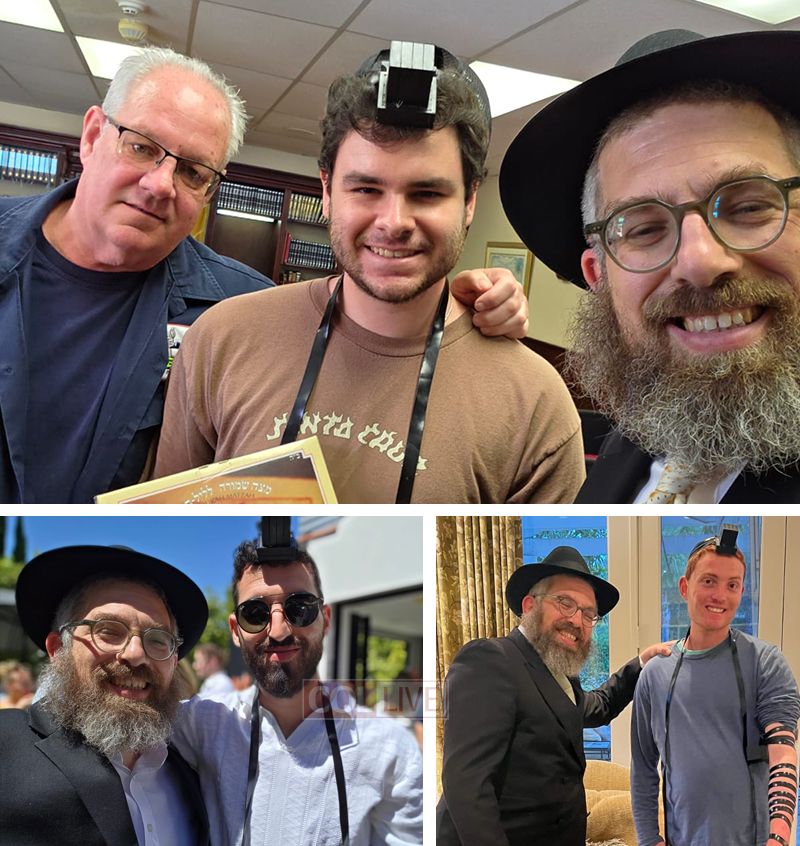
“Let’s put on tefillin!” I suggested. Bruce agreed. We snapped a selfie, and chatted about our respective backgrounds. When he heard I was a rabbi near LA, he told me he knew one other Jewish person in LA – an influencer and comedian named Menachem Kashani. Although I didn’t know him, we parted with friendly goodbyes.
Because of the delayed flight, we ended up doing our son’s hanochas tefillin the following day, which allowed for more relatives to attend. After the celebration, I dropped off each of my sons in their respective camps. On my return flight, I was seated next to a Jew with a yarmulkah.
“Sholom aleichem,” I greeted him. “What’s your name?”
“Menachem Kashani,” he replied.
My jaw dropped. “I have regards for you!” I exclaimed. I quickly pulled up the selfie I’d taken with Bruce just the day before and showed it to him.
“That’s amazing!” he said. “I know Bruce well! I’m going to tell him that we met!”
Upon landing in LA, Menachem Facetimed Bruce. “Look who I’ve been sitting next to for the last six hours!” he said, turning the screen towards me. We all got a good laugh!
Months later, Menachem texted me with an update: Bruce had been inspired to continue putting on tefillin. He now owns a set of tefillin of his own, and wears them regularly.
All thanks to Zev and his uninhibited love of chips!
——————–
We were trying to treat Zev’s condition with a new and revolutionary medication that would help him control his blood sugar without needing to remove his pancreas. The only issue was that, since it was a novel treatment, the only hospital that could treat him was in Philadelphia. HSince he needed shots once a month, so we found ourselves flying across the country very often.
On one of those flights, the time came for Zev to receive his medication. I knew he’d be resistant, and that he was deceptively strong, so I turned to my seatmate and asked him to help me hold Zev so the shot could be administered safely. The man seemed unfazed by my unusual request, and soon the job was complete.
I thanked him for his help and asked if he was Jewish.
“Yes,” he answered. “My brother and mother are sitting just a few rows back. Want to meet them?”
I was delighted to meet the rest of the family. I learned that their mother had brought them up as Christians. They didn’t know anything about Yiddishkeit, and had never put on tefillin before. Of course, I was happy to remedy that situation, and we celebrated their bar mitzvahs thousands of miles up in the air.
————————-
We try to show our community how Tanya and Chasssidus is the blueprint for life; how it holds the answers to all of life’s most challenging moments. What has proven this, far more than the classes we give, is the living example my wife embodies every day. Everyone here knows the tragic story of how she lost both her parents so suddenly, and at such a young age. I, and they, have watched in amazement how my wife has handled her grief with majesty, using it as an impetus for growth, rather than something to drown in.
When she snipped the ribbon at the dedication of our preschool, with her parents’ names proudly parading the perimeter, there wasn’t a dry eye in the audience. She is an inspiration to many, and I know that her parents are receiving endless nachas from her.
————————
As part of our drug prevention program, we received a government grant to pilot a program in schools that teach students to self reflect. We adopted the Rebbe’s “Moment of Silence,” calling it “The Quiet Moment.” Students are encouraged to use those 60 seconds before beginning their day at school to think about their overall goals and how they will use their education to fulfill their purpose.
The program was wildly successful. The teacher told us how much her students loved it and reminded her about it if she ever forgot. The students were asked to write an essay about how The Quiet Moment hads changed things for them, and the results were overwhelming! One student claimed that The Quiet Moment had helped him focus and turn his grades from F“F”s to A“A”s! Other students reported lower stress levels and anxiety, feeling more safe, and overall optimism. The three top entries were honored in a ceremony at City Hall.
We’re working closely with other shluchim to have this program adapted in all California public schools. We hope all our senators and lawmakers will see the incredible impact just 60 seconds each day can make.
*Names changed to protect privacy

Heart to heart stories incredibly touching. Feeling privileged to be part of your shlichus by
being chosen to take care of your communities Safrus needs.
Sofer Avrohom Dovid and Yehudis Wolffe