
By Leah Meisel, Mishpacha
Translted by Ezra Reichman, VIN News
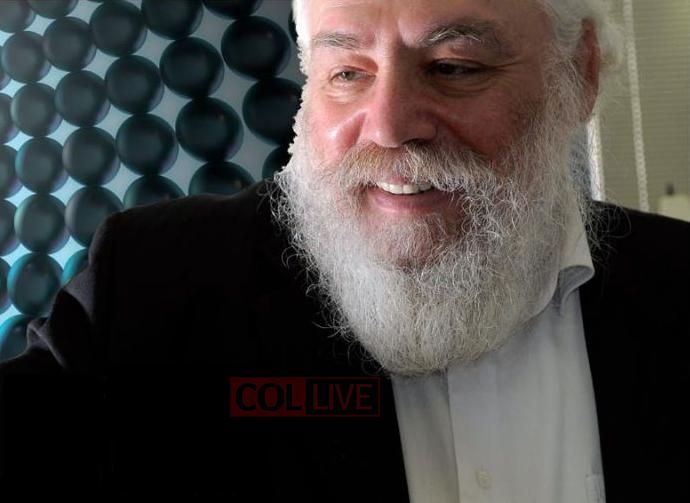
Dr. Yoram Devary, a world famous researcher in chemistry and biology was sitting in a Tel Aviv University lecture on the theory of DNA. Also at the lecture was Professor Uziel Sandler, a Chabad chosid who made aliya from Moscow in 1991 who was an expert in biology theory and math.
The lecture spoke about discovering new peptide hormones. The discovery of one such hormone, insulin, had brought relief and salvation to millions of diabetes sufferers in the world.
After the lecture, Devary and Sandler spoke together. How could it be that in the last ten years, with so many medical breakthroughs, not one peptide hormone had been discovered?
“We toyed around with discovering a peptide hormone in a different way,” says Devary. “Then one day Professor Sandler came to me and said that theoretically, at a certain place on Chromosome 10, there should be a new peptide hormone. We located a virtual sequence of amino acids that we thought would belong to that hormone.”
After Devary’s wife pressed him to verify their theory, Devary bought a PCR device which allows scientists to place a small amount of DNA on a test-tube and within a short time, multiply it billions of times. After a large amount of DNA matter is available, researchers have enough material to carry out their experiments.
“We then discovered that the peptide exists in the thymus gland which is responsible for developing the body’s immunity system,” says Devary.
Now the two scientists needed a real laboratory to further test and develop their theory.
Devary had just heard that the Jerusalem College of Technology in Givat Mordechai was planning to open a new division in Biochemistry and Computer Science. He decided to approach Prof. Lev and ask if he and his project could find a home there. Before he even had a chance to introduce himself and present his idea, Prof. Lev asked him where he had come from. When he heard he had just attended a chabura in Kiddushin by Rav Rafael Shmuelevitz in the Mirrer yeshiva, he asked him to repeat the shiur.
Dr. Devary found himself expounding the Talmudic lecture, while wondering what was going on. Finally, he told Prof. Lev that he had come to ask for a laboratory instead of a learning chavrusa.
Without even asking who he was, Prof. Lev offered to give him a 120 sq. meter laboratory. When Dr. Devary said it was too small, Prof. Lev told him that was all he could do.
Devary’s huge disappointment at hearing this was as great as his ecstasy a few days later when Prof. Lev contacted him and offered to put an entire floor in his college’s new building at his disposal for a new Computational Chemistry Faculty. Only after the department laboratory was up and running did Devary and Sandler approach President Dr. Bodenheimer and ask for his assistance in finding the new hormone they had discovered. Bodenheimer suggested that the two form their own start-up.
Their company IKS came into being in 2005. They dubbed their new hormone, whose scientific name was TEAF, “Nerofe” after the words in the Torah “Refoeinu v’nerofe.” This particular hormone is produced in the thymus gland in spectacular amounts during the fetus’s growth. Afterwards, the gland only produces small traces of the hormone.
“At first our laboratory focused on autoimmune diseases like Crohn’s and arthritis,” says Devary. “In these diseases, the immune system has gone into overkill and was destroying normal cells. We found that these destructive cells had a receptor that the Nerofe hormone attached itself to and destroyed. The perfect match between the hormone and the receptor thrilled us. We had found something completely native to the body that could suppress cells harming the immune system, without destroying the vital immune system and without causing side effects.
“We tried the hormone in laboratory conditions. The results were astounding. Mice suffering from Crohn’s who were treated with the hormone, had an amazing recovery in comparison to mice who weren’t treated with the hormone.
“Until now, there is no effective cure for Crohn’s. The new treatments with Remicade and Humira are controversial because of their long-term problematic side effects.”
Now they were ready for clinical trials. While continuing their research, the two researchers discovered that the receptor they had found on Crohn cells existed in double the quantity on acute leukemia cells. They predicted that the hormone would work even better on leukemia cells than on Crohn and arthritis cells.
“Acute leukemia is a disease with a prognosis of only a few months of life,” explains Dr. Devary. “It is treated with such aggressive medications that some of the patients die from the treatment even before the disease kills them. We tried the hormone on mice that had acute leukemia, and the results were unequivocal. Nerofe hormone greatly increased their survival rate.
“We decided to focus on leukemia because cancer has better PR appeal in the world than Crohn’s. We hope we’ll be able to get the necessary authorizations from the FDA, to carry out clinical trials as well as get research and development budgets.
“So far we’ve discovered that Nerofe selectively kills cancerous and infected cells while leaving healthy cells alone. Even more, it suppresses the creation of new blood cells and regulates immune activity. We studied cases of various difficult cancer types and discovered that, in the laboratory environment, Nerofe is useful for fighting many other kinds of cancer. We’re trying to produce a form of Nerofe that can be taken by mouth for Crohn’s and colitis.
“The curse of most new medications is that they cause severe side effects. So far, we’ve found that even high dosages of the hormone has not had side effects.”
Prof. Reuven Ohr, of the bone marrow transplant department in Hadassah Ein Kerem adds a sober note. He says that tests successfully performed on mice do not always prove themselves on humans. In addition, not all biological medications help everyone, and their effectiveness is dependent on many factors such as the individual’s immune system, degree of illness, body strength, etc.
The team of researchers, and the other chareidi scientists working in ISK, are keeping expenses down so they can continue their research in these belt-tightening days. Dr. Devary receives a modest $1,000 salary and he doesn’t own a cellphone or even wear a watch.
“I’m just a plain Jew who is trying to help people,” he says. “Don’t call this a ‘wonder pill.’ It’s grating on the ears. There is no wonder here, just a clear and simple method which we hope with the help of G-d will bring relief to many sufferers.”
Despite his modest claim, Devary and his team of researchers have registered several patents on their work, and are rapidly continuing their development of the protein into a full-fledged medication. May it soon brief relief and recovery to many sick around the world.




May Hashem keep giving u the kochos to be HIS personal executor of the brocho of Refa’ainu. What a kidush Hashem!
much hatzlacha with it, May Hashem grant you all Brachos to suceed with it, and Moshiach should come even before that right now
That’s awesome! How can he be reached?
G-d bless you!
May Hashem help you to be successful, and grant relief to many people. Moshiach Now!