Rabbi Ami and Avital Baram, Chabad of Gimzo, Moshav Gimzo, Israel
My wife and I are both Ba’alei Teshuva, but for a while there, while I had already started to become religious, my wife remained secular. On my own, I started doing shlichus around our neighborhood. I actually left my job so that I could focus on it full time.
But about a decade later, when my wife too, began to grow more religious, the two of us started an organization called Hitkashrut which helps couples dealing with what we dealt with – the reality of one being frum and one being secular.
Obviously, this came from a very personal place for us. We had first-hand experience with the challenges and hardships that came with this type of dynamic and felt that we had the tools to help other couples navigate through it. Since many of the differences, such as Shabbos, kashrus, taharas hamishpacha, and others, have a massive impact on the day-to-day workings of family life, it can feel insurmountable to navigate while maintaining a healthy marriage. Sometimes, one spouse may feel betrayed or disappointed with the other, so they’re often the ones to initiate contact with us. What we do is unique and fills a much needed void, so we don’t need to do much advertising.
We began to host seminars, workshops, and all kinds of events for couples struggling with religious differences. All of our workshops concluded with a Shabbaton, as that is one of the hardest days for couples where only one of them keeps the laws of Shabbos. For the same reason, we rented hotels for Chagim so the holidays could be a relaxing time to bond as a couple, rather than a reason for more resentment and division.
At the same time, we continued with our shlichus in Giva’atayim as well, and we felt we were being pulled in too many directions. We decided to move to a small community, so we could manageably handle a Beit Chabad, while still being available for our couples.
Gimzo was perfect. It’s located in the center of the country, so we could easily travel the length and breadth of the country for any couple that needed us. It’s a quiet, beautiful moshav with a small, close-knit community. Most of our neighbors are Dati Le’umi, so we focused more on teaching Chassidus, although we also hosted programs for all the holidays. At first, the community felt defensive and told us they saw no need for a Beit Chabad in Gimzo. When they learned about Hitkashrut though, they accorded us a begrudging respect, understanding the importance and need for the organization.
Over time, we fostered many friendships in the community, and they grew to accept us and appreciate what we offer.
———————-
We began a chessed organization called Gimzo Letova that provides sandwiches for needy children. After October 7th, we began adding stickers to each sandwich, each with the name and picture of a fallen soldier, including a line with his message.
We also had the huge zechus to supply the first menorah that went into Gaza. We gave it to one of the soldiers from the moshav so he could light candles in Gaza. We were proud when we were told our menorah was the first!
We also worked closely with a base in our area, and, as a result, had the honor of doing two Hachnasas Sefer Torah, and supplying tefillin to any soldier that didn’t have but wanted.
—————–
One time, we organized a concert with popular singer, Shuli Rand. The reservations came pouring in, and we knew the concert hall would be packed to capacity. Of course, we set up a mechitzah in the center of the room, with clearly designated areas for men and women. I knew it would be unusual for our community, who are used to events with family seating, but I was determined to stick to our hashkafos.
I saw a few confused – and even annoyed – faces as the crowd began to enter, but no one said anything to me, so I just breathed a sigh of relief and turned to greet the next guest.
As I was talking with one man, I saw Chaim*, another resident, enter with his wife. He took in the scene and his brows drew sharply together. My heart sank. I knew Chaim to be a typical sabra – with a prickly exterior and a demanding demeanor. As I expected, he immediately began moving tables around, folding up the mechitzos, and muttering angrily under his breath as he stomped around the room.
“Who do you think you are to start changing things around here?” he yelled at me. “We’ve done things a certain way in this moshav for years! It’s not right!”
I remained silent, knowing anything I said would just be oil on the fire. Still, a cool animosity settled between us from then on, and we tried to avoid each other as much as possible.
Everything changed when we heard Chaim’s son was one of the victims of a terrorist car ramming. Despite the uncomfortable tension between the mayor and myself, my wife and I decided to visit his son in the hospital. As a token of good will, I decided to gift him with a Rebbe dollar. I took down the envelope with our Rebbe dollars, and grabbed one without looking.
Chaim’s eyes widened when he first saw us, but he gave me a gruff handshake that bridged the chasm. We spoke for a while, and I pulled out the Rebbe dollar, handing it to Chaim’s wife.
“Thank you!” she said, reading the inscription detailing the date and recipient of the dollar. Her face paled. “How did you know?” she asked, her voice shaking.
“Know what?” my wife asked, confused.
“The name!” she said, pointing to the tiny writing on the top margin of the dollar. “It says Michael!”
My wife and I looked at each other in confusion.
“I don’t know what you’re referring to,” I said, carefully. “I just took a dollar without really looking…”
“The Chief Rabbi was just here,” Chaim’s wife explained, with tears in her eyes. “He told us to add the name Michael to our son’s name.”
We all stood silently, acknowledging the incredible hashgacha pratis that brought together two families with opposing views.
———–
Amos* and Dafna* had been married for years when Amos began taking an interest in Judaism. As Dafna watched with growing unease, Amos took on one commitment after another. We helped them reach an understanding and a framework for a secure marriage, despite their growing differences. Dafna and Amos agreed to respect one another’s choices without imposing their own. When it came to educating the children, they came to a standstill. Of course, Amos wanted to enroll them in a religious school, while Dafna insisted on them remaining in their secular school.
One Shabbos afternoon, Dafna went upstairs to rest while Amos played with the kids.
“Abba,” said Shani*, their 7-year old daughter, “I want to keep Shabbat from now on!”
Amos felt torn in two. Of course, he was thrilled his daughter was taking an interest in Yiddishkeit, but he also knew how Dafna would feel about it, and he wanted to respect her wishes.
“Shani, sweetheart,” he answered her, softly. “Ima and I decided that keeping Shabbat is not for you right now.”
Amos didn’t know that Dafna was lying awake and heard the entire conversation. It showed her that Amos prioritized their relationship over his religious “agenda” and the rift she felt in her heart started to heal. Knowing she could trust her husband to maintain the boundaries they’d agreed on allowed her to relax her anxieties and become more flexible.
The next time the discussion of the childrens’ schooling came up, Dafna was open to hearing about Shalavot – a Chabad school geared for secular families. She was happy to hear that our daughter, whom she’d befriended over the years – was a teacher in the school.
As their initial meeting approached, Dafna was apprehensive at the religious nature of the environment. But when they got to the school, and Dafna saw my daughter, all her worries melted. Her trust in our family and the work we have done to help her marriage allowed her to view religion less harshly and ultimately decide to send her children to the school.
—————-
Mor* and Itai* had been dealing with religious struggles in their relationship for years, and when it came time to choose schools for their children, these issues became a major sticking point. Itai wanted their children to go to a Chabad school; Mor, who had not become religious, wanted their kids to stay in secular institutions.
After some convincing, Mor agreed to go with Itai to see the school in Kfar Chabad. As they walked towards the building, Mor remained tense and anxious, dreading the next hour, while Itai davened that she’d be able to see potential in the school.
They passed a woman, and Mor stopped in shock.
“Sarah? Is that you?” she asked, taking in the sheitel, long skirt, and long sleeved shirt. “I haven’t seen you since that dance production we were both in ten years ago!”
The two women hugged, excited to see each other after so many years.
“What are you doing here?” Mor asked.
Sarah smiled. “I teach dance here,” she explained. “After becoming religious, I needed to find a way to keep my passion alive.”
Mor grabbed her friend’s hands. “And how is it here? How is the school?”
“Amazing!” Sarah promised. “It’s so warm and the teachers are great. I’m lucky to be working here!”
Itai watched Mor’s shoulders relax and her brow smooth. He knew his tefillos had been answered with a timely stroke of hashgacha pratis.
Mor agreed to enroll their children in Sarah’s school. As the children came home, excited about everything they were learning, Mor became more interested. Eventually, she decided to join Itai in establishing a home on the foundations of Torah and mitzvos.
———————
In the late months of Ayelet’s* pregnancy, she began to experience serious medical issues. Despite many doctor’s visits and tests, no one could diagnose the issue.
Ayelet was becoming more religious, while her husband, Doron*, remained skeptical. I’d already offered to check all their mezuzos and tefillin, but Doron refused. After weeks in the hospital, Ayelet knew she had to try something else, and convinced Doron to let me come to their house.
I immediately noticed the master bedroom didn’t have a mezuzah at all. Another mezuzah was upside down, and a perfunctory check of his tefillin showed me they were pasul. We quickly fixed all the issues.
Just a few days later, Ayelet’s symptoms disappeared completely. She was able to return home, and the rest of her pregnancy was entirely normal.
Ayelet and Doron now serve as shluchim, helping other Jews find meaning in Yiddishkeit.
——————
Yaniv*, one of our neighbors, is a diamond dealer. He told me about some colleagues of his, Shachar* and Noam* who might agree to donate to our Chabad house.
I launched into my spiel but Shachar cut me off.
“Let’s make a deal,” Shachar offered. “I’ll donate to your Chabad house by buying Rebbe dollars from you.”
I had five dollars with me, so I agreed and told him I would sell each dollar for $770. Shachar and his partner agreed, and we parted, mutually content.
The next day, I returned to their office.
“Rabbi Baram!” yelled Noam, grabbing me by the shoulders exuberantly. “You won’t believe what happened!”
“Good things, I hope,” I replied. “I davened for you guys!”
“After you left,” Noam told me, “We finally managed to sell this diamond, this huge diamond, that we’ve been trying to sell for the longest time! A few minutes after you left, two men walked into our office and decided they wanted to buy that diamond!”
“That’s amazing!”
Noam shook his head. “You’ll never guess how much they bought it for!”
“$770?” I joked.
“Almost!” Noam laughed. “$770,770!”
——————
One soldier from the community, Yair*, davened with us often. In fact, on that infamous Simchas Torah, he was slated to be the chazan for Tefillas Hageshem. Unfortunately, Yair was called up before we’d reached Mussaf. He was very worried as he headed down south, as his niece was at the Nova music festival.
Yair returned from Gaza a changed man. He suffered from PTSD and his faith in Hashem had been shaken. He stopped coming to shul and avoided us completely.
This year, on Simchas Torah, I was surprised and delighted to see Yair slip into shul for the first time in two years. I knew I had to honor him with Tefillas Geshem.
Yair brought along a friend, Rami*, who’d survived the Nova massacre. Rami stood before the shul and shared the miracles he’d experienced while running from the terrorists, and the clear Yad Hashem that had helped him survive.
“I decided to thank Hashem by starting to put on tefillin,” Rami announced.
“Then I will buy them!” volunteered a shul member. “I’ll buy tefillin for you and any friends that want to start putting them on!”
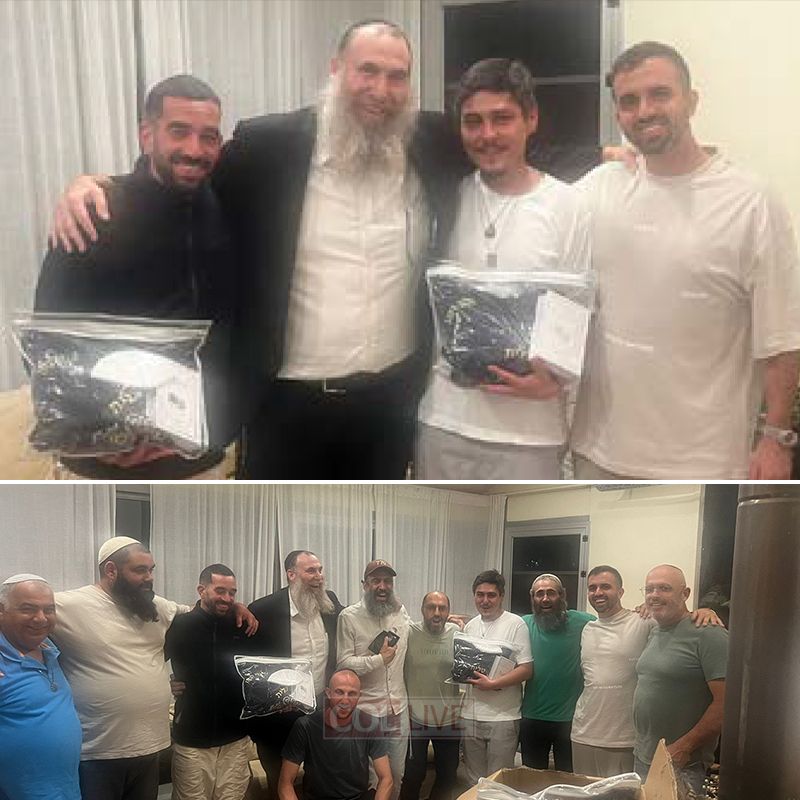
A few weeks later, we held a seudah where Rami and nine other Nova survivors received their own pairs of tefillin and shared their stories.
*Names changed to protect privacy