
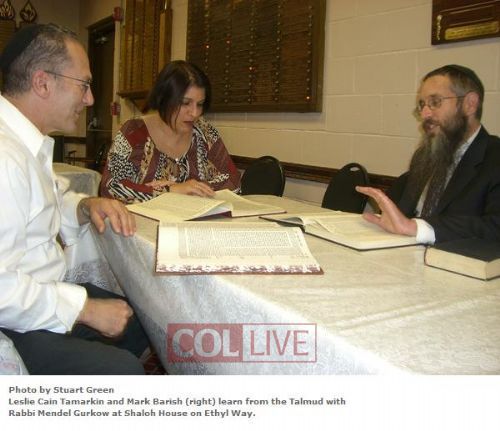
By Stuart Green, Stoughton Journal
For Mark Barish, celebrating the Jewish holiday of Purim used to mean maybe eating a traditional pastry known as a hamanteschen.
He knew about a sukkah, but he never made it a point to relax in one daily during the eight-day festival of Sukkot.
He had heard about staying up all night to study on Shavuot, but he never had experienced it.
But that was all before – before he walked into Shaloh House Chabad of the South Area on Ethyl Way.
“I think it’s warm, it’s friendly, it’s not judgmental, it’s accepting of anybody from any level, any background (regardless) or your proficiency in davening and praying,” Barish said. “At Chabad, it’s a whole different concept of Judaism.”
In October, Barish celebrated his first year of fulfilled Jewish living with an authentic experience of all the holidays, and a new understanding of the tradition and values of Judaism. Along the way, he found that his discovery is not limited to the synagogue.
“I learned from the Talmud here how important peace and harmony is in the home, and to make peace, and the extraordinary intricacies of making peace that you shouldn’t even leave an obstruction in the road so no one should (get) hurt or fall,” he said. “There are extraordinary things to make peace and harmony in the home.”
It’s this mix of synagogue and home life that congregants connect with at Shaloh House, which also contains several Hebrew school classes inside its Knollsbrook site on Route 27. The school and shul emerged from “absolutely nothing” more than three decades ago, according to Rabbi Mendel Gurkow.
“We had no money, no children,” Gurkow said. “We did have a building.”
Gurkow first got involved in the mid ‘80s. On a summer break from studying at a yeshiva in New York, he spent five days a week in the summers helping to run a Milton camp of his father, a Chabad rabbi. His father suggested going to Stoughton to organize the Chabad shul.
When the fall came, Gurkow returned to New York to study, but came back to Stoughton. He used to spend Friday nights in the empty building, alone, and just imaging what the future building would contain.
“Shabbas,” said Gurkow, referring to the Sabbath, “I was all alone. My mother would give me food. It was very, very relaxing Friday night- quiet, warm, all by myself. I would pace the room, this very same room. I had some cylinder blocks, tile on the floor. I would pace the room and pace – this is where I would have one classroom, a classroom there…”
Dream of the finished building – recently expanded to include 40 in the Hebrew school and more in the preschool – were embellished over time. But Gurkow knew that it was the congregation – the people – who would make the synagogue and school.
“I never pushed anybody,” Gurkow said. “I would invite them to a party or dinner – and hope. I’m a very easy-going person. I let people grow as they’re able, and ready.”
Leslie Cain Tamarkin was one who was ready.
While growing up in Norwood, Cain Tamarkin’s family practiced Reform Judaism. By the time she was married and living in Springfield, she had started to discover the world of Chabad.
When she moved to Stoughton more than 15 years ago, she was pregnant with her first child, Zeke. She did experience different synagogues, but was drawn to Shaloh House.
“Other places may have quality, but they’re like vichyssoise,” she said. “But when you come here, it’s chicken soup. There’s just this warmth.”
Her children – Zeke, 15; Elias, 13; Seth, 11; and Sophie, 10 – all have experienced that warmth by both going to Hebrew school and praying at Shaloh House.
“To them,” Cain Tamarkin said, “It’s so much more than a synagogue. This is family. This is home – I mean literally.”
And the differences and obligations between Jewish observant men and women? For Cain Tamarkin (“the more you learn, the more live it, the more you understand it”), It all makes sense.
“I am definitely liberal,” she said. “I am all for women’s rights and all that kind of stuff. But when you really start to learn, you understand how important women are in Judaism, and how much truly they are held in esteem.
“… I can see it here that mothers and women are so honored, and that women are not obligated to do certain things like pray three times a day. Women are so looked up (to). It’s never been a feeling of being second class.”
A first-class synagogue, a first-class place to learn? That’s what many discover at Shaloh House over time.
Like Barish, who first started attending the school a bit when he moved to Stoughton about three years ago.
“Last year,” Gurkow said, “he decided to explore it a little further, and he found it a very inviting and fulfilling home, a place where he was able to connect once more again to Judaism and to really experience what Judaism is really like. And he found something he didn’t think he would find. And I didn’t believe I would find someone like him.”
“That’s the magic that’s here, that’s a special spark that’s here – that’s Chabad,” Barish said. “There’s just love for Judaism, love for Torah, growth, wonderful commentary from the Bible and interpretation and Midrash, which I love, especially, which are the behind the scenes, the deep tradition which are passed on to give it a more meaningful approach to understanding. For me, it’s more esoterical, it’s a deeper level of understanding Torah.”




I had the honer to meet the Rabbi this week (September 8th 2015.)
found him to so very nice and very interesting to listen to him. he invited me to serives for the holidays. I might just take him up on that. would like to wish him and family the happist of holidays
Ellen Zeserson
Great Work !!! Rabbi Mendel a True Rebbe Chossid