
Photos: EMIH
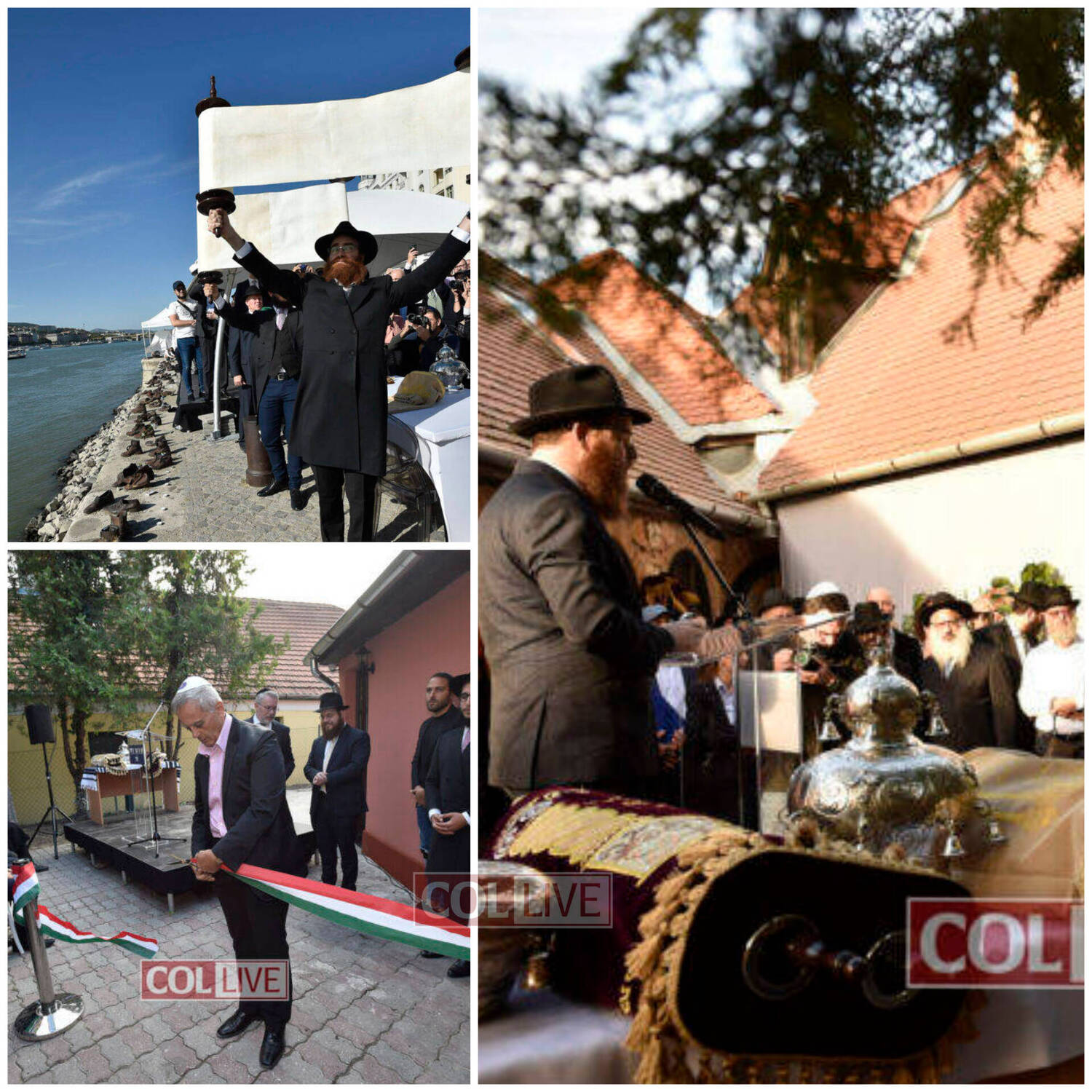
On Sunday at the bank of the Danube River in Budapest, Hungary a special dedication ceremony of two new synagogues in the area was held.
The synagogues are dedicated to the memory of the Jews who were murdered in the capital of Hungary 75 years ago, on the banks of the Danube river.
The event was attended by Rabbi Shlomo Koves, chief rabbi of EMIH – Association of United Hungarian Jewish Congregation, Av Beit Din of Orthodox Communities in Budapest Rabbi Baruch Oberlander, the deputy Prime Minister of Hungary Zsolt Semjén, survivor of the Holocaust and member of the Hungarian Parliament János Fónagy, member of the board of Chief Rabbinate of Israel Rabbi Simcha Weiss, and over 2000 members of the local Jewish community.
One of the two synagogues is located in the heart of the capital, next to the parliament building, in an area where many young families in the city live, and the second is in the popular with tourists artists’ city Santandre, which is located about 20 kilometers north of Budapest.
During the festivities, two new Torah scrolls were dedicated to the synagogues. The event is a symbol for the local Jewish community of the resurrection of Hungarian Jewry that has been evolving in recent years.
Today, the eight synagogues of Chabad (EMIH) are functioning, and seventeen rabbis serve the local community and many the tourists in Budapest, Mishkoltz, and Debrecen. According to local community reports, the level of anti-Semitism in the country is particularly low, especially in comparison to other European countries.
In his speech at the ceremony, Rabbi Shlomo Koves said: “According to the laws of nature, the river always symbolizes life. However, about seventy years ago, in 1944, on the bank of the Danube river, brutal murders of thousands of Jews took place, and since then, to us, the waters of the Danube symbolize the complete opposite – not life and completeness, but death.
“But today we are here to restore things to as they were before. The two new synagogues on the bank of the Danube symbolize the return of the Jewish people to life after the Holocaust. The Hungarian Jewish community can now live freely, develop, learn and become familiar with Jewish traditions, and become an integral and central part of the Hungarian community.”
János Fónagy, a Holocaust survivor from Hungary and now a member of the Hungarian Parliament, said that he did not remember anything he had been through during World War II. “For me, the shoe monument on the banks of the Danube is what jars my memory a bit.”
Fonagy was born in 1942, “and among my family there was no one left to give me any recollection” he said. Many of his family members were murdered during the Holocaust. “The monument here allows us to perpetuate and remember those who did not survive the inferno, and also allows to perpetuate the lost memory of those who could not be remembered” he added.
“Our duty and responsibility is to remember and not forget what was in the past, but it is no less important that we act for the future. The Torah of the Jewish people is the focus of our power and the symbol of life itself.” Ponoj added that it is our duty to make sure to pass down the heritage of the Torah and the Jewish people from generation to generation.
At the end of World War II, beginning in December 1944, tens of thousands of Jews were shot to death by the members of the pro-Nazi “Arrow Cross” on the banks of the Danube River. The Jews were lined up in rows, tied together on the west bank of the river, with their backs were to the shooters and their faces to the river. Thus they were shot, and their bodies fell into the water. Over time, members of the Arrow Cross would fire at only some people in the group, and the other Jews who were tied to them would fall into the river and die from drowning. On 2005 October, a monument “the shoes of the Danube” was erected, which became one of the landmarks of Budapest.





That is so powerful.
Mazel Tov only Simchas nice