
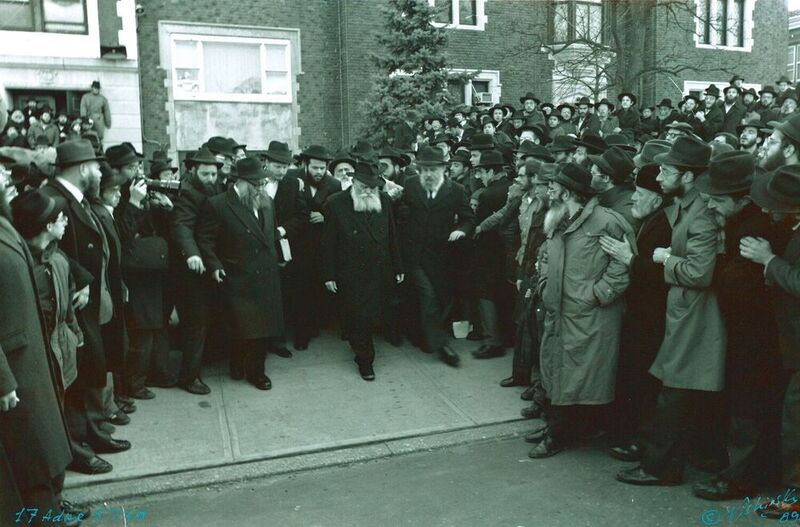
The Messiah is here in Brooklyn
In the ghetto of Crown Heights, a passion for Jewish orthodoxy and a fixation with a 90-year-old sage whose fame has crossed the world. A remarkable teacher, but his followers are convinced he is much more than that.
By DINA RABINOVITCH
Saturday, 12 December 1992
Crown Heights, Brooklyn: litter blows across the wide streets. It is a run- down neighbourhood with crack addicts on most street corners. But there is another population which does not even bother to notice them: orthodox Jews of mystical inclination, Hasidim living according to strict religious tradition, the men with beards, long sidelocks and the black coats and hats of 18th-century eastern Europe; their wives wearing wigs, mandatory after marriage, their children remarkable for their number.
In the summer of 1991 there were three days of rioting by blacks screaming ‘Get the Jew’, during which one Jew was killed. In another case, which has yet to come to court, a local Jewish woman was assaulted and murdered in her living-room. But look heavenwards and find uplift. Huge banners stretched from telegraph wires proclaim: ‘The Messiah is on his Way]’ What they actually mean is that the Messiah is here; right here in Crown Heights.
It is a principle of the Jewish faith that the Messiah will come one day. And yet messianic movements have been rare in Jewish history. The example of Sabbatai Zevi in 1665 is the most famous. His claim to be the Messiah came against a background of Jews being persecuted in Poland and Russia. There was a huge backlash when Zevi, who was a manic depressive, converted to Islam.
For years the Hasidim of Crown Heights have nurtured the hope that the Rebbe, or leader, of the Lubavitch sect, is the Messiah. In the past six months the Rebbe’s followers have put up billboards in cities with major Jewish communities announcing the arrival of the Messiah. Lubavitch vans drive around Jewish neighbourhoods broadcasting the news. And at Tel Aviv airport a notice says simply: ‘He’s here.’
‘Our sages told us the Messiah is a man of flesh and blood,’ said Rabbi Yehuda Krinsky, a secretary to the Lubavitcher Rebbe. ‘We believe it is the Rebbe.’
Does the Rebbe believe he is the Messiah? ‘Right now, the Rebbe can’t tell us,’ answered Rabbi Krinsky. Last March a massive stroke left him paralysed and unable to speak.
These days the Rebbe, 90-year- old Menachem Mendel Schneersohn, seventh leader of the Lubavitch movement, sits in a wheelchair behind the broken shutters of a red-brick building at 770 Eastern Parkway, the headquarters of his movement which has, during his 42-year tenure, been transformed from a practically moribund group of Hasidim into a powerful movement, spreading a warmth and love of Judaism to disaffected Jews, making brilliant use of modern publicity and communications, and sending out young couples to every corner of the world to bring thousands of people into the Lubavitch fold.
In contrast to other Hasidim who tend to cut themselves off from other sects, Schneersohn chose the motto ‘U’foratzto’ – and you shall spread out – and set about it. In the Sixties, he started to send followers out in ‘mitzvah tanks’ – caravans that drove down the high streets of cities and villages. They would park at a strategic spot, and out would hop a bearded type in a long black coat, full of bumptious enthusiasm, ready to seize on any passing likely-looking Jew with exhortations to keep the Tora – Jewish law. Even those who watched sardonically at first were drawn to the exuberance of these ‘crazy Lubavitchers’ and their warmth.
Then in the Seventies and Eighties you could be stuck in a motel somewhere, flicking through the cable TV channels, and find a little old man with a beard, wearing a felt hat and a long black coat, talking in a soft voice. It was the Rebbe’s lectures, broadcast from Crown Heights, with translations into English; no fancy video gimmicks to make it palatable, and no apologies for being quite so obviously Jewish.
At Lubavitch headquarters you can watch tapes of the days before the Rebbe’s stroke, when he handed out dollars to those visiting him – another of his ideas that captured people’s imagination. Schneersohn would give a newly minted dollar to his visitors, to give to charity. The queues of both Jews and non-Jews to see the Rebbe stretched round the block.
On the videos you can see Supreme Court judges saying: ‘Rabbi, I’m up for re-election; can you give me a blessing?’ There’s a non-Jewish politician from Uruguay who was so eager that he ran the last six blocks. And there are women with simple requests: for health, and fertility.
When he has instructed, they have obeyed. There is no other Jewish leader alive whose edicts are followed quite so religiously. Every time there is a major world event, there are stories circulated about the Rebbe and his amazing foresight. People will tell you how their close friends, or their mother’s cousin, phoned the Rebbe during the Miami hurricane. Those people who followed the Rebbe’s advice to stay where they were remained unscathed, whereas those who moved down the coast – following official advice – were swept up in gales. The same sorts of story are told with different backgrounds: Vietnam, or the Gulf war.
It is almost irrelevant whether the stories are true or not. There are people who believe them. The Rebbe may have lost the power of speech, but this has not stopped people asking his opinion.
The Lubavitch movement takes its name from the Belarussian town of Lybavichi, where the founding family was based. For four generations, they and their followers stayed through thick and thin, despite increasing persecution, until in 1929, the sixth Rebbe, Rabbi Joseph Schneersohn, moved to Warsaw and stayed until after the outbreak of the Second World War. It was only in 1940 that he decided his future lay in the United States. He arrived in New York on 19 March, and was welcomed off the SS Drottingholm by Lubavitch Hasidim who had escaped from Europe earlier. He settled in Crown Heights.
Joseph had no sons to succeed him so his mantle passed to Menachem Mendel, a cousin who had married Joseph’s daughter. He was a Hebrew scholar, but he had also studied at the University of Berlin and the Sorbonne, from where he graduated in engineering. He was fluent in 10 languages. His grasp of both the Jewish and the secular worlds, unique among Hasidic leaders, proved a potent ingredient in his leadership of Lubavitch. He also had piercing blue eyes, a certain presence, and an excellent memory which not only showed in his scholarship, but also allowed him to remember people’s names and details of their lives.
The subway ride to Crown Heights from mid-town Manhattan takes about 40 minutes, crossing through ever poorer neighbourhoods. For the last few stops you will see only two kinds of people on the train: Hasidim rushing home on Friday afternoon, in time for the Sabbath, and the blacks, who co-exist uneasily with the Hasidim . All the other Jews moved out of Crown Heights in the Sixties, when it became a dangerous neighbourhood, but the Lubavitch stayed – because the Rebbe said, we are not moving.
At the end of October Crown Heights was swarming with police. A court had acquitted a black teenager of killing a young Hasid, despite what seemed to be conclusive evidence of the teenager’s guilt – a bloody knife in his pocket, positive identification by the victim before he died. That killing had come after a black child was run over by a car driven by a Hasid following the Rebbe to his wife’s grave.
he sense of living in a hostile neighbourhood is very marked in Crown Heights. Jews and blacks pass each other with tight, closed faces. However, Lubavitch Hasidim do not just feel beleaguered in their neighbourhood – they also feel distanced from other Hasidic sects.
Many Lubavitchers complained that the other Jews in New York didn’t come and help during the summer’s riots. ‘Nobody cares about us,’ said one woman, mother of 14 children. Part of the antagonism arises from the way Lubavitch have reached out to assimilated Jews. But there is also suspicion of the Lubavitchers’ Rebbe worship; they even have spotlit portraits of their leader in their houses, an extraordinary thing in a religion which eschews all images of adoration. Menachem Mendel was handed the messianic baton by his father-in-law, who felt that the Messiah must come after the Holocaust. He did not show up, but Lubavitch children were drilled to perform their Jewish duties in order to hasten his arrival. So a generation of Jewish children has been raised with the subconscious idea that the point of Judaism is to bring the Messiah. In fact, the Jewish belief is that the point of the Messiah is to bring peace – in which to practise Judaism.
Lubavitch Hasidims’ hopes are focused on this Rebbe for a number of reasons. First, Menachem Mendel is the seventh leader of the movement, and seven is a number given mystical qualities in Judaism – the Sabbath is the seventh day, for example.
Second, the 18th-century founder of the Hasidic movement, the Ba’al Shem Tov, wrote a letter to his brother telling of a dream in which the Messiah appeared to him and said that when his philosophy was spread to every corner of the world the Messiah would come. Lubavitch can rightly claim that they have been very active at photocopying and propagating every word the Rebbe ever uttered.
On this particular October Sabbath, the Lubavitchers were at a high pitch of expectation. The word was out – the Rebbe would be in the synagogue for Friday- night prayers. In the streets, you could feel the thirsty need: to see the Rebbe.
The synagogue is a run-down building with bits of the floor missing, and scraps of paper flying about. Although Lubavitch has millions of dollars at its disposal – donations from supporters and the result of their own active fund-raising – the money goes not on home comforts, but on public relations and helping Jews round the world. Recently the sect airlifted children out of Chernobyl to take them to Israel.
The synagogue was jammed that night. We were upstairs in the women’s section; as everybody told me, it was the best place to see the Rebbe. Downstairs, little boys climbed up every available ceiling support structure, and many hung perilously from the skylights.
The Friday-night worship came to an end, but the concentration in the synagogue mounted rather than lessened. A curtain heaved, then opened. ‘Good Shabbos, good Shabbos, good Shabbos,’ the congregation greeted the seated, hunched figure of Menachem Mendel Schneersohn. He looked old, but domineering in the set way some old people do.
Very few people in Lubavitch talk about the Rebbe as one would about an ordinary human being. But one of those close to him told me how during the previous month, as the Rebbe had recovered somewhat, he had become frustrated about not being able to speak. ‘It was like 20 questions. They’d be asking him what he wanted, what he felt like eating, and they couldn’t get it right. It was hard.’
Downstairs, the men’s section of the synagogue was a single, driven mass. ‘Long live our teacher, our king, the Messiah,’ they sang, and the black suits and black hats jumped up and down as one to the beat. Around me, women and girls were white with emotion.
Previously, these Hasidim would chant, ‘Long life to our teacher.’ Since the Rebbe’s reappearance in public, they have added the words: ‘the Messiah’. The Rebbe’s head moved along to the singing, his hand raised as if to conduct the people.
After a minute, perhaps, Rabbi Krinsky, the secretary, leaned forward to ask something. The Rebbe’s head nodded, and as the curtains slowly closed around him he raised his hand more vigorously in time to the music, as if to say: this is good, keep going.
In every synagogue in the world, Jews pray towards Jerusalem, and the Ark is always on the wall of the synagogue facing Jerusalem. But as the synagogue in Crown Heights emptied that Friday night, I could see the lay-out of the synagogue clearly for the first time. I have been standing close to the Rebbe’s seat in the synagogue. Looking down I realise that the Ark containing the Tora scrolls is actually at the other end of the synagogue, behind the backs of the entire community who have all prayed facing the Rebbe.
Later I raised the matter with Rabbi Krinsky. Did you see, I ask him, people were not facing mizrach, not facing towards the East? He shrugged and looked away.
The Jewish idea of the Messiah is not of some supernatural event but of the coming of a divinely inspired leader whose spiritual and moral force will lead the Jews towards a model society where the ideals of justice, brotherhood and loving kindness will be practised.
Today the orthodox Jewish opposition towards the Lubavitch claim is muted – partly out of a genuine feeling of pity for a leader who did much in his time. But there is tremendous wariness of messianic claims. The repercussions of Sabbatai Zevi, the false messiah, afflicted Jewish life for 200 years, leading many to Christianity and Islam.
Professor Allan Nadler, head of the YIVO Institute in New York, an organisation dedicated to preserving Eastern European Jewish culture, says: ‘Lubavitch are setting themselves up for the worst experience of the Jewish people – failed messianic expectations, a reaction they won’t be able to control.’
Apart from anything else, for the Rebbe to be in a position to give messianic leadership would require a miraculous recovery, one which his Hasidim have not ruled out. For them, he is either the Messiah or he is going to die.
The death of the Rebbe is a taboo subject among the Lubavitch; not only is he their beloved leader, but he is the end of the line. For seven generations, the Schneersohn family have kept their followers’ hopes alive through all their tribulations. But the Rebbe has no offspring; he has a nephew living in Israel, but there was a family feud over the Schneersohn family’s valuable library about a decade ago; in any case, he is not an orthodox Jew. People outside Lubavitch have speculated that Adin Steinsalz, a renowned Lubavitch scholar, could become Rebbe, but he has no family connection and insiders scoff at the idea.
So while the Lubavitch look towards their transcendent moment, they are in fact in their moment of greatest crisis. For as with every movement that puts its faith in its leader, when the leader dies, the movement may follow.

what happend to ‘Our sages told us the Messiah is a man of flesh and blood,’
but so true.
where’s a little faith in the rebbe’s prophecy? (see sicha shabbos p. shoftim 5751[1991]et al.)
just about all promises of the rebbe took some time (and faith), and yet, they ALWAYS materialized in the end.
on a seperate note; regarding 3 tammuz: it doesn’t change the rebbe’s eligibility as the rebbe himself wrote in a transcription of a excerpt of his talk on 13 shvat 5711(1951).
reading the concluding lines of article, i ask you; what’s your point?
are you suggesting that pure faith (vayaaminu bahashem uvemoishe avdoi) w/out some enlightenment, may not be the best thing for our PR?
i think you could’ve found a slightly more appropriate article.
i expect better from col.
that’s the way you write about our Rebbe?!
dont write it that way
why do you say someone on the top should do something, shoin genug at the top. They have failed us period end of story. It’s now time for a revolution from the soldiers whom they have failed.
The Rebbe already provided what to do in these times, if only anyone on the top in Aguch Merkos etc. cared……instead of their selfish egotistic power struggles
I remember so well the shock, the fear, the pain we all suffered on Chof Zayin Adar. It was the beginning of our time as fatherless children. How we have suffered & still suffer without our Rebbe b’guf. How much more bitter is our Golus today.
Professor Allan Nadler, head of the YIVO Institute in New York, an organisation dedicated to preserving Eastern European Jewish culture, says: ‘Lubavitch are setting themselves up for the worst experience of the Jewish people – failed messianic expectations, a reaction they won’t be able to control.’
“”””‘Lubavitch are setting themselves up for the worst experience of the Jewish people – failed messianic expectations, a reaction they won’t be able to control.'”””
“The Rebbe’s head nodded, and as the curtains slowly closed around him he raised his hand more vigorously in time to the music, as if to say: this is good, keep going.”
remember what happened in lamed daled with the mitzvah tanks?