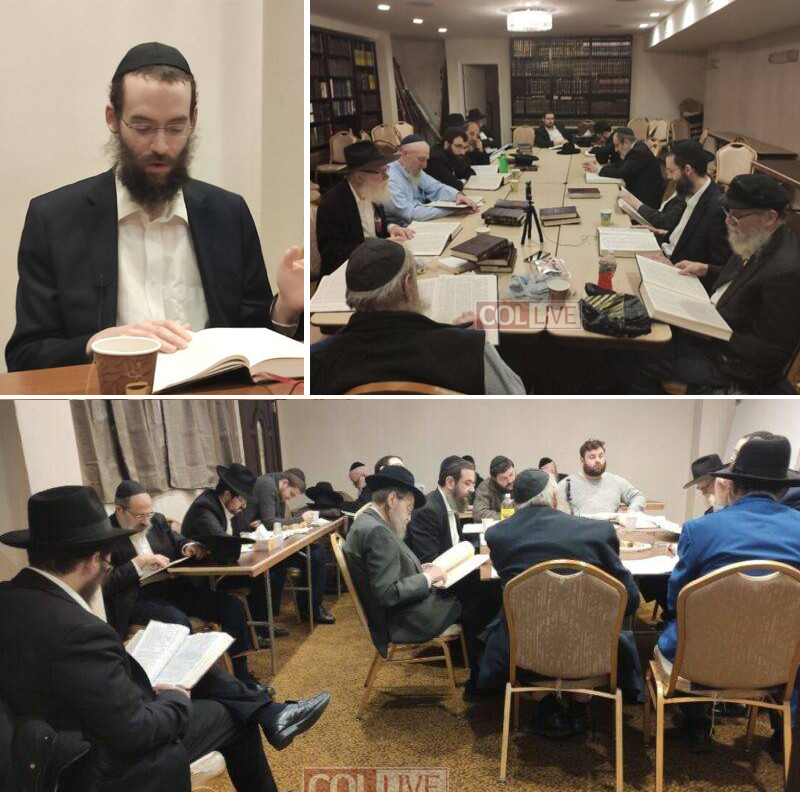

By: Rabbi Michoel Seligson
Hagaon Hachossid Hatomim Horav Levi Bistritzky was born in 1948, on the 8th of Iyar to may he live and be well Hachossid Horav Hatomim Reb Yehuda Leib and Mrs. Ita Bistritzky.
Reb Leibel Bistritzky’s father Reb Mordechai merited to a special zchus. In 1941, after the Rebbe and the Rebbetzin escaped from France to Portugal, Reb Mordechai contributed two tickets for their passage to the United States. The tickets had originally been purchased for Reb Mordechai’s in-laws, who were unable to get out of Europe. Reb Mordechai offered the Previous Rebbe the tickets for his son-in-law and daughter. The tickets were accepted, enabling the Rebbe and Rebbetzin to leave Europe for the United States.
Reb Leibel recalled. “At the time, the Previous Rebbe did not feel well and was not accepting people for Yechidus. To my surprise, I was informed by his secretary Reb Chaim Lieberman that I would have Yechidus on Friday, a day before the Bris. When I told the Previous Rebbe that the Bris was on Shabbos, the Rebbe responded with a blessing, “Arichus Yomim vshonim Tovos, Arichus Yomim vshonim Tovos, Arichus Yomim vshonim Tovos”, long life and good years. The fact that the Rebbe stated the brocho three times puzzled us. The Rebbe’s speech was impaired at the time and his responses were generally short.
We told the Rebbe, that we planned thought to name the child after a grandfather who was killed in Auschwitz. The Rebbe consented.”
The family moved to Vineland, New Jersey when Levi was three years old and he attended the Vineland Jewish School. When he was twelve, his parents sent him to Yeshiva Tomchei Tmimim, then located at Bedford Avenue and Dean Street in Brooklyn. During the day he studied in yeshiva and stayed at an aunt’s house in Queens. This is when he began to absorb Torah and chassidus from the Roshei Yeshiva and mashpi’im, and from the Rebbe’s environment.
Rebbe’s kiruvim
Reb Leibel continued. “While he was still a child, we merited to many Yechidusen with the Rebbe. The Rebbe would place him on his lap. He would motion to him to come up to the Rebbe’s bima at Farbrengens, instruct him to say L’chaim, and take a piece of mezonos.
The trip from New Jersey to 770 would take about three-and-a half hours. I would take Levi along to the Rebbe’s Farbrengens. On one occasion, there was a blizzard, and Levi was not feeling well and stayed home. At the Farbrengen, the Rebbe motioned to me, ‘Where is Levi?’ I approached the Rebbe and told him that Levi couldn’t come because he had a high fever, in addition to the extreme weather. Instead of driving, I traveled by bus to Philadelphia and then took the subway to 770. The Rebbe said, ‘If so, you surely needed to bring him’.
We once came for a Yom Tov and standing together at the side waited at 770 for the Rebbe to go home. The Rebbe went over directly to Levi and shook his hand with a special fondness and said ‘I hear that you are learning well.’ The Rebbe blessed him and his brother Yossie.”
During the Yechidus on the 5th of Iyar in 1962, the Rebbe instructed Levi to turn to the principal in the yeshiva, Horav Yosef Mendel Tenenbaum, to promote him to the next class.
A year later, the Rebbe gave the family an additional surprise. The Rebbe asked Levi if he wanted to move to Yeshiva Tomchei Tmimim in Montreal. Levi consented and the Rebbe added that the yeshiva in Brooklyn should notify the yeshiva in Montreal that he would be coming in a few days. A few days later, the Rebbe saw Levi in 770 and asked Rabbi Hodokov, why was the bochur still here. Rabbi Hodokov called the yeshiva and all arrangements for the transfer were completed. The Rebbe’s involvement with Levi was exceptional and surprising. After many years, it became clear that he had been destined for great matters.
For the next ten years in Montreal, Levi engrossed himself in his studies. This is where he obtained his knowledge and depth in Talmud and poskim. He was beloved by the Roshei Yeshiva; Hagaon Reb Aizik Schwey for nigle, the mashpia Hagaon Hamkubel Reb Menachem Zev Gringlas and the mashpia Hagaon Hachossid Reb Yitzchok Meir Gurary in Chassidus, and by the prestigious gaon Reb Pinchos Hirshprung and Hagaon Reb Yitzchok Hendel in Halacha. On Thursday nights until the early morning, he would learn with bochurim from a Litvishe yeshiva. Reb Leibel asked Rabbi Karp, one of the melamdim how his son was learning. He responded, “When I walk into the zal at one or two A.M., I see him learning.”
His mother recalled. “Levi never needed anything. Many times we offered to give him money but he refused. When he was a bochur we needed to beg him to take five dollars to fix his shoes. Until his last day he asked for nothing. He was concerned for his wife and children but not for himself. From childhood he was serious and responsible and never wasted time. At the age of seventeen, he received semicha but did not want people to know. He allowed his father to tell his parents. When he found out that we also told my parents, he was upset that we did not keep our promise.”
Kibud Av Vaem
During vacation from Yeshiva he helped in the house. In Nissan, he would assist us in our Pesach store and during Tishrei, with the selling of lulovim and Esrogim. When he began his studies in Montreal, he asked if he could travel to New York to help us. The hanhola told him that he needed to sit and learn and Levi responded, “I cannot sit and learn when I know my parents are working so hard’. It was decided that he should write to the Rebbe. The Rebbe answered that the hanhola should allow him to come to New York, with the condition that this would not interfere with his studies. He arrived and worked in the store, but every spare moment he would put down his head between the cartons of food products in order to study Gemoro and Tosfos. Although it was close to Pesach and there was no seder yeshiva, he still utilized the time to study until Erev Pesach. The same thing happened on Chal Hamoed.”
For two years, Reb Levi worked with the Bais Din of Montreal, under Rabbi Hirshprung. In these two years, Reb Levi received shimush, hands-on experience in various complicated halachic matters. In addition, Rabbi Zalman Shimon Dworkin, the Rav in Crown Heights, was asked in the Rebbe’s name if Levi could receive shimush from him in order to add to his knowledge and experience, to be ready to serve as a Rav when the time came.
On the 14th of Sivan 1973, he married, may she live and be well Miss Esther Shulamis Tiechtel of Jerusalem. The wedding took place in Israel and also on this occasion, the Rebbe revealed unusual kiruvim. In his Mazal Tov letter the Rebbe added the title “Rav” before Reb Levi’s name.
Rebbetzin’s Gifts
The couple visited with the Rebbetzin Chaya Mushka before leaving for Israel. She gave them a handkerchief that her father, the Previous Rebbe, used on Rosh Hashana at tekias shofar and was to be used to cover the Kallah’s face at the badekenish. The Rebbetzin also gave them a piece of linen with which the Tzemach Tzedek would wrap his shofros, saying “By me it is very precious”. The Rebbe approved of this and said to the Rebbetzin, “Since this never left the house of the Rebbe’im we need to check with Leibel. Probably the sheva brochos will be in Jerusalem and they say that there are many eruvin there that allow one to carry. If Leibel takes upon himself not to let these items leave his possession, even on Shabbos, except for the chupa, he can take it. The chosson Reb Levi wrapped himself with this precious item at the chupa.
During the Yechidus before this wedding, the Rebbe instructed Levi to follow all the customs which the Rebbe’s father had given the Rebbe before his own wedding. The Rebbe added that these were not directives for the public.
After his wedding Reb Levi studied in the kollel, consisting of scholars, in Natzeret Elit. After a short time, he wanted to return to New York to be near the Rebbe. He studied in the Crown Heights kollel for two years. The Rebbe said that he should be allowed to be continue for an additional year and that he should not be restricted to a specific curriculum, since he was becoming a Rav and therefore needed to learn additional material.
In the winter of 1976, the Rebbe announced that a new group of shluchim would be going to Israel and anyone who wished to volunteer should send him their names. Reb Levi immediately did so and it was said that his name was the first one selected by the Rebbe.
Before being officially appointed as the Rav of Chabad in Tzfas and later the Rav of the city, Reb Levi was an outstanding figure among the group of Shluchim, who were all yungeleit with a high level of knowledge in Torah and Chassidus and were completely devoted to the Rebbe. Alongside Rabbi Leibel Kaplan, the head shliach of Tzfas, Reb Levi took an active role in the work and activities of the Shluchim in spreading Torah in Tzfas.
The Shluchim to Israel would hold their annual convention and Reb Levi was chosen to read the Rebbe’s letter, addressed to the kinus.
On the 13th of Iyar 1952, the Rebbe’s brother Reb Yisroel Arye Leib was nifter and was laid to rest in Tzfas. Every year, Reb Levi would lead a group of to visit the resting place and recite Tehillim. He would then report back to the Rebbe. On one occasion, the Rebbe responded, “It should be the will of the above that all the prayers should be received and accomplish everything.”
“The Rebbe’s will that he remain in Tzfas”
In 1979, a Rav in Israel offered Reb Levi the position of Moreh Horo’oh of his city. Reb Levi responded that since the Rebbe had sent him to Tzfas, therefore he couldn’t write to the Rebbe regarding anything which would be contrary to this mission, but he could not stop another person from writing. The Rav asked the Rebbe about Reb Levi.
On Rosh Chodesh Elul, Rabbi Hodokov phoned Rabbi Kaplan, the shliach and founder of Chabad in Tzfas, and told him, “A rumor has reached here that they are suggesting a rabbonus to Rav Bistritzky. Since the Rebbe sent him to Tzfas, it is the Rebbe’s will that he should remain in Tzfas, the location of his shlichus. The Rebbe went to the Ohel today and requested that prior to his return from the Ohel, he should receive a report that Rabbi Bistritzky has been appointed as the Rav of Kiryat Chabad in Tzfas”.
Rabbi Bistritzky entered his new position as the Rav of a growing Kiryat Chabad with a concern for the public and the individual, with a hearing ear for any problem, appropriate guidance in Torah and Chassidus, and permeated with hiskashrus and bitul to the Rebbe
Rav of Chabad in Tzfas
From one year to the next year, many circles in Tzfas and beyond acknowledged his greatness. They saw for themselves a giant in Torah, a genuine chossid of the Rebbe; and a strong personality on one hand, and a pleasant person and easy going person on the other. A year later, the chief Rabbis in Tzfas, both the Ashkenazi and Sefardi, entrusted him with the responsibility for the eiruvin and mikvaos in the city.
His status as a giant in Torah and Halacha was publicly acknowledged when a team of scholars working on the Encyclopedia Talmudis, an enormous project, requested that he join their team as an editor.
He also served as a member of Bais Mishpat Hasholom in Tzfas. When a person came to court, he was advised by the judge to turn to Rabbi Bistritzky to settle the dispute. This settlement would be honored by the judge, demonstrating the respect that the judicial establishment had for Rabbi Bistritzky.
The Rav received additional responsibilities to which he was very committed. He enhanced these with hiddurim, keeping public comfort in mind.
Kashrus leadership
Rabbi Bistritzky became involved in kashrus and his hechsher was very respected in Israel. When the Shluchim came to Israel in 1976, it was difficult to find kosher l’mehadrin products. Rabbi Bistritzky’s efforts resulted in a large supply of such products for the entire area. The next move was to oversee the status of orlo, trumos and massros, which he conducted in a professional way. He instituted an organized, effective and computerized system to supervise this enormous operation involving farms, factories, distributors and stores.
After Horav Shmuel Eliyohu, the son of Horav Mordechai Eliyohu may he be well, was elected as the Sefardic Rav of Tzfas, he invited Rabbi Bistritzky to work with him on Kashrus, both in basic kashrus and kashrus l’mehadrin.
Government inspectors found the quality of kashrus in Tzfas to be best in the country. This was in part due to the organized manner in which it was administered. Recommendations were made that all other cities should emulate the policies and structure of the Tzfas kashrus organization.
Ahavas Yisroel
During the first years of Yeshiva Tzierei HaShluchim in Tzfas, a group of students were tested by Rabbi Bistritzky. At the end of the test he asked for the list of the students and their addresses. All of the parents of these students received a personal letter from Rabbi Bistritzky, a nachas letter, in which he described how he tested their sons and their outstanding success.
On Purim, when people from all circles would deliver shlach monos to his home, he would say L’chaim with each one. When hosting an Ashkenazi, he would say l’chaim on Smirnoff, and when he hosted a Sefardi he would say l’chaim on arak. Each person was respected for his qualities, customs and desires.
Peace between Jews and Arabs
Every Tuesday, Rabbi Bistritzky would travel to the Ziv hospital to visit the sick, going through the entire hospital. When he was ill, former patients, Arabs and Bedouin came to visit him. For security reasons, they were not allowed in to see him. They argued that he had come to see them when they were sick, and now that he was unwell they weren’t being allowed in to visit. Rabbi Bistritzky consented to their visits, adding that he made it his custom to visit them in order to maintain the peace between the Jews and the Arabs.
One yungerman recalled that Rabbi Bistritzky, although busy with communal matters, visited him, as well as calling on the phone every day to inquire about his health.
A Druze police chief in the Galil told Rabbi Bistritzky’s family at the shiva, that he would meet Rabbi Bistritzky quite often. Their offices were both in the municipal building and they would always greet each other. One of his children was getting married during the nine days and he did not send an invitation to Rabbi Bistritzky, assuming that he will not be able to attend.
Rabbi Bistritzky surprised him. He drove to the Druze village where the wedding was taking place and danced with the father.
One of the people who came to console the family after the ptira recalled. “I lost my father when I was fifteen. Rabbi Bistritzky became my father. He gave me an understanding of religion and thanks to him, I am an observant Jew today.”
Shluchim in the field
Rabbi Bistritzky made himself available to Shluchim in different countries and every one of them received his individual attention. Quite often he would receive calls from Shluchim asking for a solution to a complicated halachic question. When the commotion of his playing children interfered with the call, Rabbi Bistritzky would tell them that this was a long distance call and they needed to be quieter.
Rabbi Bistritzky did not demand respect. He was different from other Rabbonim. He did not use a chauffeur but always drove himself, even on long trips to officiate at a chupa or other official functions. He conducted himself in a simple manner and did not wear a tie as was customary with a number of other Rabbonim.
In 1979, a short while after Rabbi Bistritzky was appointed the Rav of Kiryat Chabad in Tzfas, two older chassidim approached him to discuss a confidential matter. It related to the resting place of the Rebbe Maharash’s son, Reb Menachem Mendel. It had no tombstone since 1954, when it was transferred from France. Rabbi Bistritzky wrote to the Rebbe and was instructed to place a matzeva. The Rebbe immediately sent notice through Rabbi Hodokov that he was covering all the costs, in order that there should be no need for Yungeleit in Tzfas to begin raising funds.
In Sivan 1979, Rabbi Bistritzky came to New York with his family and they entered into Yechidus. The Rebbe said that he was the Moreh D’asro, the Rav of Tzfas, although not formally. In a peaceful manner and in due time, it would be official and accepted by the entire city
In 1984, the Rebbe initiated the daily study of the Rambam. Rabbi Bistritzky immediately gathered a group and began the study of the Rambam at the Rambam’s resting place. Every year he came to make a siyum at the Rambam’s tzion and also followed up visits when he was conducting siyumim on the various sforim and halachos of the Rambam. On one occasion, the Rebbe mentioned, “He has Ahavas Yisroel and he brought along mashkeh from the siyum at the resting place of the Rambam.” Rabbi Yaroslavsky, the Rav in Nachalas Har Chabad, stated, “The siyum HoRambam is an example of Rabbi Bistritzky’s attachment to the Rebbe. Every year he conducted the siyum at the resting place of the Rambam. He felt an obligation, in particular after hearing that the Rebbe was pleased with this project”.
In later years, when the siyum HoRambam took place in Egypt, where the Rambam had lived, the Rebbe instructed that Rabbi Bistritzky should be included in the delegation for two reasons. He was the Rav near the resting place of the Rambam, and he had already conducted siyumin in the past, therefore he had a unique connection with the Rambam. A member of the delegation said, “Attending the siyum Horambam ceremony would be various delegates, Egyptian ministers, police captains and Israeli representatives. Rabbi Bistritzky would address them in English and speak with an inward chassidic storm, and would inspire the listeners who never tired of hearing him”.
Over the course of the years, Rabbi Bistritzky compiled a sefer on the Rambam and on the Alter Rebbe’s Shulchan Aruch.
In 1987, the Rabbonim in Northern Israel gathered and decided to appoint Rabbi Bistritzky to head the board of shmita supervisors that supplied all the fruit and vegetables for people who observed shmita in Israel.
In 1989, the position of the Rav of Tzfas became available. Horav Simcha Kaplan was nifter and elections were planned. Many, including Hagaon Reb Ovadia Yosef saw Rabbi Bistritzky as a natural candidate for the Rav’s position. People who visited the Rebbe at that time were urged to do everything to ensure Rabbi Bistritzky’s success. For ten years, and on many occasions the Rebbe requested that they choose Rabbi Bistritzky as the Rav of Tzfas.
Rabbi Bistritzky was elected, and on the 24th of Av 1993, he began to function as the chief rabbi of Tzfas and the Galil. The Rebbe’s prophecy of fourteen years earlier had been fulfilled.
During an impressive and beautiful ceremony, he was crowned the chief Rabbi of Tzfas, and merited to receive the Rebbe’s warm brochos. Attending the ceremony were the Rabbonim of the cities and villages of the entire North Israel. The Chief Rabbis of Israel, Horabonim Hageonim, Horav Yisroel Meir Lau and Horav Eliyohu Bakshi Doron, arrived on a special flight.
Dedication to Chinuch
Over the course of the years, there was a cooperation and partnership between Rabbi Bistritzky and Horav Eliyohu, providing a role model for a relationship between an Ashkenazic and Sefardic Rav. Rabbi Bistritzky worked successfully for over twenty years in achdus with the various groups in Tzfas, was mekarev them, and contributed much to the Jewish chinuch in all the mosdos of the city.
The Father and Son project was not known by Chabad in Israel until approximately ten years ago. Rabbi Bistritzky established this project in Tzfas. He would sit and study with his young son every Shabbos. This served as a role model for others.
Rabbi Bistritzky was advised by the Rebbe to write sforim on the Alter Rebbe’s Shulchan Aruch. One of the seforim was published right after his wedding in 1973. He compiled a total of ten sforim, in which he wrote insights on the halachos of the Shulchan Aruch, explanations and so on. This week a new sefer of Rabbi Bistrisky’s works was published. The sefer “Shaar Menachem” consists of a compilation of laws and customs and contains the Rebbe’s directives and comments on the siddur.
When Sichos in English was preparing the Alter Rebbe’s Shulchan Aruch in English, later published by Kehos, Rabbi Bistritzky was the Rav chosen to review and edit the Shulchan Aruch. He was very particular with every detail and at times, he added comments or corrections. He worked very quickly and edited the third volume during his hospitalization before his ptira.
Over the years, as a moreh hora’o in Halacha, and conducting public affairs in a professional manner, Rabbi Bistritzky was greatly respected. Many people from different circles, the Chassidishe and Litvishe worlds, and various government parties supported him in the bid to be a candidate for the Chief Rabbi position in Israel.
A week before his ptira Rabbi Bistritzky was hospitalized after suffering a heart attack. The following Motzoei Shabbos he was nifter, leaving the whole city of Tzfas in mourning.
He left may they live and be well, his Rebbetzin, Mrs. Esther Shulmais Bistritzky; his son, Horav Mordechai who succeeded his father as the Rav of Kiryat Chabad of Tzfas; his son, Horav Shlomo, the Rebbe’s shliach to Hamburg, Germany; his son, Horav Schneur Zalman, administrator of Chasdei Lev, an organization in his name, providing bikur cholim, packages for Shabbos, and low priced clothing; Horav Yosef Yitzchok, the Rebbe’s shliach in Lehovim, Israel; his daughter, Mrs. Nechomo, wife of Horav Dovid Kurtz, of the Mosad Nemonei Bayis Cham, in Israel; his son, Horav Shmuel, associate director of Reshet Oholei Yosef Yitzchok; Hatomim Moshe; Hatomim Yisroel; grandchildren.
Yehi Zichro Boruch! May Hagaon Hachossid Hatomim Reb Levi Bistritzky, a Chossid who was committed to the study of Torah, and demonstrated love, concern and respect for a fellow Jew on a daily basis, who assisted them with two basic requirements for spiritual nourishment – chinuch and kashrus, and in his position as a Rav represented the Rebbe and Lubavitch with great pride, and glorified the Rebbe’s initiatives and mosdos, who was gracious and warm to everyone; serve as the inspiration to be sincerely devoted and committed to the study of Torah and Halacha, and schedule time to relate to the well being of every individual Jew spiritually and physically.
We should speedily witness “The ones who dwell in the dust will awaken and rejoice” with Hagaon Hachossid Hatomim Reb Levi Bistritzky, among them.